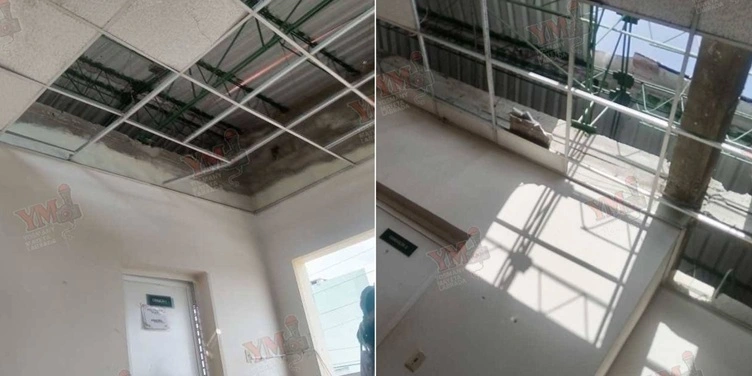
The waiting room at the South Polyclinic in Palma Soriano has fallen tiles, exposed cables and leaks, in a space where vulnerable patients await care.
MADRID, Spain.- The waiting room of the Palma Soriano South Polyclinic, in Santiago de Cuba, is in a state of deterioration that puts babies, mothers and elderly people who attend Pediatric and Psychiatry consultations at risk, according to a public complaint made by the independent communicator Yosmany Mayeta Labrada.
The images shared show the partial collapse of the false ceiling, with fallen slabs, open holes, exposed metal structures, electrical cables and visible pipes, as well as accumulated humidity and dirt. At several points, the opening allows direct sunlight to enter, leaving the area practically uncovered and exposed to rain, dust and possible landslides.
Mayeta warned that it is not just an aesthetic affectation, but “a real risk to health and life,” as it is a space where newborns and patients who require minimum conditions of hygiene and safety remain.
The publication generated reactions among users on social networks, some of whom pointed directly to the center’s management. “And the director of the polyclinic? That is his responsibility,” wrote Kalia Palacios. Others clarified that, although there is local administrative responsibility, the problem of insurance and resources depends on higher levels, that is, the State. “The assurance does not come from those people, it comes from higher up,” commented Mónica Vázquez.
Fears were also expressed about the possibility of a tragedy. “Holy cow. Something has to happen,” wrote another user, alluding to the seriousness of the conditions in which vulnerable patients await medical attention.

During recent years, similar situations have been constantly recorded in different provinces of the country. Just to mention a few, in Havana, part of the roof of the Calixto García Clinical Surgical Hospital has collapsed on several occasions, while patients and companions were at the scene. In Camagüeythe Manuel Ascunce Domenech University Hospital had to be evacuated after the landslide and upheaval in the Ophthalmological Center area, due to structural deterioration and accumulated humidity.
These episodes reflect a phenomenon that is repeated: the advanced deterioration of hospital infrastructure, with damage ranging from ceilings and false ceilings to floors, walls and electrical systems. The succession of partial collapses, evacuations and public complaints points to a structural problem that compromises the safety of patients, family members and medical staff in centers that should guarantee minimum conditions of protection and health.