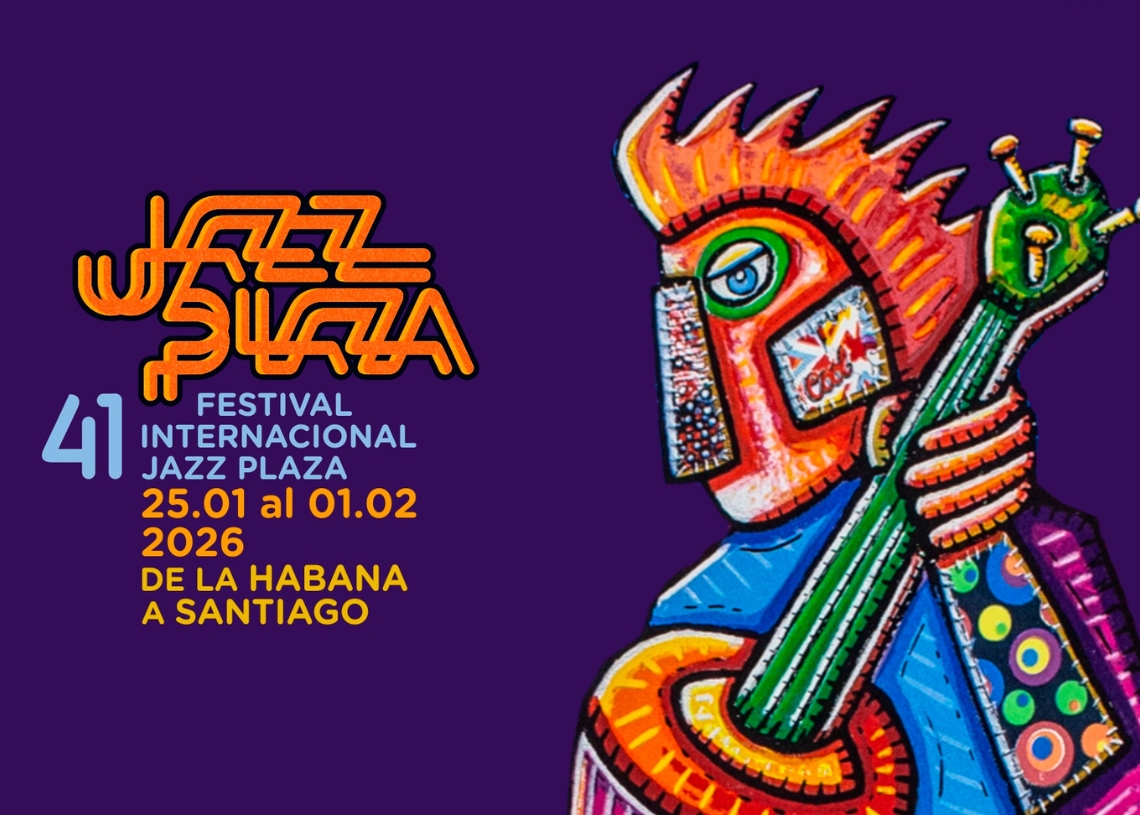
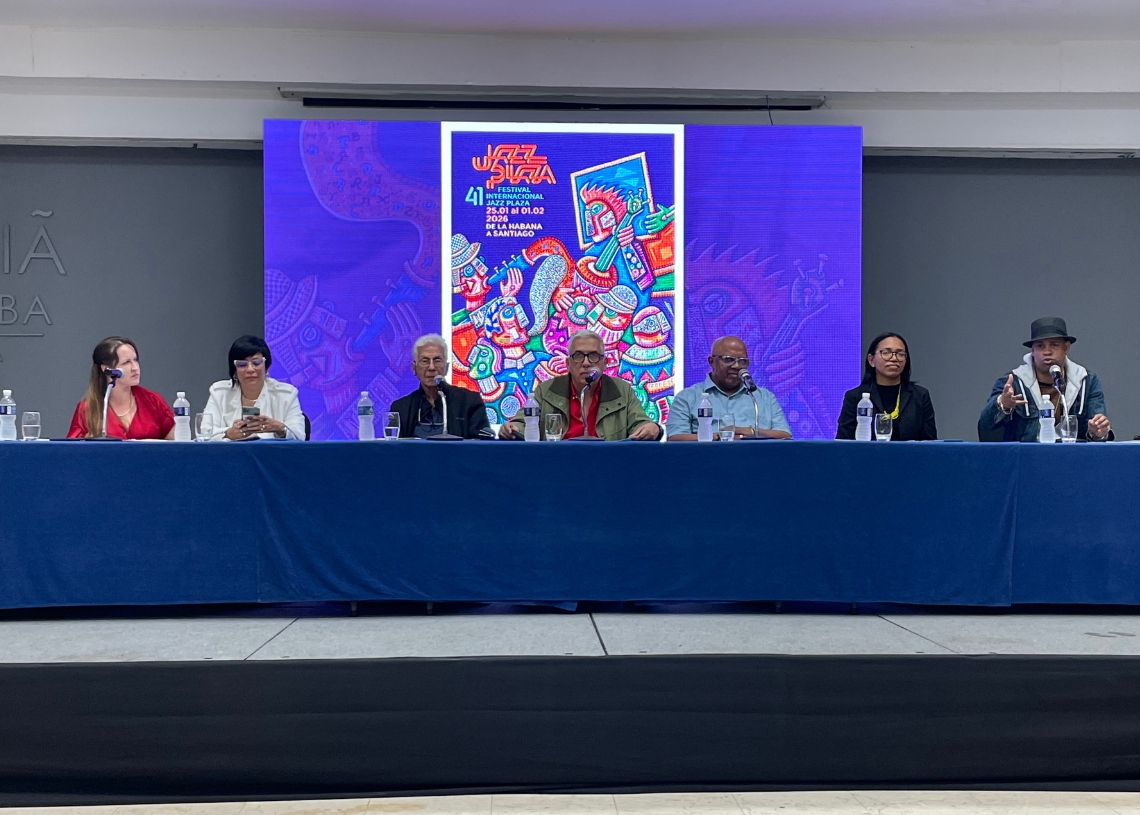
More than 280 foreign artists will participate in the 41st edition of the Jazz Plaza International Festival, which will take place from January 25 to February 1, as confirmed this Tuesday at a press conference by Víctor Rodríguez, president of the event.
The United States repeats as the nation from which the most artists will come to continue strengthening the ties that have existed between both nations through jazz; although musicians and groups will come from all over the world on a list that includes Azerbaijan, Haiti, the Netherlands, Peru, Switzerland, Spain, Colombia, Venezuela, Austria, France, Cameroon, Russia, Lithuania, Chile, Brazil, Canada, Puerto Rico, Mexico and China.
Cuban musicians, however, will not only be hosts, but also protagonists of the festival with the participation of an immense roster of local creators; Jazzists or exponents of other aspects of Cuban music will come together, showing the influences that all genres of music weave together.
For this edition, more than 20 Cuban artists residing in other nations will return home, consolidating Jazz Plaza as one of the events that most promotes and achieves this.
“We thank those musicians who decide to come to the festival at this very complex time,” said Victor Rodríguez, aware that once again the event takes on the feat of a huge edition in the midst of an essentially unfavorable context for the country.
In turn, Roberto Fonseca, artistic director of the event, stated that one of the fundamental reasons for the growth of Jazz Plaza is that “musicians are worrying about making each festival a unique concert.”
Synchronized jazz in four cities
The event, born in the Plaza House of Culture, in Havana, is the only music festival in Cuba that takes place unanimously in more than one territory of the country, and this year for the first time it will reach four cities.
The capital will continue to be its fundamental headquarters and will host the most intense part of its extensive program, while Santiago de Cuba, Santa Clara and, for the first time, Holguín will develop another important number of presentations and actions.
Fonseca assured that reaching most of the country, as conditions allow, is one of the dreams that led him to join the organizing committee of the event, and that they intend to continue increasing that reach in future editions, for which conversations are being established with the provinces of Matanzas and Camagüey.
Santiago de Cuba, Santa Clara and Holguín will each have more than a dozen stages for the event’s concerts, ranging from theaters, cultural centers, plazas, emblematic parks and communities.
Havana will have nearly twenty venues, which include regular and essential spaces, such as the cradle of the festival: the Plaza House of Culture; the National Theaters and the National Museum of Fine Arts, the Bertolt Brecht Cultural Center and the Cuban Art Factory.
This year it has the distinction of adding a greater number of spaces from the private sector, such as the Cesar Jazz Club, Saudade Jazz Tapas Bar and Yarini Habana.
out of scene
One of the dedications of Jazz Plaza 2026 is to artistic teaching, something marked in the musical theme that distinguishes the edition and in which middle-level music students participate, and which will continue in various ways on the days of the event.
The master classes in the music schools of the provinces that are part of the event, and in other cities such as Artemisa, Mayabeque and Matanzas, are conceived as an important part of the agenda of the Cuban and international musicians who are part of the event.
In turn, the essential moment of this link will be the inaugural concert, named “Maestro de Juventudes”, in which the pianist Frank Fernández will have a large number of guests, including students and orchestras from art schools in the country.
Theoretical is another of the fundamental moments of the festival that occur outside the stages and this year each of the host cities will have their own spaces in this sense.
The XXI edition of the Leonardo Acosta International Jazz Colloquium will take place in Havana In Memoriamwhich will have a pre-festival program at Uneac from this Wednesday until January 24, and from January 26 to 31 its central program will inhabit Fábrica de Arte Cubano.
Its sessions will cover very diverse themes ranging from the female presence in jazz, interpretive techniques, album presentations, tributes and master classes.
Santiago de Cuba and Villa Clara will host the colloquiums “Mariano Mercerón in memoriam” and “José Luis Cortés in memoriam”, respectively. In the central city, the theoretical space will be on January 26 and 27, and in the hot land from January 26 to 28. The city of Holguín will offer theoretical sessions from Monday, January 26 to Friday, January 30.