In November 2025, the identity of 39 Cubans who died on the Russian front was known.
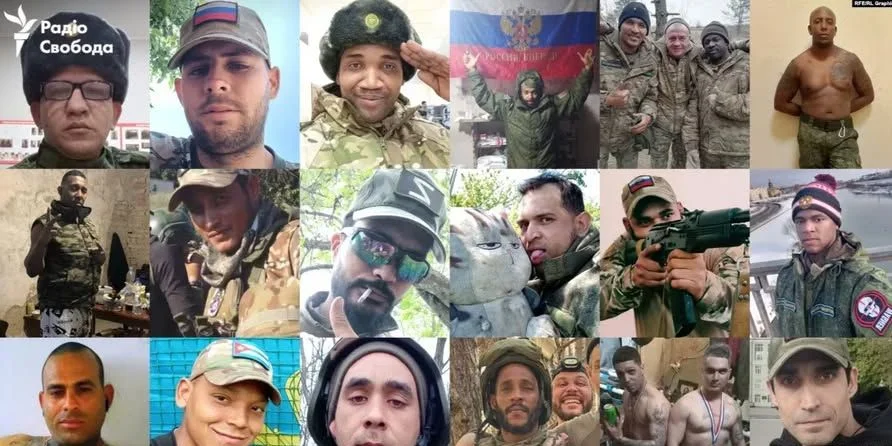
MIAMI, United States. – The Ukrainian government project “I want to live” disclosed on social networks the names of 54 Cubans who died in Russia’s war against Ukraine who fought on the side of the Russian Armed Forces.
The project, which has the support of the Ministry of Defense and Ukrainian military intelligence, denounced that the Cuban Government has not dedicated “any honor”, “any mourning” or “any public mention” to them, despite the fact that their identities would be known “in Moscow and Havana”.
“They died with weapons in their hands, 10,000 kilometers from their home. Their names are known both in Moscow and Havana; however, you will find no honors, no mourning, no public mentions about these people (…). Havana does not recognize its mercenaries, recruited by Russia for money, neither the dead nor those who, perhaps, are still alive (…). Cuba also does not remember its citizens who have fallen into Ukrainian captivity,” the publication adds.
The same note contrasts these deaths in Ukraine with the reception in Havana of the remains of 32 Cubans who fell in Venezuela during the United States military operation that culminated with the capture of Nicolás Maduro, for which the Cuban regime declared two days of national mourning.
Last November, too transcended the names of 39 Cubans who died while fighting on the Russian side. At that time, Ukrainian deputy Maryan Zablotskiy assured that there were “hundreds of dead Cubans fighting for Russia” whose identity was still unknown.
This Tuesday, CubaNet He compared the names of those Cubans with the other 54 recently revealed by “I want to live”—taking into account transliteration variants and frequent spelling errors in surnames and names—and only identified two matches: they are Lázaro Aramís Pérez Rodríguez and Reumerto [sic] Placencia Reyes.
List of all Cubans who died while fighting on the Russian side identified by the “I want to live” project. (This is a version normalized to probable Spanish spelling, with no guarantee that it is the exact legal writing of each person):
- Amilkar René Álvarez
- José Antonio Andarsio
- Juan Arias
- Pedro Manuel Bareyra
- Reyner Berrillo
- Daniel Betancourt
- Rafael Vidal
- Yoandris Villafaña
- Yoan Viondi
- Yordis Rafael Gainsa
- Vladimir Guevara
- Yosvani González
- Yosbel Gonzalez
- Yosnier Midel Gutiérrez
- Luis Hiraldo Diaz
- Pedro Diaz
- Hunior Dieguez
- Lisvannis Donathen
- Abel Doris
- Hiolykis Hinojosa
- Rainer Castro
- Alberto Kuan
- Ober Luis Leyva
- Julio César López
- Leosvannis Martínez
- Santiago Matamoro
- Julio César Milián
- Danner Mora
- Alen Moxena
- Guillermo Moxena
- Denis Frank Pacheco
- Rafael Perez
- Lazaro Aramis Pérez
- José Antonio Pérez
- Yoelsis Santiago Pérez
- Miguel Antonio Pérez
- Félix-Omar Pérez-Castro
- Reumerto Placencia
- Osmani Reyes
- Osmani Rivero
- Rafael Rodriguez
- José Mario Rodríguez
- Pedro Antonio Romero
- Onilde Romero
- Fabian Santiago
- Richard Santos
- Franki Santiago Sánchez
- Eladio Sanchez
- Tomas Toledo
- Denis Fraga
- Leonel Fundicheli
- Rainel Hernandez
- Juan Carlos Estevez
- Carlos Estrada
Last November, Zablotskiy reported that Ukraine currently had “four Cuban prisoners,” who were being “treated humanely and, more than humanely, well.” The deputy presented two ways to resolve the situation of the detainees: “There are two options: that the Russian Government gives us Ukrainian prisoners and we give them the Cubans (…). As an alternative, we are going to ask the Cuban regime to consider the following humanitarian gesture: we can consider releasing the Cuban mercenaries if there is a simultaneous gesture of releasing Cuban political prisoners.”
He also stressed that, in prisoner exchanges since the beginning of the invasion, Russia had not asked for “any foreign fighters,” but only Russians.
At that time, Zablotskiy also insisted that Ukrainian authorities could “continue identifying bodies” and formally communicate the information to the relatives of those who died on the Island.