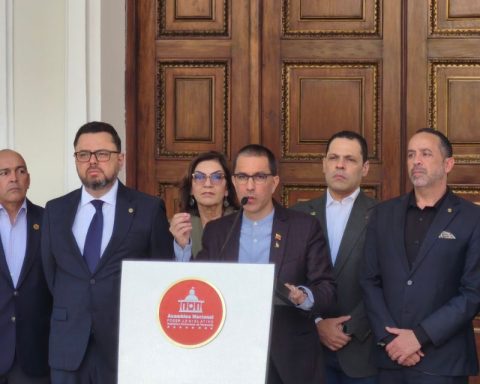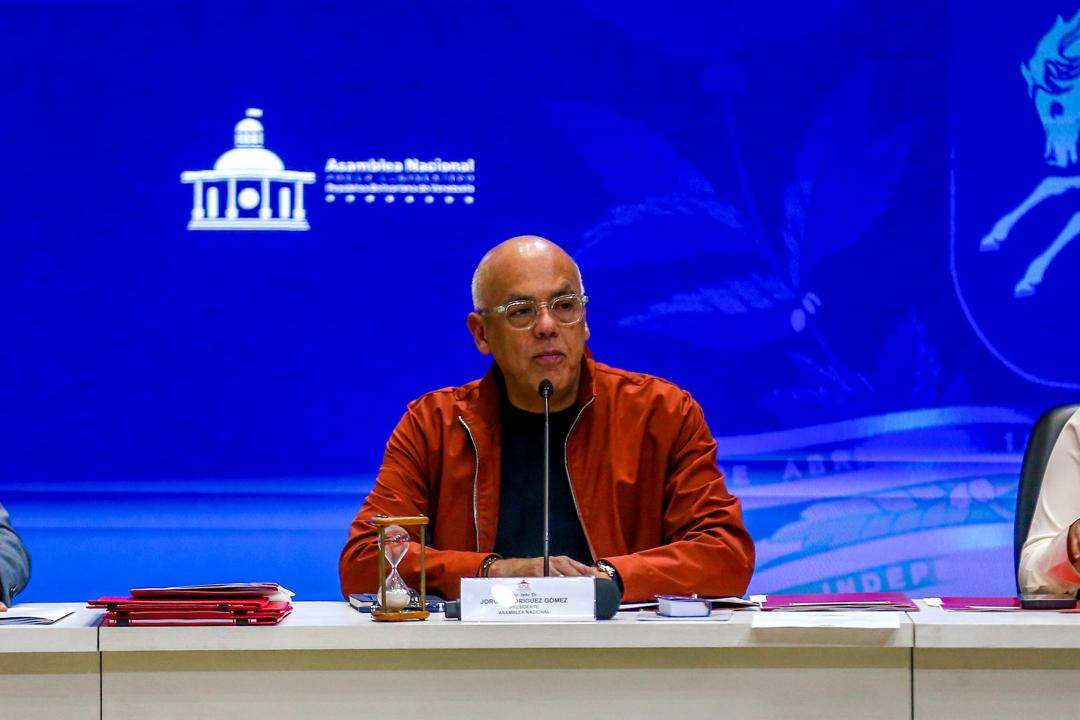
The president of the National Assembly (AN), deputy Jorge Rodríguez, led this Tuesday the meeting of the Advisory Commission of the National Assembly, where the 2026-2027 legislative plan was evaluated together with the boards of directors of the permanent commissions of parliament.
“The legislative plan is the backbone of the law-making work, which is the main work of the deputies in the National Assembly for the year 2026 (…) This legislative plan is part of a great tree that will be incorporated into the entire framework of the laws of the Bolivarian Republic of Venezuela,” Rodríguez explained.
In this regard, the highest representative of the Legislative Branch highlighted that from the board of directors of the National Parliament, and by each deputy that comprises it, priority has been given to the work to accompany the Venezuelan people in the constructive moment that the Republic is going through.
He reported that 29 bills have been prioritized, of which 12 are initiatives of the national Executive. “And of those 12 that are initiatives of the Executive, the most important were already delivered to the National Assembly by the acting president Delcy Rodríguez when she presented her report to the National Assembly on January 15 of this year 2026.”
- The Hydrocarbon Law.
- The Anti-Blockade Law.
- The Law on the Protection of Socioeconomic Rights.
Regarding the latter, Rodríguez said that the President of the Republic, Nicolás Maduro, “despite the blockade, despite the immense difficulties, despite the sanctions, undertook a process of salary recovery and the growth in income has been geometric since the moments of greatest difficulty. But it has been an income that does not have its legal basis because it has been based on a war economy. I think it is a good time to develop protection laws where people know what the progress of the people’s income process is. There is also an element that is important: Venezuela overcame price control and replaced it with a system of agreed prices. “This system of agreed prices must be in a law that protects all people.”
Rodríguez questioned the management of the currency exchange in the country. «I don’t know if you have noticed, for example, the price of the so-called parallel dollar; It has fallen from about a little more than 900 bolivars per dollar, it has fallen almost 100% to be close to or below 400 bolivars per dollar. More or less 400 bolivars per dollar. That is much less than half (…) I wonder, were the prices in the Sambil reduced after they were increased to that dollar level? They have to do it, it is an obligation. Because sometimes it happens that they raise the price because the dollar went up and now that the dollar goes down, they act stupid. No, that cannot be, that’s why the law for the protection of socioeconomic rights,” he denounced.
“There has to be a mechanism where people say: ‘No, look, there is a law that protects me, there is a law that protects me,'” he said.
Rodríguez also detailed nine other laws that the national Executive is proposing to be reformed:
- The mining law.
- The export committee law.
- Intellectual property law.
- The law of artificial intelligence.
- The law of natural medicine.
- The law of digital and natural rights.
- The cybersecurity law.
- The law of the national electrical system.
- The law of rational use of energy.
- The telecommunications law.
- The law of peace and national coexistence.
“Create a true mushroom of protection, a true dome of protection for the peace of Venezuela and the right that Venezuelans have to live in peace,” said the president of Parliament.
Organize and update the legislative tree of the Republic
On the other hand, Rodríguez highlighted the need to organize those laws that are necessary, because there are laws that have lost validity and that have lost their functionality, “so to be able to organize the laws that really have importance in the process of accompanying the work of the Bolivarian Republic of Venezuela.”
«We have laws that are pre-constitutional and are still in force. We have codes that are not only pre-constitutional, they are pre-Fourth Republic. Before the Fourth Republic, before the advent of the electric typewriter, the Commercial Code of the Bolivarian Republic of Venezuela was still in force,” he added.
For this legislative process, the president of the AN aims to develop eight major codes:
First of all, a new penal code, a penal code that broadly reviews all the elements related to the administration of justice, “so that everyone feels that justice in Venezuela does not obey the canons of who is there, who has some influence or who has no influence, especially to the most needy sectors that often suffer the direct consequence of their defenselessness. It is our obligation as deputies to provide tools to the entire population so that they feel defended and cared for and that they also feel that the justice system is there for that, to administer justice and not to administer injustice.
Secondly, a new social code where all the protection laws: the laws for the protection of women, the laws for the protection of our native peoples, the laws for the protection of our young people, the laws for the protection of our cultures, the laws for the protection of our scientists, the laws for the protection of the family, “all the laws that are promoted for the protection of people, are organized into a great social code.”
“If something has characterized the future of the Bolivarian Revolution and we, of course, claim it, it has been bringing the demands that had historically been postponed for the vast majority of the population,” he said.
Third, a new economic and trade code. «We have approved laws related to the digital economy and it turns out that this digital economy did not exist, it did not even exist in science fiction books. Everything that was later developed in terms of digital commerce, in terms of cybersecurity for the economy (…) We necessarily have to, in this legislature, approve a new commercial code. A code of direct democracy and communal power and, I would say, deep, true power, whatever the modality.
In this sense, he invited that, if there is an alternative proposal where forms of social organization and forms of popular organization also want to be part of the elaboration of this code of direct democracy, “that is what this cycle is for, that is what this parliament is for, that is what the sessions are for, so that we can all sit down to build the new laws that the Republic requires.”
As well as a Code of Direct Democracy and Communal Power. He pointed out that these instruments must be aimed at consolidating deep and authentic power, regardless of the modality adopted, with the purpose of strengthening popular participation and organization.
Fourthly, a new civil code. “This civil code that we have has so many patches that it is often taken advantage of by super-scrupulous lawyers to not say what I really think about them and start getting into the ins and outs of the civil code and in that way, seek to win a trial, harm a person, harm a family, a code that is much clearer, much more coherent, much easier to grasp, to implement.”
«We must establish not a law, not a group of laws, but a true code for the protection of our environment. The code of comprehensive protection of the Venezuelan family, but of the family in its daily condition, because many times we speak and write things that are unintelligible, as the word unintelligible is also, which are very difficult to understand and, deep down, the important thing would be for the family to feel that this group of laws grouped in a code does not pursue anything other than its protection,” said Rodríguez.
Fifth, a new electoral code. «The electoral laws of Venezuela, which are very advanced laws, which are very complete laws, are sometimes also complex in their application and are sometimes also cumbersome in the elements of political participation, that if a political party, which then I do not know how many signatures, I do not know how many stamps, which goes here, which goes there, which establishes elements of discretion. “Well, let’s look for a way to ensure the same formation of electoral power, even when it is constitutional.”