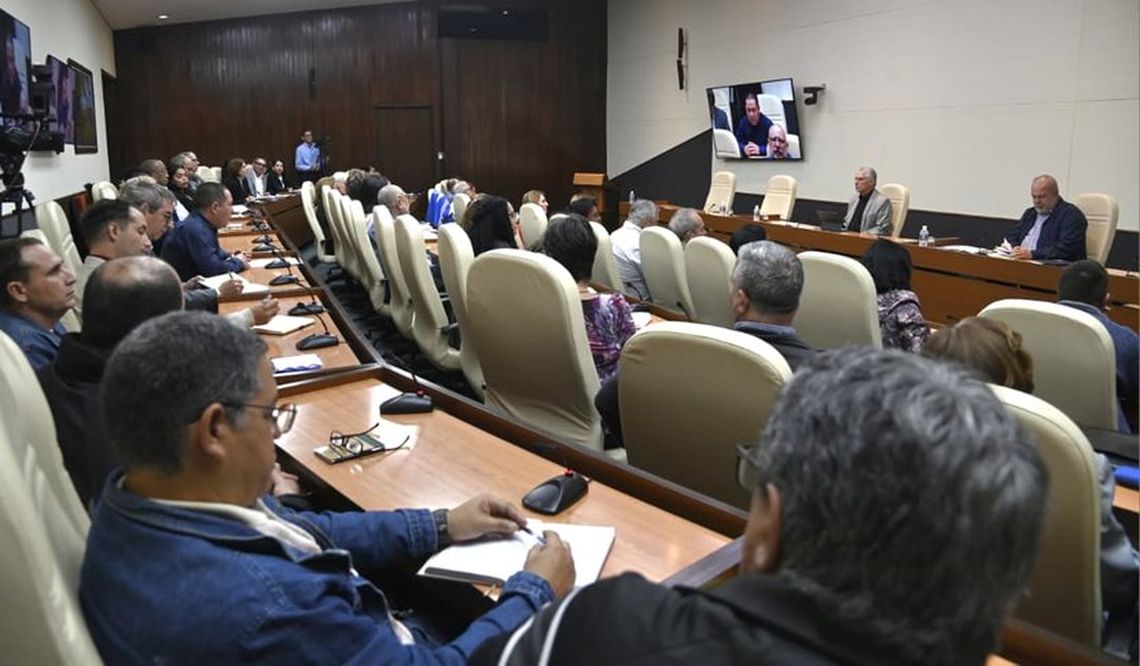
Promising clinical results of the Cuban drug Jusvinza in patients affected by chronic post-chikungunya arthritis were presented this Monday at a meeting of scientists and researchers with President Miguel Díaz-Canel and Prime Minister Manuel Marrero, according to a press release from the Presidency of the Republic.
Preliminary studies suggest that the drug, originally developed to treat rheumatoid arthritis and Covid-19, could become a key tool to stop inflammatory progression in those suffering from the consequences of the virus.
The event brought together experts from the Center for Genetic Engineering and Biotechnology (CIGB), clinical researchers and specialists in rheumatology.
Díaz-Canel summarized the spirit of the meeting with one phrase: “There are results here.” The statement reflected the optimism generated by the partial data from the trials carried out in Havana and Matanzas since December 2025.
Dr. Julio Esmir Baldomero Hernández, director of Clinical Research at the CIGB, announced that the final report will be ready in March, with long-term evaluations on safety and persistence of the therapeutic effect. The study, he said, complies with good clinical practices and was endorsed by the Center for State Control of Medicines (CEDMED) after an early inspection.
A repositioned medicine
Jusvinza is a Cuban biotechnological product that regulates the immune response and controls hyperinflammation. Although it was not conceived for chikungunya, its repositioning has shown benefits in patients with chronic postviral arthritis.
Dr. María del Carmen Domínguez, principal investigator, explained that the scientific challenge consisted of transferring previous experience in rheumatoid arthritis and covid-19 to a scheme of repetitive administrations, with encouraging results in safety and early clinical improvement.
Although the results are preliminary, the Cuban scientific community is confident that Jusvinza can become a reference treatment for patients with chronic post-chikungunya arthritis. The challenge now will be to consolidate clinical evidence, guarantee production at scale and define agreed protocols that integrate rehabilitation and pharmacotherapy.
The voice of the specialists
Dr. Miguel Hernán Estévez del Toro, director of the Hermanos Ameijeiras Hospital and rheumatologist, stressed that a percentage of patients evolve into chronic inflammatory arthropathy, comparable in mediators to rheumatoid arthritis. “Having a medicine capable of stopping this progression will be very beneficial,” he said.
Estévez also announced a national survey promoted by the Ministry of Public Health and the Cuban Society of Rheumatology to agree on treatment and rehabilitation guidelines. The resulting document, he said, will serve as a guide to position Jusvinza in the management of these consequences.
The experts agreed that the advances with Jusvinza represent a “country result”, the result of national scientific capacity and the commitment to biotechnology as a response to health emergencies.
Regarding an ailment that has shown the face of its complexity, Doctor Miguel Hernán Estévez del Toro, director of the Hermanos Ameijeiras Clinical Surgical Hospital and Cuban expert rheumatologist, highlighted towards the end of the meeting: “We are facing a disease for which there will be a percentage of patients who will finish the three months of evolution and will go towards chronic inflammatory arthropathy.”
“As early as the administration of four to six doses in Jusvinza patients, they have shown a therapeutic response and from here we have seen a significant result… We have achieved that the patients’ general symptoms such as weakness and sleep have improved after the second administration of the medication,” said Dr. Jorge Gómez, specialist in Rheumatology at the “10 de Octubre” Clinical Surgical Hospital.
Declining epidemic, fatal toll and controversial statistics
The meeting also addressed the epidemiological situation. According to official data, Cuba accumulates from July 2025 to January 2026 50,101 cases of chikungunya and 55 deaths, mostly minors.
The Vice Minister of Health, Carilda Peña García, reported that the incidence rate decreased to 19.73 in the last week, although she recognized that the majority of cases are clinical suspicions and not laboratory confirmations.
The country also faces a parallel outbreak of dengue, with more than 25,000 infections reported in 2025. The combination of both arboviruses has strained the health system, limited by the economic crisis and the dramatic shortage of medical supplies.
A third of the Cuban population has been infected with arbovirus, according to authorities
In November 2025, Dr. Francisco Durán, national director of Epidemiology of Cuba, declared on the Mesa Redonda television program that approximately a third of the population had been infected with dengue, chikungunya and other arboviruses in recent months.
During the broadcast, dedicated to the critical health situation on the island, the authorities recognized for the first time that the country was facing an epidemic. Durán, a figure known for his role during the COVID-19 pandemic, denied that 90% of Cubans were infected, as had been spread on social networks, but admitted that the evaluations showed percentages close to 30%.
This calculation is equivalent to around a third of the Cuban population, which according to official figures was around 9.7 million inhabitants at the end of 2024.
According to these estimates, the number of patients would exceed three million, although the specialist did not offer an exact figure. The statements reflected the magnitude of the epidemiological crisis that the country is going through and the need to reinforce control measures and medical care against the spread of these mosquito-borne diseases.
Arboviruses have found fertile ground in Cuba to spread due to the country’s serious economic crisis, which limits the capacity for prevention – mainly through massive fumigation against mosquitoes -, control – with tests to confirm the type of disease -, care for the sick, due to lack of medicines and other health supplies, in addition to the poor public hygiene in urban segments given the breakdown of domestic garbage collection services.