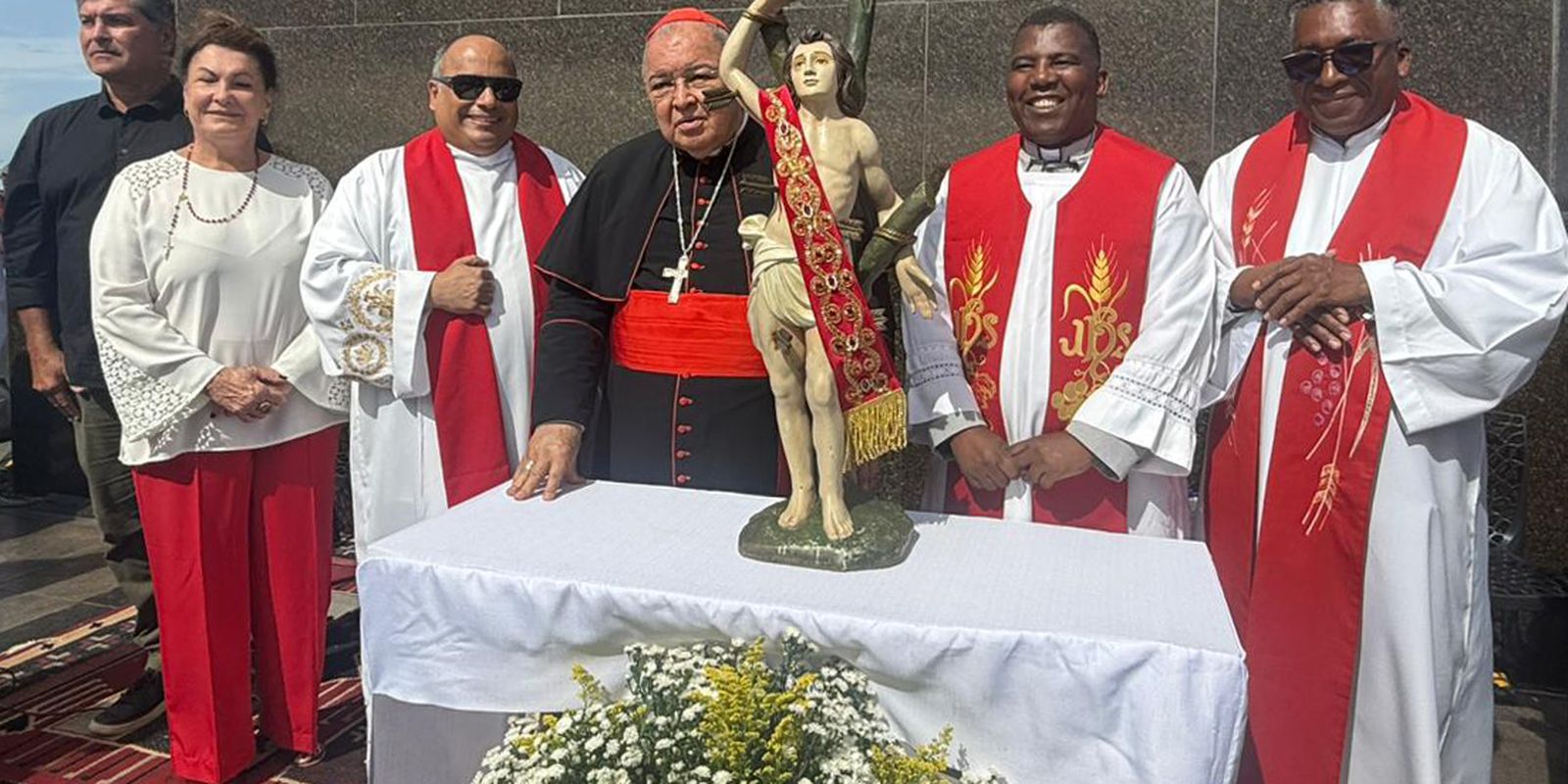
This Tuesday (20), the city of São Sebastião in Rio de Janeiro will be celebrating its patron saint São Sebastião with masses and processions. The first of them will be prayed by Cardinal Dom Orani João Tempesta at the Basilica Sanctuary of São Sebastião, in Tijuca, north of Rio, at 10 am.
In the afternoon, starting at 4pm, there will be the Archdiocesan Procession leaving the Basilica, in Tijuca, to the Metropolitan Cathedral of São Sebastião do Rio de Janeiro, located on Avenida Chile, central region of Rio.
The route of approximately five kilometers was recognized as the city’s cultural heritage in 2014. At the end of the route, the Auto de São Sebastião 2026 will be presented on Avenida Chile, celebrating the life and faith in the patron saint, followed by a solemn mass in the cathedral.
Patron
Rio de Janeiro was founded by Estácio de Sá, nephew of governor-general Mem de Sá, on March 1, 1565, at the entrance to Guanabara Bay, between Morro Cara de Cão and Pão de Açúcar. The city was named in honor of the boy King D. Sebastião of Portugal, and his patron saint, São Sebastião.
But it was on January 20, 1567, when the Portuguese expelled the French who had settled in the region in 1555, that the date began to celebrate the saint as patron saint of the city of Rio. This occurred because, according to legend, Saint Sebastian was seen with a sword in his hand, among the Portuguese, Mamelukes and Indians, fighting against the invaders in the final battle of Uruçumirim.
The saint
One of the Roman martyrs of the first centuries of the Christian Church, the boy Sebastian was born in Narbonne, France, in the year 256 of the Christian era. At a young age, he moved with his family to Milan, Italy, his mother’s hometown.
He enlisted in the Roman army and ended up becoming commander of Emperor Diocletian’s guard. Secretly, however, Sebastião converted to Christianity. He made frequent visits to imprisoned Christians who were waiting to be taken to the Colosseum, where they would die devoured by lions or in fights with gladiators. He encouraged and consoled the prisoners, making them believe that they would be saved after death, according to the principles of Christianity.
His reputation as a benefactor of Christians came to the attention of the emperor who tried to make him renounce his faith. Failing to achieve his aim, Diocletian condemned him to death. His body was tied to a tree and shot with arrows. The soldiers who tortured him left him apparently dead.
Sebastião was rescued by some women who took care of him until he recovered. However, as soon as he recovered, the young man returned to the emperor’s presence asking him to stop persecuting and killing Christians. Diocletian ordered him to be flogged to death, which happened in the year 287 of the Christian Era. His body was buried near the apostles’ catacombs.
The cult of Saint Sebastian began in the 4th century, when Emperor Constantine, converted to Christianity, ordered the construction of the Basilica of Saint Sebastian, on the Via Appia, to house the saint’s body.
At that time, it is said that Rome was ravaged by the plague, but, after the transfer of Sebastian’s relics, the epidemic disappeared. He is appointed as the patron saint against plague, hunger, war and, more recently, has come to be considered an icon by LGBTQIA+ communities [Lésbicas, Gays, Bissexuais, Travestis, Transexuais, Queer, Intersexo, Assexuais] for its resistance and beauty.
Oxóssi
In addition to being an object of devotion for Portuguese and Brazilian Catholics, Saint Sebastian was identified in the religious syncretism of Afro-Brazilian rituals, which equates orixás with Catholic saints such as the orixá Oxóssi. Orixá of the forests, hunting, abundance and knowledge. Oxóssi is also the deity associated with the spirits of the caboclos, indigenous ancestors who work on the front lines of healing and guidance.
Another fact that unites Sebastião and Oxóssi is that they were both warriors, linked to nature and the use of the arrow, and celebrated on the same January 20th. Just as Saint Sebastian was martyred by arrows, Oxóssi’s arrow symbolizes accurate aim, the ability to achieve goals and protection against evil.