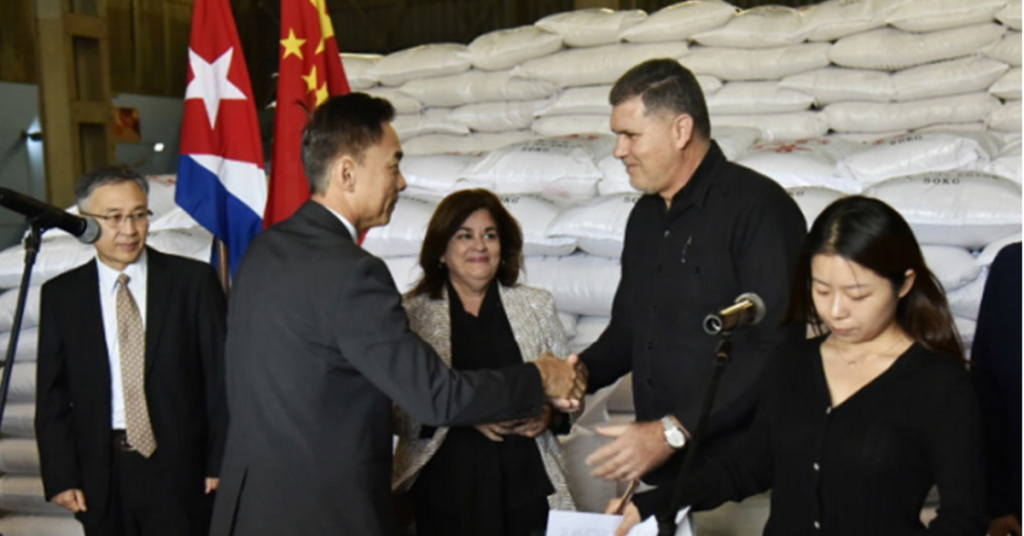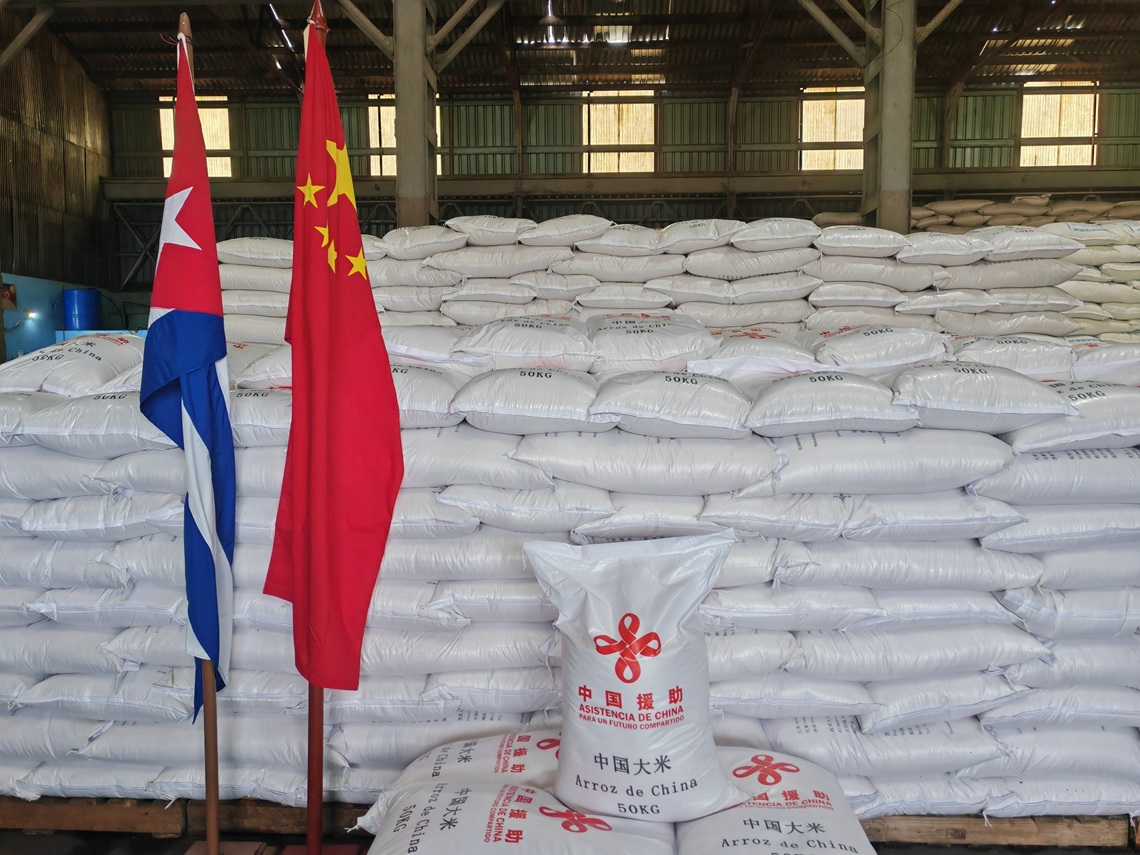
In a gesture that seeks to alleviate the food insecurity that hits Cuba, the Government of China donated 30 thousand tons of rice to the island, of which 4,800 have already arrived, according to official media.
This is emergency food assistance, agreed to by Beijing, which will be deployed in several deliveries in the first months of the year.
During the official reception of the first shipment in Havana, the Chinese ambassador, Hua
“Each grain of rice delivered today condenses the unbreakable commitment of the Chinese people to never abandon the Cubans,” declared the diplomat in support of his country’s alliance with the island, in moments of geopolitical uncertainty after the recent events in Venezuela.
For his part, the Cuban Deputy Prime Minister and Minister of Foreign Trade, Óscar Pérez-Oliva, assured that the cereal will be distributed “immediately and free” to the population.
“This donation is a concrete expression of China’s exemplary, unconditional and selfless cooperation with Cuba,” said the official, who stressed that the support also includes projects to increase national rice production and collaboration in sectors such as energy.
Crisis scenario
The aid comes at a critical time for the island, which is experiencing serious shortages of basic products, frequent and paralyzing blackouts and inflation that refuses to subside.
The crisis, which has been going on for several years, responds to the combination of the effects of the pandemic, the tightening of United States sanctions and the impact of failed government policies that have failed to reverse the country’s economic decline.
Cuba spends around 2 billion dollars annually on importing food for the basic basket, according to official figures.
In 2024, the island harvested just 80 thousand tons of rice, which represents 11% of its annual consumption and just 30% of what it produced six years before.
The drop in productivity has been drastic: while in 2018 each hectare produced just over two tons, in 2024 that same area barely reached one ton.
Solidarity after Hurricane Melissa
Ambassador Hua Xin recalled that after Hurricane Melissa hit the eastern region of Cuba last October, his country sent donations of food and essential supplies such as solar lamps, roofing materials and mattresses. “We deeply understand that true friendship is revealed in times of greatest need,” Hua said.
The diplomat added that “in the face of the current complex international situation, China has always been Cuba’s strongest partner.” As he explained, the third batch of rice – 15,600 tons – is already ready for shipment, while the fourth, 9,600 tons, will be shipped in mid-February.
Havana and Beijing have maintained close political and economic relations for decades. China has established itself as one of the island’s main allies, not only in the food field, but also in energy and infrastructure projects.
“We are convinced that with the joint efforts of both countries, no blockade will be able to extinguish the light of hope, nor will any difficulty be able to hinder the path forward,” said Hua Xin, quoted by the official press.
The ambassador stressed that his country is willing to “continue strengthening cooperation with Cuba, overcoming difficulties together and promoting the construction of a Chinese-Cuban community with a shared future.”
China donates 5,000 solar panels to Cuba to support recovery in rural areas affected by Melissa
Immediate distribution
On the Cuban side, Pérez-Oliva detailed that two initial deliveries of 2,400 tons each have already been received in Havana and the port of Santiago de Cuba, and confirmed that they will be distributed immediately and free of charge.
“We deeply recognize and appreciate this help in complex moments where the economic, commercial and financial blockade of the United States against the Cuban people is intensifying in an unprecedented way,” said the deputy chief of staff.
The Minister of Foreign Trade and Foreign Investment added that the Asian giant’s assistance “is a concrete expression of the construction of a community with a shared future between the people of Cuba and China.”
China is not the only country that has recently sent food aid to Cuba. In December 2025, South Korea donated more than 24 thousand tons of riceintended for people in vulnerable situations and pregnant women.
According to the United Nations System in Cuba, half of that cargo was unloaded in the port of Santiago de Cuba, with the objective of doubling for five months the quotas that the World Food Program distributes in eastern provinces.
Likewise, Vietnam has repeatedly donated rice to the island and maintains collaborative projects aimed at increasing rice production in the country.
A Vietnamese company currently produces cereal on land in the province of Pinar del Río, and became the first foreign firm to receive concessions for this purpose since 1959. Its first harvest reached one thousand hectares, equivalent to 3.3% of what was planted on the entire island, and achieved performance about 7 tons per hectare.
Fall in national production
Rice production in Cuba has suffered a collapse in recent years. In 2018, the country reached 304 thousand tons, but since then the lack of inputs and fuel has drastically reduced the figures.
In 2024, the island was forced to import 100% of the rice it offers at prices subsidized by the supply book, the current rationing system.
The agricultural crisis extends to other basic crops, despite the approval of a group of measures that sought to boost agriculture and a hitherto ineffective food security law. The Government has recognized that the lack of resources has made it impossible to sustain productivity and guarantee self-sufficiency.
In private markets, a pound of rice sells for about 300 pesos, while a kilogram of imported rice does not go below 700 pesos, 10.5% of the average state salary in Cuba.