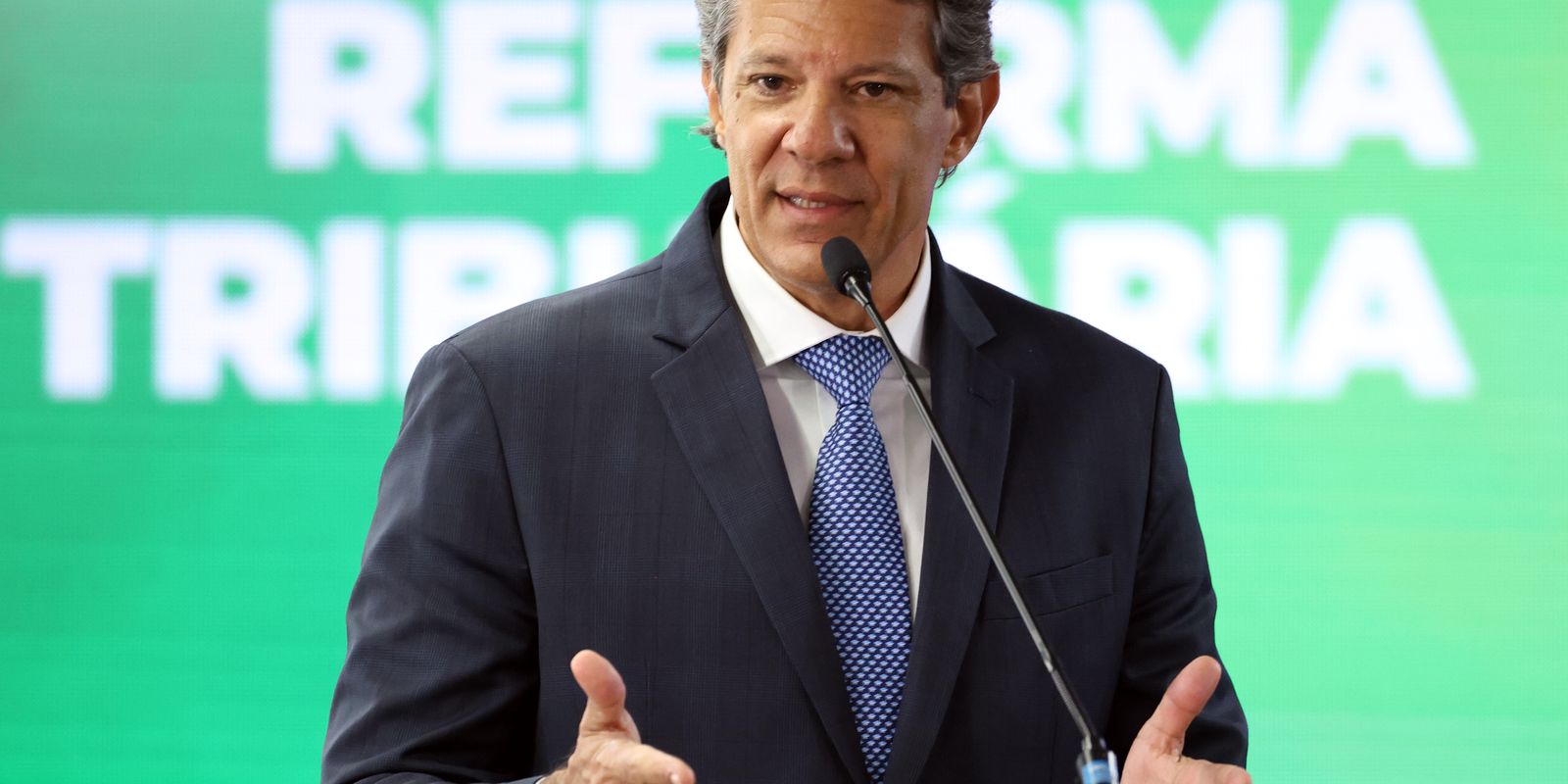
The Minister of Finance, Fernando Haddad, argued this Monday (19) that the problem of Brazilian public debt arises from the high level of real interest rates in the economy [taxa nominal descontada a inflação] and not from excess public spending.
“In two years, we reduced the primary deficit by 70%. The debt problem has to do with the real interest rate, it has nothing to do with the deficit, which is falling”, he pointed out, in an interview with the UOL News program.
“In fact, the target for this year is an even more demanding primary result target than last year, the year before last and the first year of government. We are raising the bar on the demands”, added the minister.
According to Haddad, even considering all tax exceptions, with the reimbursement of undue discounts for INSS workerslast year’s deficit was 0.48% of the Gross Domestic Product (GDP), which would demonstrate, in his view, that the problem is not the deficit.
“If you take the projected deficit for 2023 from [governo Jair] Bolsonaro, dividing by the year’s GDP, you have a deficit of more than 1.6% of GDP. And how much was last year’s deficit, considering all the exceptions? It was 0.48%, considering all the exceptions such as the Plano Brasil Soberano, because of the tariff, and the INSS issue, where we returned money to those injured by the gang that took over the INSS”.
Interest drop
In the interview with Uol News, the minister argued that there is room for the basic interest rate, the Selic, currently set at 15%, to be reduced. “Obviously, when people ask me [sobre esse tema]I say there is room to cut [os juros] because I think there is.”
Even defending this reduction, Haddad praised Gabriel Galípolo’s performance as president of the Central Bank. For the minister, the president of the BC faces a series of problems, such as the scandal of Master Bankand knows how to handle these issues. “I said that he inherited a problem that will only be known later. He inherited a problem which is Banco Master, all of which was created in the previous administration. Banco Master did not happen in the current administration, Galípolo peeled a pineapple. And it peeled the pineapple with responsibility”, praised the minister.
When praising Galípolo, especially in relation to the Banco Master scandal, Haddad highlighted that the BC should take over the supervision of investment funds, a task that is currently carried out by the Securities and Exchange Commission (CVM).
The minister said that he presented a proposal, which is being discussed within the Executive, to expand the regulatory perimeter of the Central Bank.
“There are many things that should be within the scope of the Central Bank and that are within the scope of the CVM, in my opinion, mistakenly. The Central Bank has to expand its regulatory perimeter and start supervising the funds.”
For the minister, there is a very big intersection between funds and finance. which even impacts public accounting, for example. “The interest-bearing account, the committed accounts, all of this is related to public accounting”, he said.
Taxad
Asked during the interview about a nickname given to him on social media, where he has been called Taxad because of the increase in taxes, Haddad replied that he doesn’t care about it and that he is happy to be remembered as the minister who taxed the richest.
“I’m very happy to be remembered as the only Finance Minister in the last 30 years who taxed offshore, who taxed a closed family fund, who taxed a tax haven and who taxed dividends. BBB taxation came to fruition: banks, bets and billionaires were taxed. So, I assume that this group that didn’t pay taxes, yes, paid again.”
Economy and elections
During the interview, the minister also said that the economy will not be a decisive factor for the next presidential elections in the country – nor even in the rest of the world.
“The economy around the world is a very important element, but not necessarily decisive in winning or losing an election,” said the minister.
According to him, research has highlighted other themes among national fears, such as public security and the fight against corruption.
Haddad also said that he does not intend to run for any public office in the next elections and that he has been talking about this with President Luiz Inácio Lula da Silva, but that this issue has not yet been defined.