Brussels. The countries of the European Union (EU) showed their unity yesterday Sunday afternoon in the face of the tariff threats launched by Donald Trump against the eight countries that have sent military personnel to Greenland, an autonomous Danish territory.
Given the seriousness of the situation, the president of the European Council, António Costa, announced an extraordinary summit of EU leaders “in the coming days”, after an emergency meeting of the ambassadors of the bloc’s countries.
According to EU sources, it is likely that this extraordinary summit will take place on Thursday.
“Together, we remain firm in our commitment to defend the sovereignty of Greenland and the Kingdom of Denmark,” said the President of the European Commission, Ursula von der Leyen, in X.
The senior official added that she spoke on the day with several leaders, including the British Prime Minister, Keir Starmer, and the Italian Prime Minister, Giorgia Meloni.
An EU diplomat pointed out that the ambassadors’ meeting yesterday showed the willingness of the bloc’s members to make it clear to the United States that the use of trade measures as a means of pressure was not acceptable.
In addition, this source mentioned, the EU had “several instruments at its disposal to respond if necessary.”
In parallel with the search for a diplomatic solution, the countries asked the European Commission (the bloc’s executive arm) to examine possible responses, according to another source.
Previously, French President Emmanuel Macron had indicated that he intended to request the activation of the EU’s powerful anti-coercion instrument in the event of new US tariffs.
This instrument, called the “economic nuclear weapon,” makes it possible to limit a country’s imports or its access to certain public markets and block certain investments.
Diplomatic sources said that no decision had been made in this regard for now.
Another possible response for EU countries would be to reactivate retaliatory measures on a list worth 93 billion euros of American products.
That response, which had been considered for a period, was suspended after the signing of a trade agreement between Washington and Brussels in 2025.
The agreement, which the European Parliament must examine in the coming days, is no longer to the liking of MEPs.
“Customs threats undermine transatlantic relations and risk leading to a dangerous spiral. We will continue to remain united and coordinated in our response. We are determined to defend our sovereignty,” said the eight countries that have sent troops: Denmark, Finland, France, Germany, the Netherlands, Norway, Sweden and the United Kingdom in a joint statement.
Trump insists on wanting to take control of Greenland, citing national security reasons, since if he did not do so it would be occupied by Russia or China.
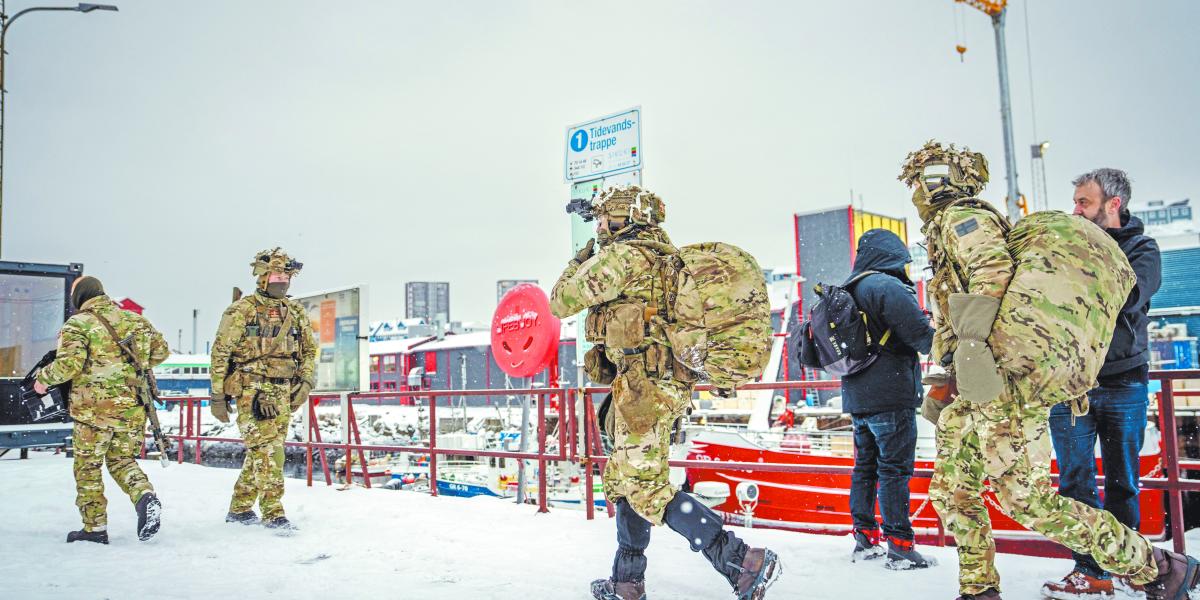
In response to tensions between Washington and Copenhagen, Norway, Sweden, France, Germany, the United Kingdom, the Netherlands and Finland sent troops to Greenland for a training mission this week.
Trump intensified his warnings on Saturday. “These countries are playing an extremely dangerous game,” Trump wrote on social media.
Tariffs, February 1
Irritated by this deployment of military forces, Trump threatened these countries with imposing new tariffs until “an agreement is reached for the complete and complete purchase of Greenland.”
The 10% tariffs would take effect on February 1 and could rise to 25% on June 1.
European Council President Antonio Costa, who chairs EU summits, said in a social media post that his consultations with member states showed his firm commitment to supporting Denmark and Greenland and his willingness to defend himself against any form of coercion.
Danish diplomacy
Danish Foreign Minister Lars Lokke Rasmussen, visiting with his Norwegian counterpart in Oslo, said Denmark remains focused on diplomacy, referring to the agreement Denmark, Greenland and the United States reached on Wednesday to create a working group.
“The United States is also more than just the president of the United States, I was just there. There are also checks and balances in American society,” he added.
Danish Prime Minister Mette Frederiksen expressed hope for the coherence of messages from the rest of the continent, adding that “Europe will not allow itself to be blackmailed.”
The tariff threat worried world markets, with falls in the euro and sterling against the dollar and a return to volatility expected.
Italian Prime Minister Giorgia Meloni, closer to Trump than other EU leaders, yesterday described the tariff threat as a “mistake” and added that she spoke with the American president a few hours before and told him what she thinks.
Asked how Britain would respond to a new round of tariffs, British Culture Secretary Lisa Nandy said allies needed to work with the United States to resolve the dispute.