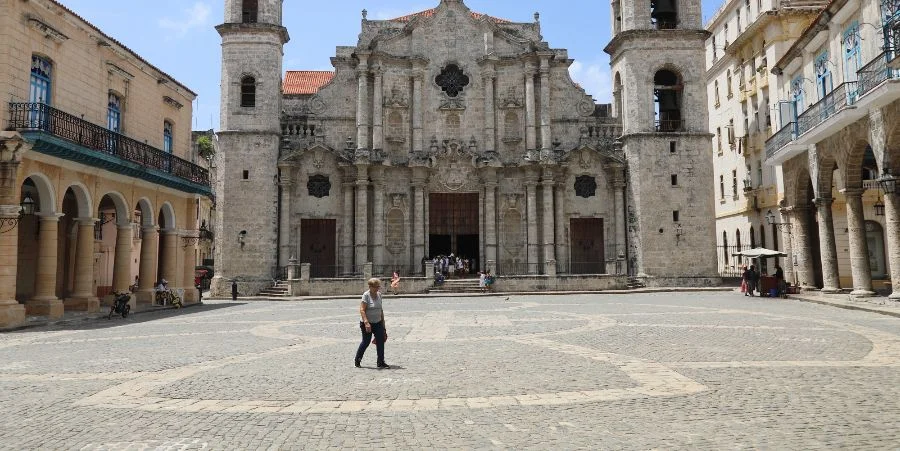
It’s not tourism that has been scared away, nor is it fearmongering propaganda from abroad — it is the Island and its regime that repel visitors.
HAVANA, Cuba. – “It’s now official: tourism in Cuba has disappeared,” declares Preferentialthe most important Spanish digital newspaper for tourism professionals, owned by the group of the same name, which also controls other industry publications such as the site reportur.com.
Perhaps the most interesting thing about the headline is not that it reports something so evident on the ground that it shouldn’t even be news, but that it appears in a publication that has maintained a close collaborative relationship with the Cuban regime since its founding in the early 1990s. Furthermore, it has been, exclusively and through agreements with the Ministry of Tourism (back when the current Prime Minister, Manuel Marrero Cruz, was its head), responsible for globally promoting the Havana International Tourism Fair (FITCuba), to which it has dedicated several special issues of its magazine each year.
If Preferential says it — and does so with that tone in the headline — then the situation regarding the rickety “locomotive of the Cuban economy” is more serious than it appears. Not only because Preferential has historically flirted with Castroism, but also because it came to Cuba hand-in-hand with Meliá, the Spanish hotel chain most loyal to the dictatorship. Gabriel Escarrer Juliá, Meliá’s founder, had a major influence on the creation of the Preferential group in 1991, led by his friends Rafael Caballero (editor) and Emilio Martínez (director).
So, the “new measures” to encourage foreign investment, announced by Marrero Cruz during the Havana International Fair (FIHAV) — just days after Meliá’s bleakest report on its plummeting sales, and almost simultaneously with Preferential‘s death sentence — are the desperate thrashing of someone dangling in midair with a rope around their neck. These reforms have come too late, poorly conceived, and are unlikely to ever succeed, as they not only contain more hidden traps than those already in place, but also reveal that the obstacles imposed on foreign investment for over three decades were driven more by a strategy of political control than by any real need for economic protection.
But in truth, when you take a closer look at the situation, there hasn’t even been a genuine political control strategy. What’s clear is that the entire bureaucratic structure related to foreign investment — especially in tourism, which they now claim can be dismantled with a couple of decrees — exists because it serves a web of corruption that is, and will continue to be, the core around which anyone wishing to set up a business on the island must revolt, as long as the communists remain in power.
If you doubt it, just ask Ernesto Machado, son of José Ramón Machado Ventura, who for many years monopolized the personal business of granting foreign investment licenses. Or ask current Deputy Prime Minister Oscar Pérez-Oliva Fraga, who, in his previous role as Director of Business in the Mariel Special Development Zone, knows very well that investment and tourism have declined in direct proportion to the rise in bureaucracy and corruption.
Preferential‘s article announces the death of Cuban tourism using data released by the National Office of Statistics and Information (ONEI) showing a fall in visitor numbers — the lowest in 17 years, not counting the pandemic years — along with alarming occupancy rates (18.9%, which Meliá blames on “malicious propaganda”). And although Preferentialboth in this article and others, refers to the ruinous state of “destination Cuba,” citing problems with power generation, fuel shortages, and the lack of other essential services needed to offer a quality product to tourists, it carefully avoids mentioning what foreign businesspeople already established on the island cannot ignore: the web of corruption hidden behind the regime’s bureaucratic apparatus — a system not only recognized by the regime, but one that exists by its own design.
“The corruption and greed of the government have turned the paradise they once painted into today’s empty shell,” a Spanish businessman told me during the Havana International Fair. His business in Cuba, linked to the Iberostar Selection, is reportedly on the verge of collapse — along with several others in the tourism sector.
The so-called “Tower K” now clearly stands as a money-laundering operation for the Cuban regime (or for certain “friends” under its protection). In this sense, its primary purpose was never truly to attract tourism — although it was for Iberostar, which has paid a very steep price for its involvement in a venture that is set to generate even greater losses than its other equally empty properties.
Since its inauguration in February 2025, according to sources connected to Iberostar Selection, only 65 rooms out of the hotel’s 594 have been occupied in nearly nine months of operation. The average number of stays to date does not exceed the absurd figure of 0.2 rooms per day — and that includes reservations made for the building’s opening ceremony, as well as bookings by the Cuban government to host several foreign guests invited to attend May Day celebrations. Those stays also conveniently served to justify, under the pretext of security or as a “necessary evil,” accommodations for Miguel Díaz-Canel and his wife the night before the parade.
We should keep in mind the concept of “necessary evil” and the self-protection strategy with which Fidel Castro Cuba opened to tourism and foreign investment in the 1990s. In an effort to shield himself from the collapse of the “socialist bloc,” he has allowed his Spanish friends to enter Cuba as business partners — but only under the condition that he personally retained control over all internal administrative operations of those companies. This not only gave him direct control over their revenue but also allowed him to infiltrate them completely with the political police and, of course, with corruption.
That is to say, with his trusted people — appointing none other than Rodolfo Davalos as Meliá’s representative on the Cuban side — and naturally, involving the military.
These factors contributed to the strengthening of the bureaucratic apparatus that, long before Osmany Cienfuegos headed the Ministry of Tourism (MINTUR, by its Spanish acronym), had already defined a ministry that — later under the control of Colonel Manuel Marrero Cruzwho came from GAESA—was transformed into the largest corruption machine. Together with the Ministry of Foreign Trade, it generated easier and “clean” dollars for the dictatorship than even the dangerous, dirty dollars from the now-dismantled drug trafficking network that once connected the Ministry of the Interior (and the emerging GAESA) with regional drug cartels.
Foreign investors, even before setting foot in Cuba, are treated like cash cows. They pay money both above and under the table — to have their projects received, to get them approved, to avoid too many questions, to be allowed to choose their own staff, to import goods, to make renovations, even to gain some form of legal immunity.
In the end, they realize that once they enter this circle of extortion, that’s all there is — and that it’s just as hard for them to get out as it is for the government to abandon bureaucracy and deception as a business model.
Within that bureaucratic machinery — which is, in fact, the real platform supporting everything else — intermediaries emerged as a business, both essential and burdensome. Whether it’s for hiring staff, importing or exporting goods, wholesale distribution, setting up a system of “preferred partners,” or, of course, getting projects approved and licenses granted, intermediaries became unavoidable.
It’s no coincidence that the newly announced “reforms” are coming far too late — precisely when Preferential’s own friends (this isn’t even about the so-called “enemy press”) are declaring the final death of Cuban tourism.
The reality is simple: there are no more cows left to milk — and without cows, there’s no milk. It’s taken them far too long to grasp what even some within the regime have been parroting for years: it’s not that tourists have been scared off, nor is it some fear-mongering foreign propaganda — it’s the island and its regime that repels visitors. But they’ve been far too corrupt, foolish, and greedy to admit it.
Receive information from CubaNet on your cell phone through WhatsApp. Send us a message with the word “CUBA” on the phone +1 (786) 316-2072, You can also subscribe to our email newsletter by giving click here.
OPINION ARTICLE
The opinions expressed in this article are the exclusive responsibility of the person issuing them and do not necessarily represent the opinion of CubaNet.