Havana/The approval of the “plans and measures for the transition to the State of War”, announced briefly by the official Cuban press, marks a new turn in the regime’s rhetoric of confrontation in one of the most fragile moments in the recent history of the Island. Without details, without dates and without public explanations, the National Defense Council once again resorted to one of the most extreme notions of the Cuban political-military apparatus, historically associated with scenarios of external threat and, above all, the suspension of any margin of civil normality.
The note published by Cubadebate It limits itself to reporting that the decision was made “in compliance with the activities planned for Defense Day” and as part of the “War of All the People.” There is no reference to the practical implications of this step nor is it reported whether it is a theoretical exercise, a partial test or a scenario that the Government considers plausible in the short term. It is also not clear if it is instituted or if it is only a review of its protocols for when it is decided to apply.
Cuban law formally reserves the declaration of the State of War to the National Assembly or, failing that, to the Council of State, while the president and the National Defense Council concentrate the real and operational direction of the process. This legal architecture allows the regime to activate exceptional scenarios with little parliamentary control and no public transparency, reinforcing the centralized and militarized nature of power in crisis situations. It implies a maximum degree of militarization of the country, the subordination of civil structures to defense bodies and the possibility of restricting rights and freedoms that are already quite limited.
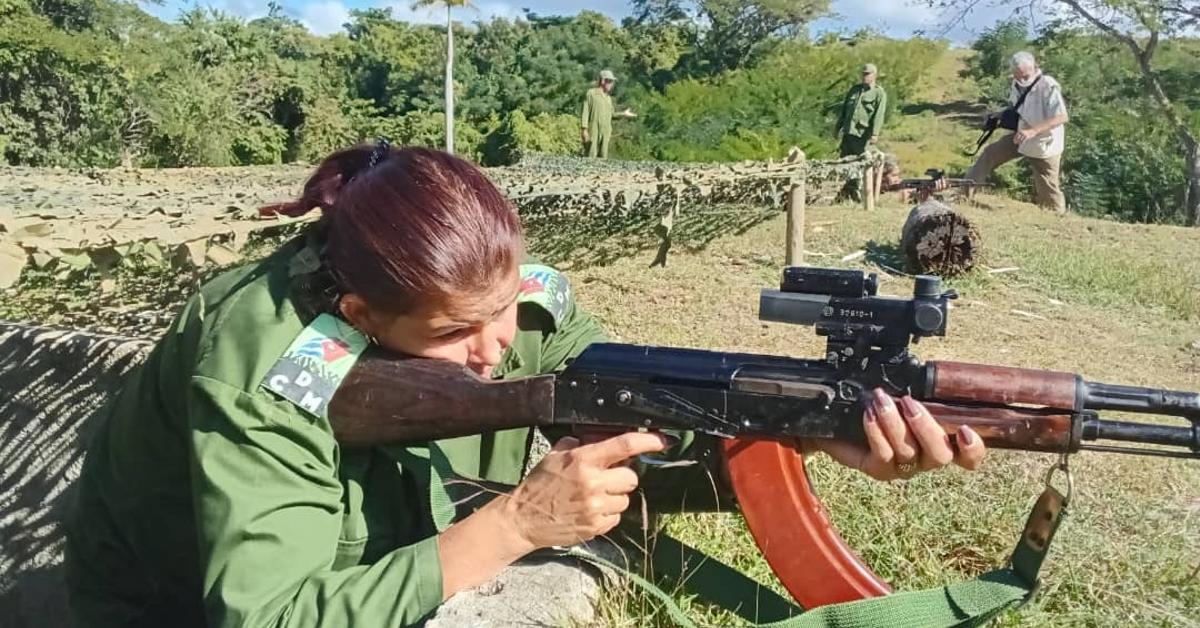
The so-called War of all the People, according to the definition collected in EcuRed and in the official Cuban military doctrine, it is a strategic conception formulated by Fidel Castro that deliberately dilutes the border between combatants and civilians. Under this approach, in the face of a large-scale military aggression, not only would the Revolutionary Armed Forces and the Militias act, but the entire society would be incorporated into the war effort, with functions assigned by territory, without clear distinction between military defense and civil life.
The forced militarization of the civilian population contravenes the principle of distinction contained in the Geneva Conventions
From the perspective of international humanitarian law, this conception is problematic. The forced militarization of the civilian population contravenes the principle of distinction included in the Geneva Conventions and reiterated by organizations such as the International Committee of the Red Cross, which establishes the obligation to protect the civilian population and separate it from military objectives.
By converting neighborhoods, communities and citizens into an active part of the defensive device, the doctrine not only exposes civilians to direct combat risks, but also transforms them into legitimate targets according to the rules of war, effectively annulling their civil status and transferring to society the human cost of a strategy designed from political-military power.
The term State of War appears collected from the first years of the revolutionary regime and is linked to the moments of greatest international tension. During the October Crisis of 1962, although it was never formally proclaimed, the country was placed de facto in an equivalent situation: general mobilization, absolute control of information and total suspension of ordinary civil life.
Later, the notion reappeared explicitly in Cuban military doctrine and in legislation associated with national defense. The National Defense Law and the regulations of the Defense Council establish that, in a scenario of external aggression or imminent threat, the country can transition to a State of War, which activates a strictly military chain of command and grants extraordinary powers to the Executive.
In practice, this figure serves to justify exceptional controls on the population, the economy and internal mobility. It is not just about preparing for an armed conflict, but about reinforcing political control in crisis contexts.
The Defense Council’s announcement comes amid a regional escalation following the capture of Nicolás Maduro by US troops in Caracas, a strategic blow that has left Havana without its main political and financial ally. The official confirmation that dozens of Cuban soldiers and agents were operating in Venezuela, including in the deposed president’s security ring, revealed an involvement that the regime had repeatedly denied.
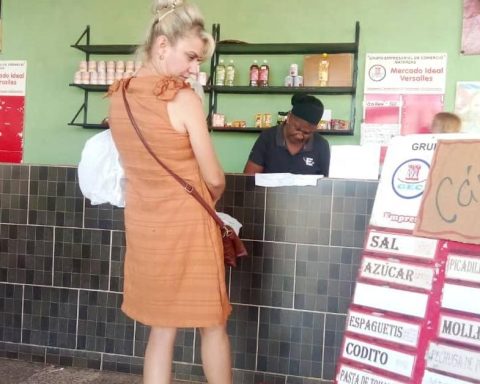
The population faces a daily emergency that already resembles a state of war, with prolonged blackouts, infrastructure in ruins, extreme shortages of food and medicine, and outbreaks of preventable diseases.
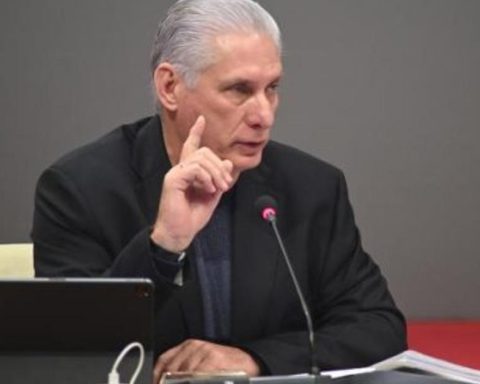
Since then, the leadership in Cuba has reappeared in public in military uniform, has intensified the anti-imperialist discourse and has recovered a narrative of a besieged square that seemed worn out even for its own propagandists. The Defense Council itself, chaired by Miguel Díaz-Canel, has been in permanent session since the beginning of the Venezuelan crisis.
The tutelary presence of Raúl Castro, who “stayed aware” of the meeting and described it as “good and efficient,” reinforces the idea that key strategic decisions continue to pass through the historic military apparatus, beyond formal positions.
While the regime talks about war, the population faces a daily emergency that already resembles a state of war, with prolonged blackouts, infrastructure in ruins, extreme shortages of food and medicine, outbreaks of preventable diseases and inflation that devours salaries and pensions. The repatriation of the remains of 32 Cuban soldiers killed in Venezuela during the capture of Nicolás Maduro was used as an emotional catalyst to reactivate an epic discourse that brutally contrasts with the precariousness of daily life.
The State of War, in this context, functions more as a political instrument than as a response to a specific threat. It serves to unite the elite, justify the closing of ranks, divert attention from the economic collapse and warn citizens that any protest can be interpreted as an affront to national defense.
It is not known which sectors would be mobilized, what economic measures would be activated, or what impact it would have on civilian life. This lack of information is part of the design, because keeping the population in uncertainty is also a form of control.
The regime insists, at the same time, that it is willing to “dialogue” with the United States, as long as it does not imply political concessions. However, resorting to the State of War suggests the opposite: a commitment to confrontation and the survival of power at any cost.