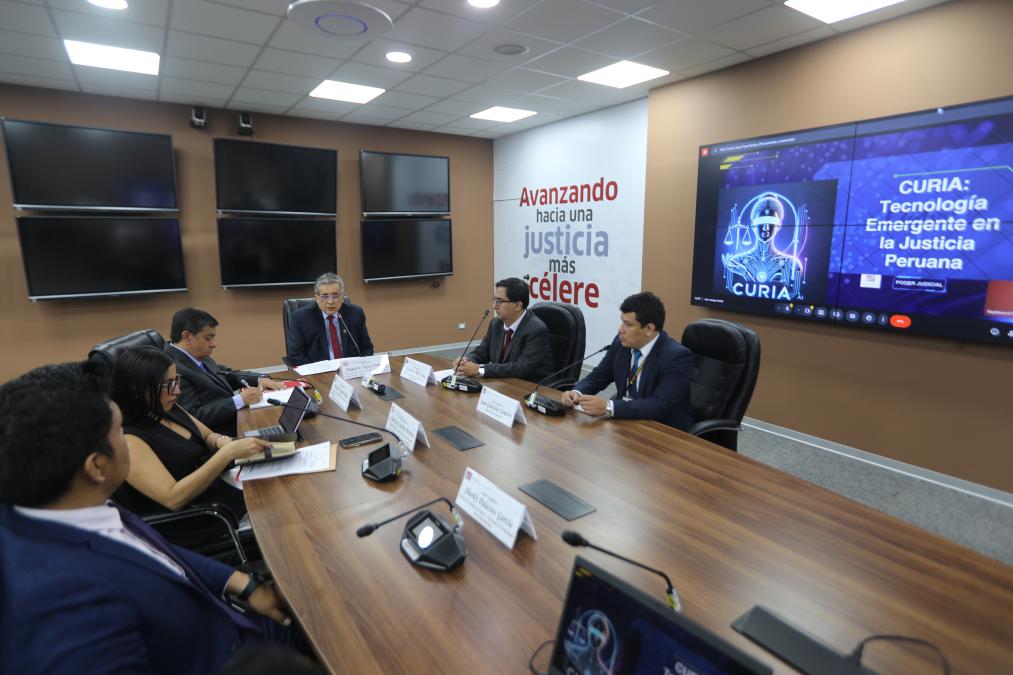
He Judiciarychaired by Janet Tello Gilardi, held the first strategic work table for the implementation of the technological project ‘Curia’, a system based on generative artificial intelligence that will be applied in processes of the domain extinction specialty.
The meeting was held in the Palace of Justice and was attended by the president of the Fifth Chamber of Constitutional and Transitory Social Law of the Supreme Court, Ulises Yaya Zumaeta, as well as the coordinator of the Specialized Subsystem in Asset Forfeiture, Manuel Luján Túpez, in addition to the technical teams in charge of the development and implementation of the system.
During the day, the institutional approach to modernizing the judicial system was presented, the promotion of the use of technological solutions with artificial intelligence and the strategic role that technology plays as support for jurisdictional work.
Likewise, the main functionalities of ‘Curia’ were presented, its applications in judicial work, operational benefits and security and responsible use considerations.
The ‘Curia’ system, promoted by the supreme court chaired by Yaya Zumaeta, assists judges in the analysis of files and in the preparation of duly substantiated draft resolutions in an average of one minute, a process that in the traditional model can take up to three hours.
Key tool against organized crime
Magistrate Manuel Luján Túpez described ‘Curia’ as a “powerful and valuable” tool for asset forfeiture processes, which seek to recover assets obtained from illicit activities linked to organized crime. These crimes include drug trafficking, corruption of officials, terrorism, kidnapping, human trafficking, tax fraud, environmental crimes and money laundering, among others.
Luján Túpez pointed out that the application of artificial intelligence will allow the optimization of jurisdictional work and the consolidation of jurisprudential uniformity in the judicial bodies that hear this type of cases. “The domain forfeiture specialty has a very expectant position and we are going to take the necessary steps to be incorporated into ‘Curia’, because from the beginning we have provided the population with predictable justice,” he stated.
For his part, Ulises Yaya Zumaeta highlighted that the supreme court under his charge has been promoting technological products that contribute to improving the justice system for the benefit of citizens. “They are tools with emerging technology and the use of artificial intelligence that are allowing justice to be more predictable, faster and effective,” he indicated.
The magistrate also specified that ‘Curia’ does not seek to replace the work of the judge, but rather to support the well-founded drafting of resolutions – always subject to review – and to strengthen the capacity for analysis, allowing the magistrates to concentrate on the merits of the cases.
Peru needs us informed to make decisions. Subscribe for free to the Perú21 newsletter: THE TOP 5 NEWS YOU SHOULD KNOW TODAY. Click on the next link.