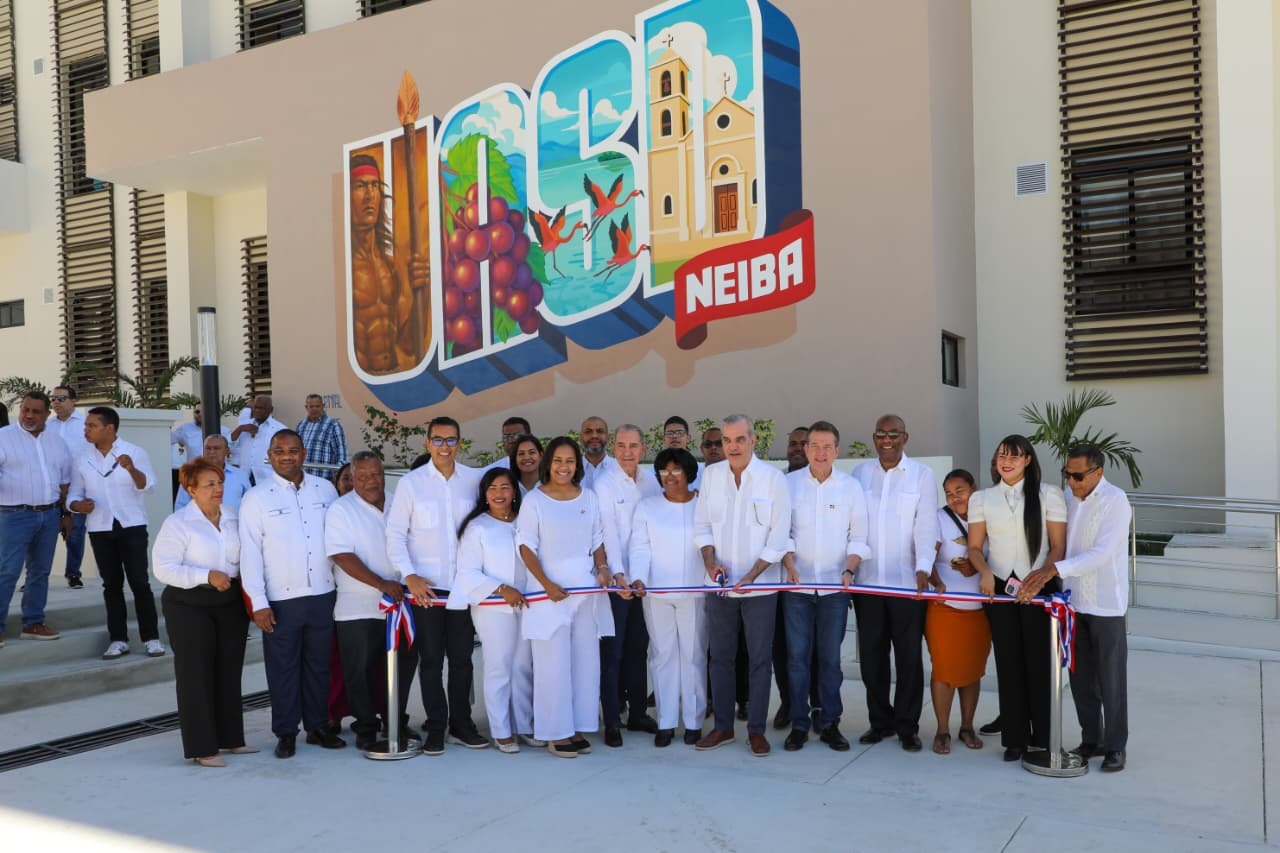
Bahoruco.– The President Luis Abinader, inaugurated this Saturday the Regional University Center of the Autonomous University of Santo Domingo (UASD) in Neiba, Bahoruco province, becoming the fifth university city of the state academy and a work that significantly expands access to higher education in the southwest region.
The work will directly benefit more than 1,200 students, strengthening opportunities for academic training, social mobility and regional development.
During the inauguration ceremony of the new UASD University City in Neiba, President Abinader stated that the work arose in response to the insistence of the community and the Government’s commitment to decentralize higher education in the southern region.
The president recalled that, despite the emergencies caused by the COVID-19 pandemic at the beginning of his administration, the project was prepared since 2021 and finally included in the budget for its construction, today managing to become an academic and cultural center for the Bahoruco province and nearby areas.
The ruler shared the anecdote of thousands of students from the south who had to move to Barahona or Santo Domingo to be able to study. He pointed out that at that time it was estimated that between 1,800 and 2,000 young people traveled daily in search of a university education, but that many others did not have the resources to travel and, therefore, were left without the opportunity to train.
These words, he expressed, marked his determination to bring the university to the provinces and guarantee equal access to education.
The head of state also responded to those who questioned the construction of new universities due to an alleged lack of professors. He explained that the purpose is for professionals from each province to be able to teach in their own communities, which strengthens educational decentralization and regional development.
“Decentralizing education is also decentralizing development,” said the president, highlighting that in all provinces there are talents trained to take on this challenge.
Likewise, he indicated that this university in Neiba must be oriented towards the strategic areas that will promote the growth of the south. Among them he mentioned tourism, with the creation of a hotel school; civil and electronic engineering to support the expansion of regional infrastructure; and mining technology, especially in the study of rare earths that will be exploited in Pedernales and the Independencia province.
These initiatives seek to prepare young people from the south to occupy key positions in the economic development of the region.
President Abinader also highlighted that this work is part of a comprehensive strategy that includes the construction of university centers in Azua, Baní and Comendador, as well as the strengthening of the Higher Institute of Agriculture in Bohechío province of San Juan and the university extension of UCATEBA in Pedernales.
The president expressed his satisfaction with the progress achieved and called on the community to take care of and take advantage of this university infrastructure. He noted that this work symbolizes the passage from what was previously known as the “deep south” to a “fertile south,” where education, health and employment become fundamental pillars for the social and economic development of the country.
What the new UASD Regional Center includes
Meanwhile, the Minister of Housing and Buildings, Víctor Bisonó, explained that the investment of approximately RD$974 million reflects the Government’s commitment to strengthening public higher education and the sustainable development of the Southern region of the country.
He indicated that the UASD Neiba Regional University Center has an area of 8,280 square meters of construction and was designed to serve an approximate population of 1,090 students, allowing young people from Bahoruco and surrounding areas to pursue university studies without having to move outside their province.
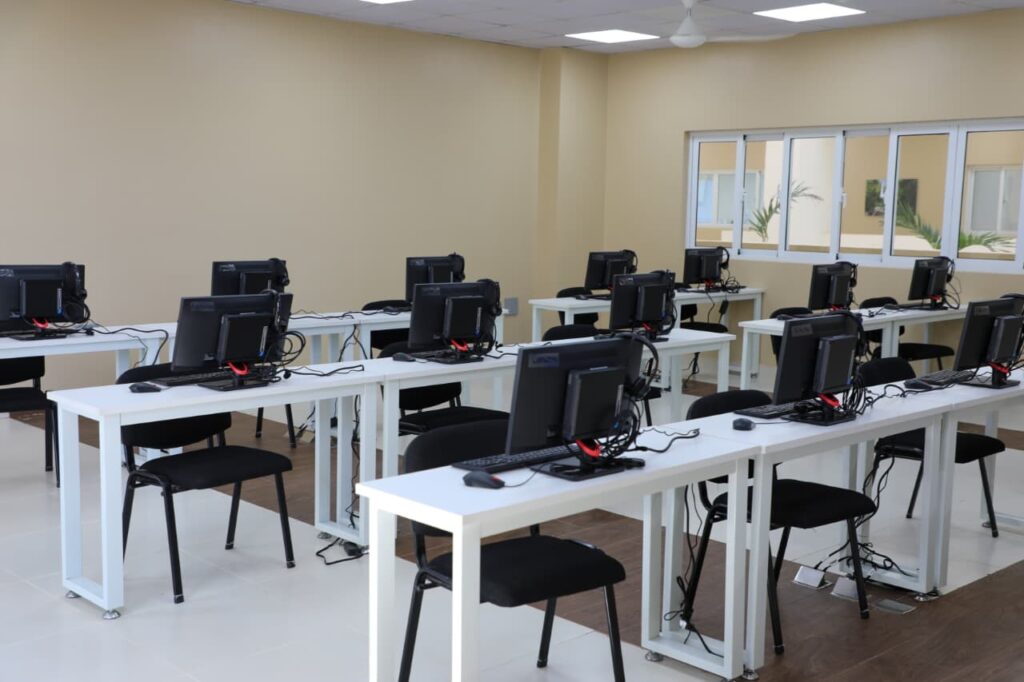
The infrastructure includes a three-level teaching building with 24 classrooms, four laboratories, a smart classroom and a computer room, as well as an administrative building of equal height for student services, guaranteeing more efficient and close academic management and has an auditorium with capacity for 322 people, a library and a postgraduate area with five classrooms, integrating as a modern, functional academic space in accordance with the current demands of higher education.
The center also has a treatment plant, a mixed court with bleachers, a patriotic plaza and a perimeter fence, as well as pedestrian and vehicular access, 135 parking spaces and facilities for people with disabilities, ensuring conditions of safety, accessibility and inclusion.
University education in all regions of the country
Meanwhile, the rector of the Autonomous University of Santo Domingo (UASD), Editrudis Beltrán Crisóstomo, highlighted that with the delivery of the UASD-Neiba Regional University Center the expansion of public higher education in the Dominican Republic is consolidated and pointed out that this work is the result of the strategic alliance between the State and the UASD, known as the UASD-State Binomial, whose main objective is to bring opportunities, equity and social mobility through access to education. university in all regions of the country.
Likewise, he recalled that the UASD Neiba was created as a subcenter on July 25, 2009, attached to the San Juan de la Maguana Campus, and that on March 15, 2023 it was elevated to the category of Center, currently having an approximate enrollment of 1,200 students and highlighted that this new university infrastructure provides the youth of Bahoruco with a space for teaching, research and innovation, strengthening development of the southwest region and reaffirming that “where the UASD arrives, the homeland arrives.”
They deliver recognition
The UASD Neyba Center and the Student Federation recognized President Abinader for his firm decision and the support provided for the construction of the UASD University City in Neiba. This important work strengthens access to higher education in the Southern region and represents a transcendental advance for the academic development of the country.