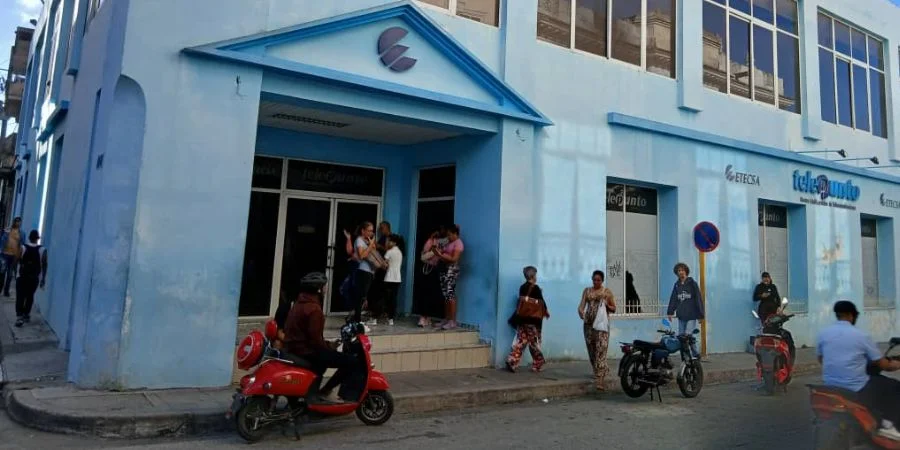
Alleged infrastructure modernizations that are not noticeable in practice, disappearing balances, frozen services during blackouts, excessive delays in repairs, are just some of the main customer complaints
HAVANA.- In the year just concluded, the Cuban Telecommunications Company, SA (ETECSA) carried out a series of “technical maintenance”, supposed improvements aimed, in theory, at optimizing the quality of services. One of them, executed in May, served as a prelude to an unpopular modification in mobile data prices and offers. To justify the criticized – and restrictive – transformations, leaders and spokespersons for the telecommunications empire argued the need to increase the income essential to guarantee their services. However, months after that controversial episode, the quality of telecommunications in Cuba continues to visibly decline, and not only in the field of mobile telephony.
According to the rules of the state monopoly, each customer has the right to a single terminal replacement in national currency for the price of 60 pesos – at least in theory, since in practice there is no availability. Now, as is natural, due to time and use, equipment deteriorates and breaks down irreparably over the years, often becoming unusable. In these cases, the technicians – when they finally appear – are incapable of repairing them, mainly because they do not have the essential spare parts (as unlikely as it may be, given the company’s million-dollar income). This leaves the customer with no other option than to buy a new device, which, for those who have already consumed their opportunity in Cuban pesos (at this point most, if not all subscribers), means paying in hard currency for some of the telephones available in commercial offices, which are not cheap at all, by the way.
As a result, there are many who are deprived of using the service for months (in the best of cases) due to not having dollars to purchase the available terminals, or failing that FE (relatives abroad) who make the purchase from their countries of residence. Anyone who browses the official pages of the only telephone provider on the island will be able to see that they are flooded with offers aimed at the local public, but to pay from overseas. There is no reason to be surprised, this is just one of the many ways in which the government of the largest of the Antilles profits from the unmet needs of its citizens.
However, despite not having service, many users are forced to continue paying to avoid losing the contract permanently, and with the hope of being able to recover communication one day. And in a context in which vandalism and government neglect have long affected public telephones, landline telephony is vital for anyone who does not have a cell phone, especially the elderly, low-income people and anyone who is in a vulnerable situation. On the other hand, this service acquires special importance in administrative and commercial establishments – mainly since public transport was virtually collapsed – because before making the trip in vain it is advisable to verify certain information such as opening hours, availability and price of certain items, etc.
Although, paradoxically, in stores, state institutions and other work centers dedicated to serving the population or related in some way to receiving clients, the latest fashion for some time now is not to answer the landline. This phenomenon has gained strength as employees have been equipped with mobile phones, so that the calls that interest them reach them directly without going through the whiteboard in the workplace. For the customer in need, this translates into hours and hours of useless dialing plus countless rings that no one answers, until finally there is no choice but to risk going in person, with the expense that this represents in terms of time, money and energy. When you bring up the issue, employees usually just shrug their shoulders and claim that the phone “is broken.”
Unfortunately, these are not, by any means, the only failures that cloud the reputation of ETECSA. Alleged infrastructure modernizations that are not noticed in practice, balance that disappears, services frozen during the blackouts, excessive delays in repairs, are just some of the main complaints from customers. Every year both the fixed and mobile networks show greater deterioration, leading to growing dissatisfaction among users of both. “In war as in peace, we will maintain communications,” reads the traditional slogan of the respective cabinet in times of the Castros. “If it doesn’t rain and there is a current,” the jokers add.