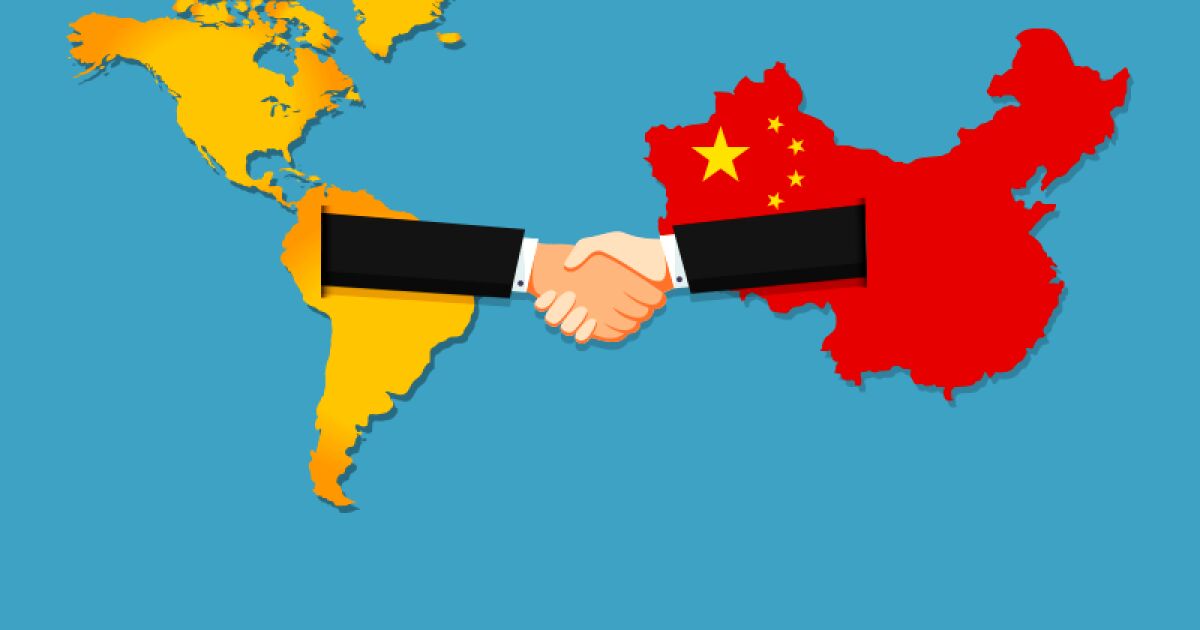
According to an analysis by the European Parliament Study Center, this advance responds to a deliberate long-term strategy focused on ensuring access to natural resources, expanding markets for its manufactures and consolidating its economic and political presence in the region. The document highlights that Latin America has become a key partner for China due to its abundance of critical minerals, its energy capacity and its growing weight in global supply chains.
Trade between China and Latin America multiplied rapidly. Between 2000 and 2020 it grew 26 times, going from 12 billion to 315 billion dollars. By 2024, total trade reached 518 billion dollars and projections suggest that it could exceed 700 billion by 2035.
Latin American exports to China are concentrated in primary products. Minerals represent 32% of the total, followed by oilseeds such as soybeans with 18% and mineral fuels with 12%. In exchange, China mainly sends machinery, electrical equipment, vehicles and auto parts.
The red stain spreads unchecked not only in the region. According to the Lowy Institute, almost 80% of the world’s countries import more products from China than from the United States. The Australian research center drew a map that shows how the Asian giant becomes the main global supplier, displacing Washington.
The investments
Beyond trade, Chinese investment leaves a deep mark, as Latin America is the second largest destination for Chinese direct investment, only behind Asia. The accumulated wealth is estimated at 187.5 billion dollars, with nearly two-thirds concentrated in energy, mining and natural resources, particularly key minerals for the energy transition.
The Monitor of Chinese Foreign Direct Investment in Latin America and the Caribbean indicates that Chinese investment in the region totaled 8,530 million dollars in 2024. Between 2000 and 2024, the average annual amount decreased significantly, going from 13,830 million dollars in 2015-2019 to 11,125 million in 2020-2024, even below the average from 2010-2014.
Brazil is by far the main destination of Chinese investment in the region, with an annual average of 2,678 million dollars between 2000 and 2024, followed by Peru with 1,460 million, Mexico with 990 million and Argentina with 978 million. Venezuela, in contrast, averaged just $129 million annually. Even so, the structure has diversified significantly. While in 2000-2004 Brazil concentrated 55.13%, its participation fell to 30.50% in 2020-2024.
Recently, Argentina, Peru, Mexico and Chile have established themselves as the most dynamic recipients, although Brazil maintains first place.
Mastery in mining and infrastructure
Lithium and copper occupy a central place in this strategy. China has invested at least $11 billion in lithium extraction projects since 2018, especially in Argentina, Bolivia and Chile, the so-called lithium triangle, which concentrates about half of the world’s reserves. In copper, Chile and Peru, the two largest global producers, have China as their main destination.
Infrastructure is another key axis. Since 2018, China extended its Belt and Road Initiative to the region. One of the most emblematic projects is the Chancay megaport, in Peru, which will open a direct maritime route with Asia and will modify South American logistics by reducing dependence on the Panama Canal.
Beijing also finances airport, highway, port and railway projects. Chinese entities maintain different levels of ownership or control over more than 100 port projects around the world, at least a dozen in Latin America and the Caribbean. At the end of 2024, the inauguration of the new megaport in Peru reinforced this deployment.
According to an analysis by the Council on Foreign Relations, the China Development Bank and the Export-Import Bank of China are among the region’s largest lenders. Since 2005, they have granted more than $120 billion to countries and state-owned companies in Latin America and the Caribbean, in many cases linked to oil and destined for energy and infrastructure projects.
Venezuela accounts for almost $60 billion of these loans, almost double that of Brazil, the second largest borrower. China also participates as a non-borrowing member with voting rights in the Inter-American Development Bank and the Caribbean Development Bank.
China is also driving the development of so-called new infrastructure, encompassing artificial intelligence, renewable energy, smart cities and 5G technology, with telecommunications companies such as Huawei at the forefront.