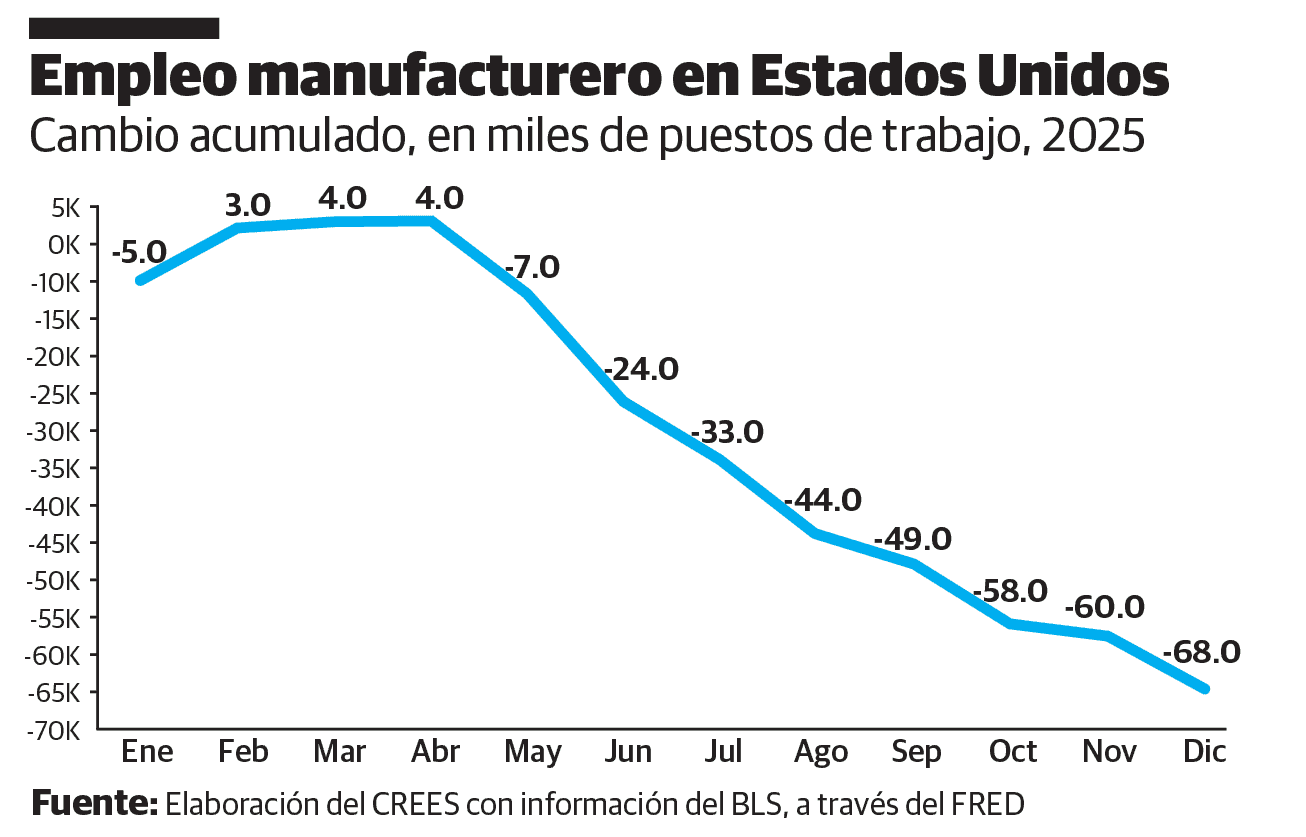
At the end of 2025, the manufacturing employment in the United States accumulated a drop of 68,000 positions, after registering eight consecutive months of declines. As a result, the total level of employment in the sector was around 12.7 million workers, one of the lowest records since 2022.
During that same period, the unemployment rate showed an upward trend throughout the year, although in December it stood at 4.4%, slightly below the 4.5% recorded in November.
However, the creation of new jobs was mainly concentrated in the health sectorwhile other sectors, such as manufacturing, continued to lose employment, a behavior that has been showing for several years.
One of the explicit objectives of the economic strategy of the current administration has been to reverse this trajectory and promote the creation of manufacturing jobs through changes in the tariff policy and the reorganization of supply chains.
However, the available evidence suggests that, at least so far, that goal has not been realized.
In conditions of free tradeWithout tariffs, companies can integrate into broader value chains, specialize and take advantage of the advantages of exchange, and work tends to be reallocated towards more productive activities. On the contrary, when these mechanisms are weakened with introduction of tariffsthe adjustment usually manifests itself in lower job creation. Thus, employment ends up being a victim of bad economic policies.
__________
A collaboration of Regional Center of Economic Strategies Sustainable (You believe).