The mayor of Cubatão, in São Paulo, César Nascimento (PSD), decided to ask the federal government for help after two companies that had operated in the city for decades closed their activities in less than a year. One unit belonged to the petrochemical company Unigel. The other, to Yara Brasil Fertilizers.
The head of the municipal Executive Branch plans to travel to Brasília in the company of political, business and union representatives from Baixada Santista. The objective is to try to raise awareness in the Union about the need to review the tariff policy that affects the petrochemical sector, in particular on the import of fertilizers.
“We will request a meeting with the vice president [e ministro do Desenvolvimento, Indústria, Comércio e Serviços, Geraldo Alckmin] to deal with the consequences of the closure of factories located in the city, a problem that the municipality has been facing for more than a decade”, the mayor told Brazil Agencydefender of trade defense measures and better financing conditions for productive activity.
“The loss of protagonism of an industrial hub of the relevance of Cubatão is not a local problem, but a factor in weakening the national industry as a whole”, added Nascimento.

César Nascimento, mayor of Cubatão, wants help from the federal government to reverse factory closures in the city – Photo: Cubatão City Hall/Disclosure
He also intends to ask for speed in the conclusion of the administrative process that the Ministry of Foreign Trade (Secex), of Mdic, initiated in 2025 to investigate the alleged existence of dumping in Chinese exports of rolled iron or steel products to Brazil. Dumping is when a foreign company or country exports its products at prices lower than the cost of production, with the aim of undercutting local competitors.
On December 26, 2025, the secretariat made public a preliminary opinionreporting that it had found dumping in Chinese exports, but extending the deadline to complete the investigation and assessment of the losses to the Brazilian steel industry.
Strike
After almost 70 years of operation in Cubatão, Unigel announced, on the 8th, the suspension of activities at the styrene factory (liquid used in the production of a type of plastic, polystyrene, used in the manufacture of household appliances, packaging and for many other purposes) and toluene (solvent for paints, resins, rubbers and coatings).
According to the company, the decision to close its activities in Cubatão was taken in a “context of unprecedented decline in the global chemical industry, marked by a strong oversupply of petrochemical commodities, intensified by the expansion of international production capacity”, starting in 2023.
The company did not rule out the possibility of resuming activities “as soon as market conditions allow”, but highlighted the “lack of prospect of reversal in the short term”, which motivated it to concentrate its polystyrene production in the factory in the neighboring city, Guarujá, also in Baixada Santista, where production at the São José dos Campos plant, in the interior of São Paulo, whose closure was announced this Tuesday (13), will also be transferred.
Considered one of the main petrochemical companies in Brazil, with factories spread across São Paulo and Bahia, Unigel has been in judicial recovery since October 2025. The request to the Court was the way the company found to renegotiate with its creditors a debt that exceeds R$5 billion and, thus, try to “enable the readjustment of its capital structure” in order to “preserve its activities”.
In recent times, the Unigel unit in São José dos Campos employed around 40 employees, while the one in Cubatão was operating with 70 direct workers and around 30 indirect workers.
Days before Unigel made its decision public, Mayor César Nascimento expressed to company executives his willingness to grant tax exemptions to avoid the loss of jobs and tax revenue. Furthermore, at the last meeting of the Baixada Santista Development Council (Condesb), he defended that the mayors of the nine cities that make up the Metropolitan Region (Bertioga, Cubatão, Guarujá, Itanhaém, Mongaguá, Peruíbe, Praia Grande, Santos and São Vicente) come together to request federal and São Paulo agencies for measures to stimulate and encourage the industry.
Taxation
In an interview with Brazil Agencythe president of the Union of Workers in the Chemical, Pharmaceutical and Fertilizer Industries of Baixada Santista (Sindquim), Herbert Passos Filho, lamented the fate of the traditional Cuban factory.
“Cubatão was once the main fertilizer producing hub in Brazil. And Unigel, a symbol of our industrial history. The union itself was born there, when it was still the Brazilian Styrene Company”, recalled the union leader, adding that the closure of the factory worsens the emptying of the once thriving industrial hub of Cubatão, which was once a symbol of São Paulo and national industrialization, especially in the steel, chemical, petrochemical, fertilizers and basic industrial inputs segments, an activity that, in the decade 1980, motivated the United Nations (UN) to award the city the title of most polluted municipality in the world.
“Since then, Cosipa has been privatized [antiga Companhia Siderúrgica Paulista, adquirida pela Usiminas] and the closure of several factories”, highlights Passos.
According to the city hall, when Usiminas paralyzed the steel mill’s primary activities in 2016, shutting down the hub’s iconic blast furnaces, it not only led to the closure of around 15,000 jobs, but also the closure of companies that used inputs derived from steel production acquired from the neighboring factory.
According to Passos, at its peak, the city’s petrochemical industries alone employed around 12 thousand workers. “Today, there are approximately 3 thousand. And the expectation is that this number will continue to fall”, lamented Passos, who also works with the National Secretariat of Chemists of Força Sindical.

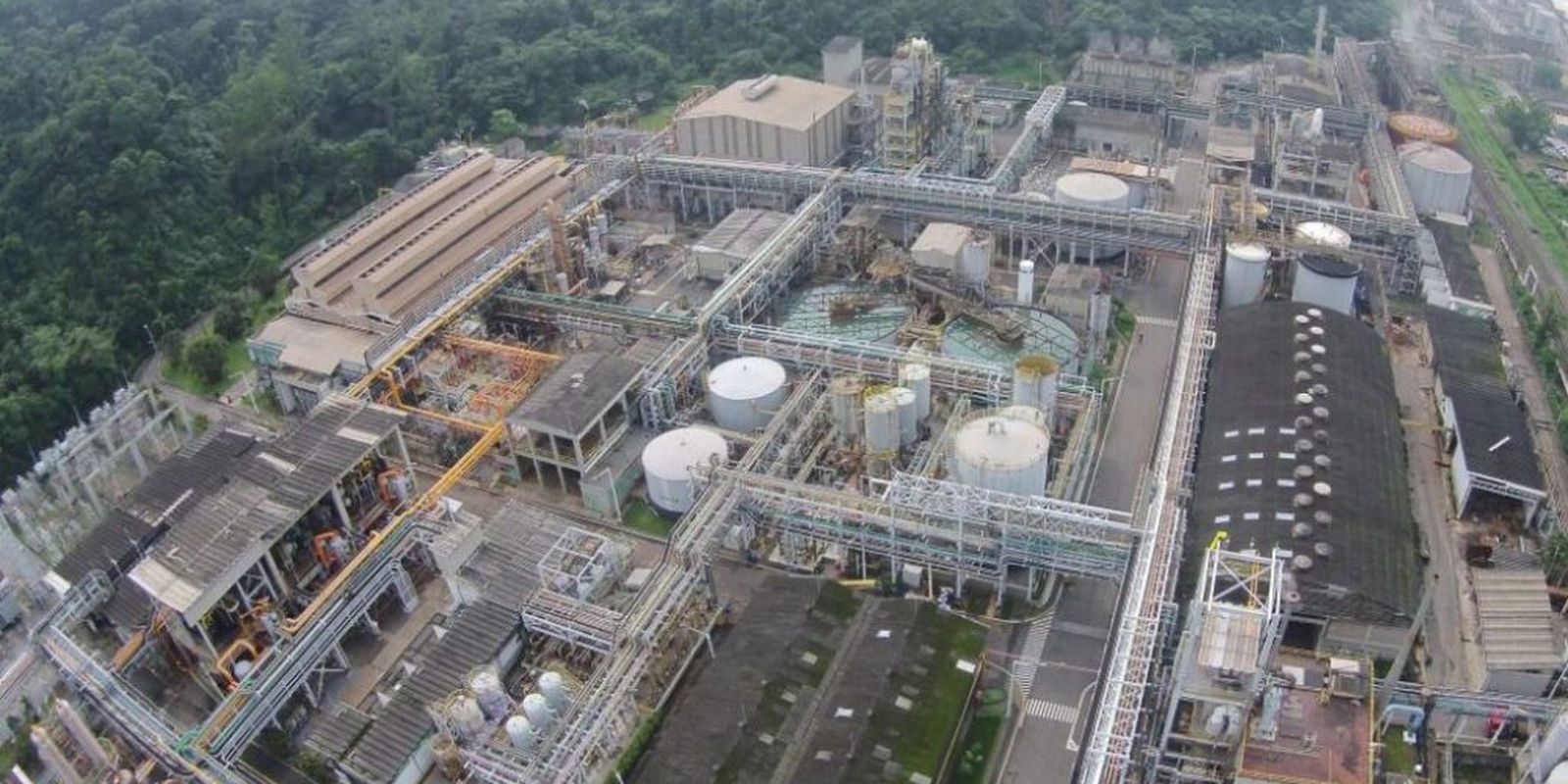
Factory in Cubatão – Photo: Cubatão City Hall/Disclosure
“I am becoming a specialist in the closure of industrial units across the country, mainly in the fertilizer sector,” said the union leader.
According to him, producers of agricultural inputs, such as the Norwegian Yara, which halted production at its factories in Cubatão and Paulínia in February this year, face a economic crisis that ended up making Brazil dependent on imported inputs that, for decades, benefited from exemption or reduction in the tax burden.
“As a result, many companies operating in Brazil were reducing or interrupting production and started importing fertilizers”, highlighted Passos, pointing out that, since 2008, national fertilizer production fell from around 11 million tons/year to around 6 million tons/year, while consumption went from approximately 24 million tons per year to more than 41 million tons/year.
Stimulus
In recent years, public policies have been implemented to try to correct imbalances and promote the national chemical industry and the fertilizer sector in particular. Mainly after Russia’s invasion of Ukraine in 2022, which exposed Brazil’s high dependence.
In 2021, the National Council for Financial Policy (Confaz) updated the rule that allowed states and the Federal District to grant a reduction or exemption from charging the Tax on Circulation of Goods and Services (ICMS), establishing a gradual increase in the tax burden until reaching, in December 2025, the rate of 4% of the value of the operation.
“Obviously, agribusiness does not want to change the exemption given to fertilizers, as this reduces the profit margin of the agricultural sector”, said Passos, considering that measures that discourage the import of agricultural inputs face resistance from agribusiness, as they tend to make the product more expensive.
In fact, the Brazilian Agriculture and Livestock Confederation (CNA) claims that, in just four years, from 2021 to 2024, the ICMS Agreement No. 26/2021from Confaz, increased the cost of rural producers by R$11.74 billion.
“We need to make choices. And remember that, throughout the world, the chemical industry is protected by national governments, and that, by stimulating the industry, we are stimulating the generation of qualified and better paid jobs”, argued Passos.
At the end of last year, President Luiz Inácio Lula da Silva sanctioned the Law No. 15,294establishing the Special Chemical Industry Sustainability Program (Presiq), which provides tax incentives in excess of R$10 billion to be invested between January 2027 and December 2031. Previously, in August 2023, the government had already resumed the Special Chemical Industry Regime (Reiq), a program that provides tax incentives for investments in the sector.
Competitiveness
This Thursday (15), when visiting the headquarters of Brazilian Communication Company (EBC)in Brasília, where he participated in the program Good morning, Ministerthe vice-president and minister of Development, Industry, Commerce and Services, Geraldo Alckmin, commented on the situation in Cubatão.
According to him, the entire national petrochemical industry faces difficulties due to international competition.

Geraldo Alckmin recognizes the competitiveness difficulties of the national petrochemical industry – Photo: Rafa Neddermeyer/Agência Brasil
“The Brazilian petrochemical hub suffers competitiveness difficulties. That’s why we created the Special Regime for the Chemical Industry, which reduced the tax on inputs for the petrochemical industry so that it could be more competitive,” said Alckmin, adding that the country has also sought to defend the Brazilian productive sector from anti-competitive practices.
“We do not promote a trade war, but we have to have a trade defense. Brazil is in favor of free trade, but with rules, obeying the dictates of the World Trade Organization [OMC]”, concluded the minister, confirming that he is dealing with the issue with the Brazilian Chemical Industry Association (Abiquim).
I’m sorry
Consulted by the report of Brazil Agencythe Center for Industries of the State of São Paulo (Ciesp) lamented the closure of factories in the Cubatão Industrial Complex. In a statement, the entity assured that, together with other entities, it has sought to intensify dialogue with municipal, state and federal governments with the aim of strengthening the competitiveness of national industries and, thus, “containing the process of deindustrialization that has been ongoing in the country since the 1980s”.
“Although the federal government has already adopted important initiatives, such as Nova Indústria Brasil and Brasil Mais Produtivo, Ciesp assesses that the scenario requires the creation of complementary and more effective measures to address structural bottlenecks and enable the construction of integrated public policies that guarantee the sustainability of the productive sector and the preservation of jobs”, stated the entity.