While human rights organizations raise the number of victims, the official media of the Cuban Government reproduce Tehran’s narrative, in line with the historical alliance between both regimes.
MADRID, Spain.- At least 2,751 people have died in Iran as a result of the repression of the protests that have shaken the country since the end of December 2025, according to figures released by the organization Human Rights Activists News Agency (HRANA).
According to this balance, among the victims are 2,403 protesters, 147 people linked to government forces, 12 minors and nine civilians who were not directly participating in the protests. HRANA pointed out that the figure could increase due to difficulties in verifying information in several regions of the country, where restrictions on the internet and communications persist.
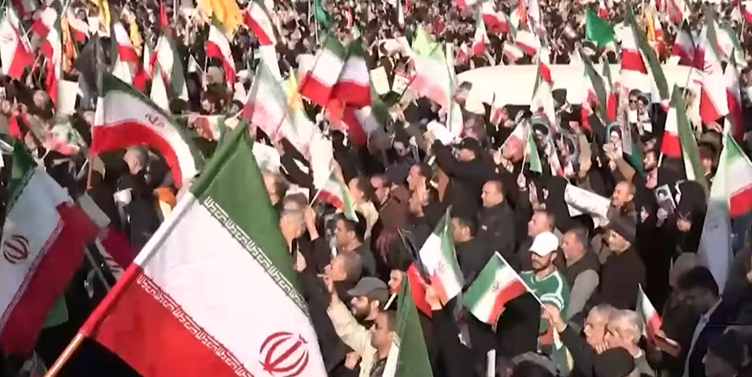
The mobilizations spread across dozens of Iranian cities and have been described as one of the largest waves of protest in years, in a context marked by the deterioration of the economic situation and social unrest. Security forces have responded with operations that include the use of lethal force, mass arrests and the initiation of legal proceedings against people accused of participating in the riots.
Iranian authorities have offered lower figures and maintain that some of the violence has been caused by “armed groups” and foreign interference. However, human rights organizations insist that the majority of victims are civilians and protesters.
Trump: “Help is on the way”
The internal crisis coincides with an increase in tension between Iran and the United States. US President Donald Trump publicly expressed his support for the protesters and stated that “help is on the way,” without specifying what it would consist of. From Tehran, senior officials warned that any direct action by Washington could have a response against US interests in the region.
As protests and repression continue, governments and international organizations have called for containment and respect for human rights, while concern is growing about a possible escalation of the conflict beyond Iranian borders.
In this context, the Cuban Government has not issued public statements regarding the increase in the death toll. The island’s state media has focused its coverage on play the official Tehran version, that promotes marches of “national solidarity” and blames the United States and Israel for the violence. The widespread narrative presents the protesters as agents of foreign powers and minimizes the social demands that gave rise to the protests.
The historic alliance between Havana and Tehran
This approach is part of a line supported by the official Cuban press in the face of internal crises in allied countries, prioritizing the arguments of governments and attributing conflicts to external factors, without giving space to complaints from independent organizations or testimonies from victims.
The relations between Havana and Tehran They date back to 1979, when, after the Islamic Revolution, Fidel Castro was one of the first heads of state to recognize the new leadership led by Ayatollah Ruhollah Khomeini. That same year, Cuba promoted Iran’s entry into the Non-Aligned Movement, then chaired by Castro himself, who publicly defended that there was no contradiction between revolution and religion.
Since then, both governments have maintained stable diplomatic ties and cooperation that has spanned political, scientific, economic and military fields. During the 1990s, in the midst of the Cuban economic crisis after the disappearance of the Soviet Union, Iran established itself as one of Havana’s strategic allies in the Middle East.
Although bilateral trade exchange has been limited – according to the Economic Complexity Observatory, in 2018 Cuban exports to Iran were around 97,000 dollars and imports around 60,000 – the political alliance has remained active, especially in international forums. Cuba has systematically supported Tehran in critical resolutions and both governments have agreed on positions towards the United States and on the interpretation of internal protests as a result of external interference.