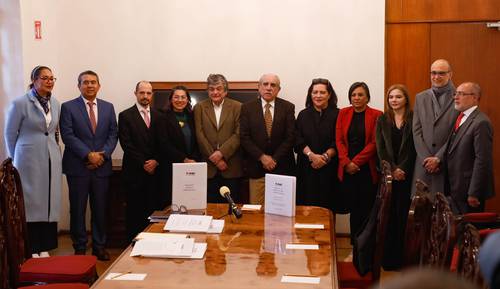
▲ Some councilors who make up the General Council of the National Electoral Institute (INE) presented proposals to the presidential commission for electoral reform on Monday before delivering the initiative to Congress. In the center appears Pablo Gómez, head of the Executive entity.Photo Jorge Ángel Pablo García
Fernando Camacho Servin
La Jornada Newspaper
Wednesday, January 14, 2026, p. 3
Without the approval of the Labor (PT) and Green Ecologist of Mexico (PVEM) parties to the electoral reform proposal of President Claudia Sheinbaum, said amendment “has no chance of coming out”, so the first agreement that must be reached is with them, even before the project is publicly announced, admitted the Morena bench in the Chamber of Deputies.
“If we do not have the opinion of both parties, or we are missing one of them, the constitutional reform (in electoral matters) has no chance of succeeding,” acknowledged yesterday the coordinator of the Morenoist deputies, Ricardo Monreal.
The legislator considered that “the first agreement we must reach, even before presenting the initiative, is with the PVEM and the PT, who have been allied political actors, with characteristics of loyalty and institutionality. They have to be the first to know the scope of the initiative, at the same time that they must externalize their contributions and incorporate them” into the project.
Monreal emphasized that “tomorrow (today) is key,” because in the afternoon a private meeting will be held at the National Palace with the President – to which he and Morena’s coordinator in the Senate, Adán Augusto López, were invited – where the conclusions of the commission on the electoral reform, headed by Pablo Gómez, will be announced and the times will be set to formally present the project.’
Asked about the issue, the coordinator of the Green party in San Lázaro, Carlos Puente, pointed out that his parliamentary group prefers to wait for the final version of the president’s reform proposal, but he announced that in matters such as the reduction of the parties’ budget, they would be willing to support it with certain conditions.
“If they say ‘let’s make a reduction of 20 or 25 percent’, we would support it, but with one detail: let’s distribute the money equally among all the political parties. We can lower it a good amount, but with the willingness of all the parties that we go under the same conditions of competition,” he indicated in a telephone interview.
The Zacatecas legislator stressed that it is not the same to take away 20 percent from the majority party than from one with a smaller number of parliamentarians, because the latter “you leave with nothing. Because, furthermore, it is not only the money, but also the time on radio and television. Aren’t we all supposed to compete under the same conditions?”
For their part, sources from the PT bench in the Chamber – who preferred to reserve their identity – expressed their skepticism regarding measures such as reducing or eliminating proportional representation legislators or making a drastic cut to party funds.
“Eliminating multi-member representatives is not viable, because many times they are the voice of those who do not have one. They must be maintained, but in such a way that the mechanisms for them to register are reviewed and that it is not a list that is imposed from power. And more than cutting financing, it must be monitored in a better way,” estimated the people consulted by this newspaper.