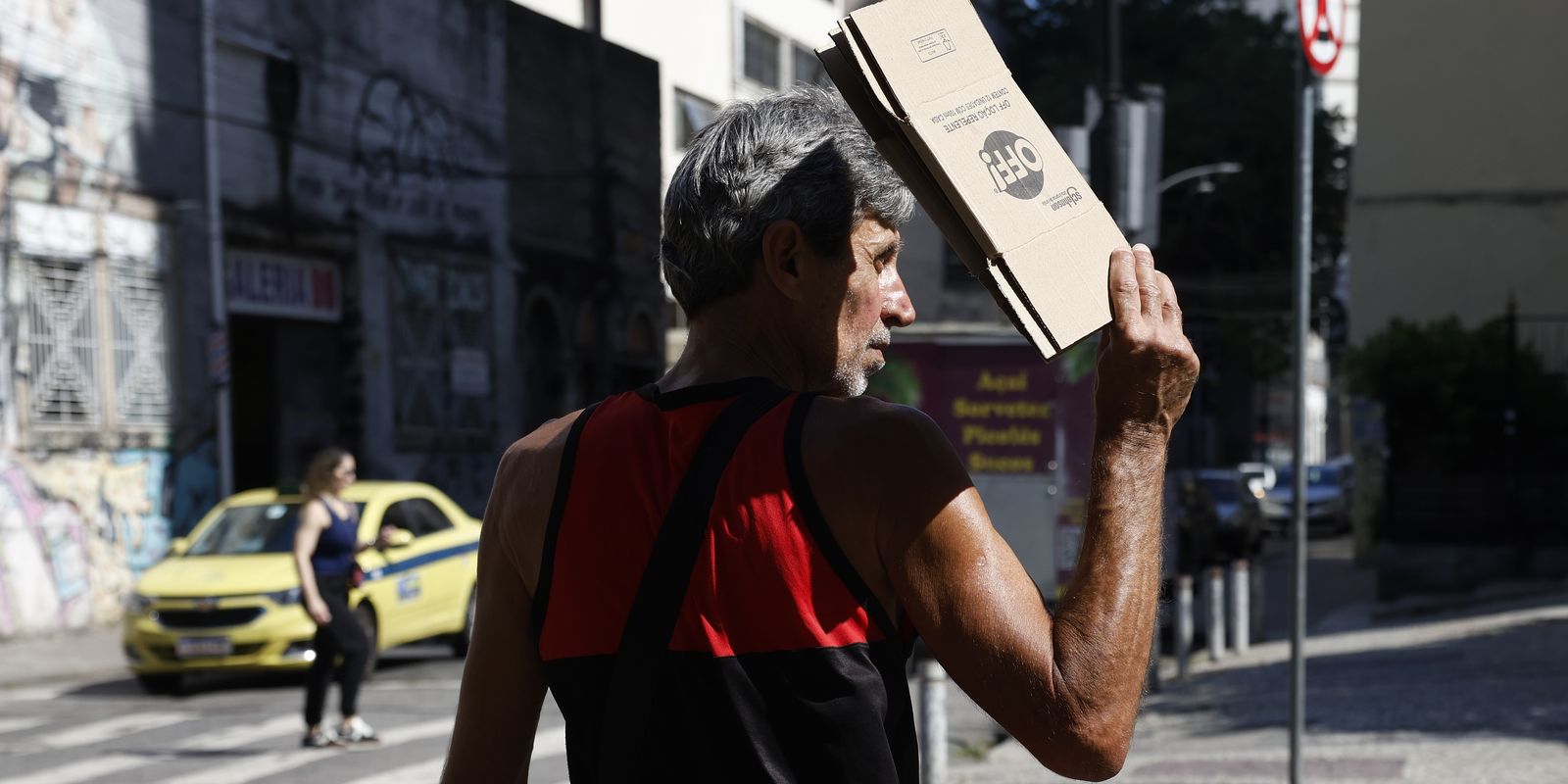
The Federal Public Defender’s Office (DPU) and the Public Defender’s Office of the State of Rio de Janeiro (DPRJ) sued the Rio de Janeiro Court asking the city of Rio to take measures so that the population in vulnerable situations, especially the homeless population, does not suffer so much from the effects of excessive heat.
“[A população em situação de rua]which depends critically on public taps and the solidarity of local businesses, is today completely unassisted. Businesses have closed or ration water; public taps have dried up”, says the request.
Given the situation, DPU and DPRJ ask that a series of measures be taken, such as in places with greater circulation of homeless people:
- Distribution of inputs such as water, sunscreen
- Provision of drinking fountains and bathrooms
- Installation of cooling or refrigeration points
In addition, they also ask that breaks be determined for hydration and refreshment of professionals and public agents in external activities, especially those linked to the Street Clinic and Social Assistance. The request is that the measures last as long as the Extreme Heat Control is hung.
The forced removal of homeless people without the guarantee of adequate reception must also be prohibited.
DPU and DPRJ request that the municipality of Rio de Janeiro be ordered to pay R$1 million in “compensation for collective moral damages, due to the serious violation of fundamental rights and human dignity resulting from state inertia in the face of the climate catastrophe”, as the request says. This money must be donated to the Fund for the Defense of Diffuse Rights.
Rio de Janeiro has presented temperatures higher than the historical average. The high temperatures recorded in the first two weeks of 2026 led thousands of people to seek care in health facilities.
Homeless population
This is not the only request made to the Court. The DPU, DPRJ and the Federal Public Ministry (MPF) had already asked the Federal Court for an injunction against the municipality of Rio for failing to take measures aimed at the homeless population in the capital of Rio de Janeiro. There has been no court decision yet.
The bodies ask that the Court determine that the Municipal Intersectoral Monitoring and Monitoring Committee (Ciamp-Rua) be created within 30 days. It is a collegiate body that brings together government and civil society to create, monitor and evaluate public policies aimed at social inclusion and guaranteeing the rights of people living on the streets.
Furthermore, they request that the Executive prepare, within 60 days, a detailed action plan to comply with the determinations of the Action for Non-compliance with Fundamental Precepts in the Supreme Court (ADPF) 976, an injunction decision of the Federal Supreme Court (STF).
Among other measures, the ADPF determines that states and municipalities implement measures that guarantee the personal safety and property of homeless people within existing institutional shelters, including support for their animals. Furthermore, they must prohibit the forced collection of goods and belongings, the compulsory removal and transportation of homeless people and the use of hostile architectural techniques against this population.
The authors also ask that the municipality agree with the Union, within 30 days, to carry out all the actions foreseen in the Visible Streets Plan, ensuring that federal resources allocated to these public policies are not given up.
Non-compliances
According to the bodies, the situation in Rio de Janeiro is worrying. Currently, the municipal network has only 2,688 reception places for a population estimated at more than 7 thousand people.
The statement cites data from an audit by the Municipal Audit Court (TCM/RJ), which revealed that 75% of the new reception vacancies provided for in the 2022-2025 Multi-Year Plan were not implemented. Furthermore, there was a budget cut of 61% in 2023 for reception actions, with only R$553 thousand remaining from an initial forecast already considered insufficient by the accounting body.
Another critical point addressed is the insufficiency of the service structure. Rio de Janeiro has 14 Social Assistance Reference Centers (Creas), when the technical parameter for the current population would require 34 units. The petition also mentions the existence of only two Pop Centers in operation and a single 24-hour Reception Center, located on Ilha do Governador, whose isolated location makes voluntary access by the homeless population difficult.
“The municipality of Rio de Janeiro has not expanded its social assistance network for more than 30 years”, says the regional human rights defender of Rio de Janeiro (DRDH/RJ), Thales Arcoverde Treiger, who signs both demonstrations.
Regarding the measures to combat the heat, he says: “What is the protocol for the heat? What is the municipality doing regarding the heat? Is it offering water? Isn’t it? How is the increase, for example, of the network for people to take a shower? There is no such thing.”
Position of the municipality
The Public Prosecutor’s Office of the Municipality of Rio (PGM) informed, in a note, that it was not notified of the request made by the Federal Public Ministry and the Public Defenders’ Offices of the Union and the State of Rio.
“It is worth highlighting that the Municipality was already in negotiations with the Public Ministry of the State of Rio de Janeiro to update the TAC [Termo de Ajustamento de Conduta] referring to the homeless population, in force for more than 10 years. The Public Prosecutor’s Office of the Municipality of Rio de Janeiro anticipates that, once subpoenaed, it will make a statement in the case”, says the note.
The Municipal Department of Social Assistance (SMAS) also informs that, in 2025, 510 new vacancies were created to serve the homeless population. In the first quarter of 2026, another 75 vacancies will be opened. Regarding Creas, in 2025, SMAS implemented the Electronic Medical Record in the 13 units and modernized service to guarantee users’ service history in the secretariat’s database.
He also says that, with digitalization, a study was started to assess the need for new units. This month, the Single Center for Regulation of Vacancies for Adults, Elderly People and Families also came into operation, “which organizes, in a single system and with daily updates, the distribution of reception places in the municipality, with more transparency and agility”, he says.
Regarding the heat, SMAS highlights that “all units in the network continue to operate to serve the homeless population. Furthermore, the approach teams operate 24 hours a day on the streets, carrying out active searches and offering reception”, he states.