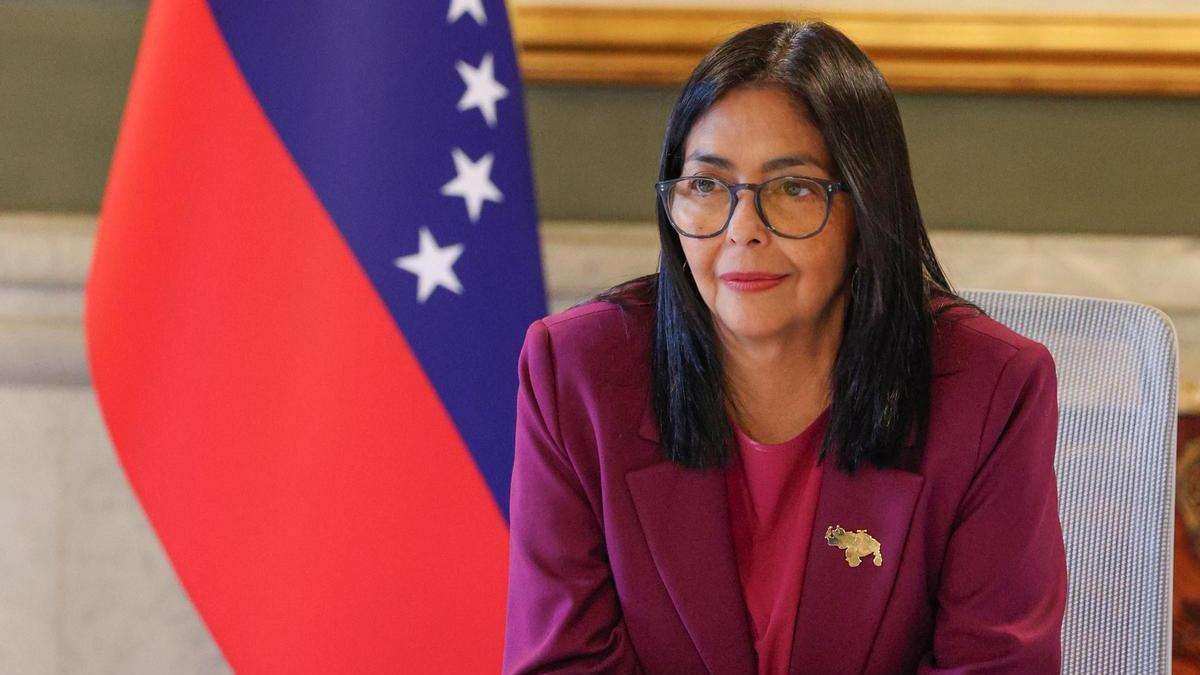
Acting President Delcy Rodríguez reported this Wednesday that she held a conversation with the President of the United States, Donald Trump, amid the tensions between both countries after the military attack carried out by the North American nation.
“Today I had a long, productive and courteous telephone conversation with the President of the United States, Donald Trump, developed within a framework of mutual respect, in which we addressed a bilateral work agenda for the benefit of our people, as well as pending issues in the relationship between our governments,” Rodríguez wrote on his social networks.
I had a long and courteous telephone conversation with the President of the United States, Donald Trump, developed within a framework of mutual respect, in which we addressed a bilateral work agenda for the benefit of our people, as well as pending issues between our governments. pic.twitter.com/TPxQMo4mn0
— Delcy Rodríguez (@delcyrodriguezv) January 14, 2026
Earlier, the president of the United States, Donald Trump, had announced that he had extensive communication with the president in charge of Venezuela, Delcy Rodríguez.
During a meeting with the press, Trump highlighted the fluidity of the direct dialogue, ensuring that the call was productive.
This approach occurs in a scenario of extreme complexity, after the military attacks on January 3 that resulted in the kidnapping of the legitimate president, Nicolás Maduro, and the first lady, Cilia Flores. While Washington tries to impose a trial without legal basis in New York, Trump’s statements seem to seek a means of detente in the face of the unwavering institutional resistance of Caracas.
Sovereignty versus rhetoric of control
Despite the courtesy expressed by Trump towards the president in charge, the background of the relationship continues to be marked by the Venezuelan demand for the immediate release of the presidential couple and the end of the blockade of the oil market. Caracas rejects Washington’s claims to control sales of Venezuelan crude oil “for an indefinite period”, a position that Delcy Rodríguez has firmly defended against the interventionist statements of officials such as Marco Rubio and Peter Hegseth.
Rodríguez has timely denied the White House narrative that seeks to project absolute control over the destiny of the Bolivarian nation. The fact that Trump now recognizes that he gets along “extremely well with the people who run Venezuela” and does not rule out a formal meeting in Washington, highlights that the Bolivarian leadership remains the determining actor with whom imperialism must deal, even in the midst of its neocolonial policy.
The Trump administration has stated that, although the protocol for the meeting has not yet been organized, the willingness to receive representatives from Caracas is on the table. However, for the Venezuelan Government, any real diplomatic advance necessarily involves respect for national sovereignty and repairing the damage caused by the military incursion that left the country in mourning at the beginning of the month.