Varadero/The night falls on Varadero with a calm that does not invite rest but rather restlessness. It is around eight o’clock and the boulevard, designed for hustle and bustle, music and the coming and going of tourists, offers a repeating postcard: a few Cuban families and few open sales establishments, with hardly any customers. Not even because the panorama changes on Saturdays. The pedestrian promenade seems more like an empty decoration than the recreational heart of the main Cuban resort.
Amaury, custodian of the place since its opening in 2021, observes the scene with the resignation of someone who no longer expects surprises. “Tourists are lost. Only from time to time a Russian appears who doesn’t even leave a tip,” he tells 14ymedioleaning on one of the illuminated columns that contrast with the surrounding emptiness. From time to time two or three people pass by, disoriented, asking for a coffee, a drink or something to eat.
Managed by the Palmares Extrahotel Company, the Varadero boulevard was conceived as a space capable of concentrating commercial and gastronomic offers, a nighttime complement for those staying in nearby hotels. On paper, bars and shops should operate until one in the morning. In practice, explains Amaury, “at five in the afternoon they are already closed.” When someone asks at this hour where to have a drink or eat a pizza, the custodian has no choice but to suggest that they try it the next day.
From time to time two or three people pass by, disoriented, asking for a coffee, a drink or something to eat.
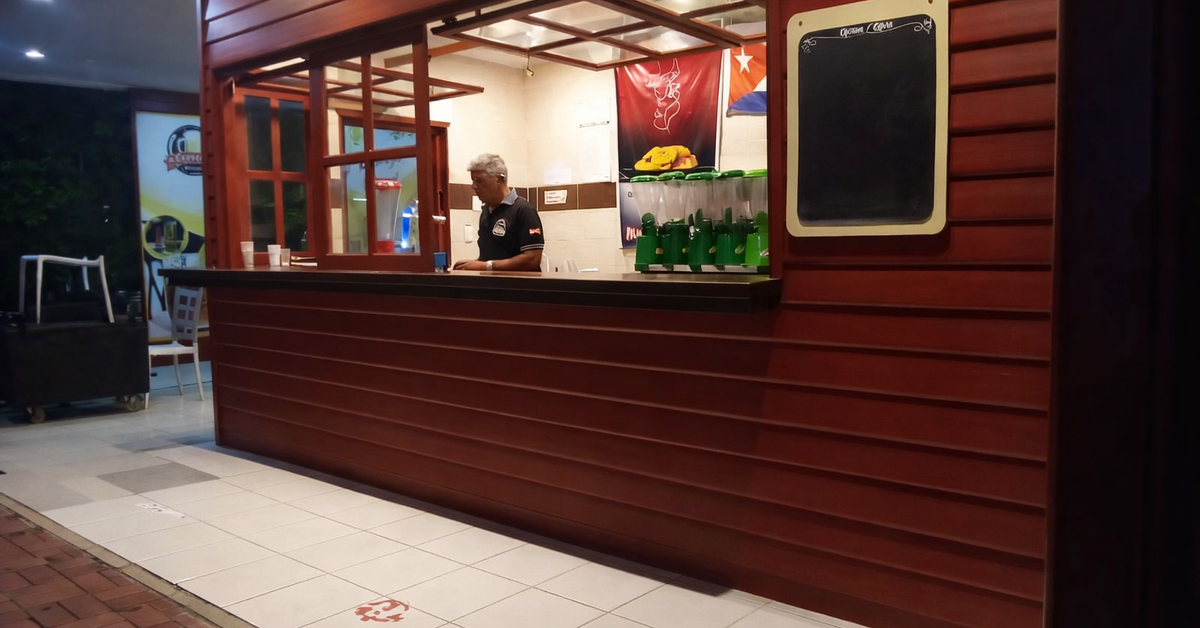
The night images reinforce that feeling of abandonment. In the middle of the walk, a kiosk displays an impeccable bar but its menu board is empty. “At this time we are no longer selling any food, we take out all the processed merchandise until the afternoon,” warns the employee. A few meters away, the cobblestone promenade stretches almost empty, barely interrupted by a couple walking without a clear direction, more to kill time than out of expectation of finding something open.
Ana María arrived at the boulevard with her husband and little son convinced that, at least on a Saturday night, there were options to eat. Reality disorients her. “It is inexplicable that there is only one cafeteria operating,” he says. The menu is brief and uninspiring: mixed skewers at 140 pesos and croquettes at 80. “We had the idea of having dinner in a nice place and it turns out that we are eating some stiff croquettes, in total silence,” she laments, sitting at a table surrounded by empty chairs.
/ 14ymedio
Cocktail lovers, the couple also dreamed of a mojito or a cubalibre served with a certain elegance. “The only thing there is is a piña colada, at 150 pesos,” Ana María complains. The glass is so small that after a couple of sips there is nothing left. Adding to the disappointment is the lack of options for the child: only canned cola, no natural juice. “So it is impossible for one to want to spend the money, among other things because there is nothing to spend it on,” he summarizes.
The scene is repeated a few meters away, where a group of young people gather around a concrete bench. Claudia, 18, usually comes to the boulevard with friends “to see if anyone shows up,” a tourist to talk to or simply to break the monotony. “It’s amazing how everything is deserted,” he says. “Everywhere you go you find the same desolation.” For her, who grew up hearing stories of Varadero full of vacationers, this absence is disconcerting. “I have never seen such a lack of tourists.”
In mid-December, the Cuban Government finally admitted what the partial data predicted each month: the tourism sector had not met its revenue forecasts nor of international visitors by the year 2025. It was the confirmation of a reality that, in places like the traditional tourist centers of the Island, is perceived every day in empty rooms, businesses in crisis and the loss of income for local businesses.
During his speech before the plenary session of the National Assembly of People’s Power, the Minister of Economy and Planning, Joaquín Alonso, presented last month an assessment of what was for years the main engine of the national economy. According to his portfolio’s calculations, the number of international visitors at the end of December would be around 1.9 million people, 73.1% of the state estimate for 2025.
His words resonate as he points to the dark kiosks, reflecting a boulevard as unoccupied as the rooms of some nearby hotels.
According to Claudia, many foreigners do not return to Cuba after facing shortages. “If there are no offers, people leave and never return.” His words resonate as he points to the dark kiosks, reflecting a boulevard as unoccupied as the rooms of some nearby hotels. The drop in clientele not only affects large establishments, it also hits small businesses.
“My mother had a table right here to sell crafts,” says Claudia. He withdrew it because it was no longer profitable. Now she sews purses for others to sell in busier places. Frustration creeps into his voice. As he speaks, a sweeper briefly interrupts the chat to sweep around with a broom and pick up some dry leaves from the ground, one of the few signs of activity in the night.
Further ahead, the walk opens into a garden area. The streetlights illuminate empty benches, huge flower pots and perfectly outlined paths that lead to a nearby hotel, with most of the windows also turned off. Tourism is not only scarce during the day, it also evaporates when night falls.