The government of Venezuela claims to have freed more than 400 people since December 2024, in a release process that intensified shortly before and after the capture of President Nicolás Maduro on January 3 by United States forces.
The measure, presented as a unilateral gesture of peace, has generated both hope and skepticism among relatives, human rights organizations and opposition sectors, which question the official figures and demand the release of all political prisoners.
The president of the National Assembly, Jorge Rodríguez, reported that some 160 releases occurred in December of the year before last, while the rest occurred in the year following the official announcement of the massive release process by the Chavista authorities.
From December 2025 there would be about 300, according to official figures. The most recent, already in the current month and after the capture of Maduro and in the midst of strong pressure from Washington, amount to 116, agency reviews EFE.
According to Rodríguez, the measures have not been applied to “political prisoners,” but to people accused of crimes against the Constitution, among them those who have requested foreign intervention, according to press reports.
“The national Executive began a massive process of release precisely to promote peaceful coexistence,” Rodríguez declared in a parliamentary session broadcast on the Venezuelan parliament channel.
The official insisted that this is a unilateral gesture promoted by the National Council for Sovereignty and Peace, a body created in 2024 to facilitate dialogue with various sectors.
Disparate figures, disputed truth
The official figures are questioned by the opposition and contrast with those offered by non-governmental organizations.
The Ministry for the Penitentiary Service reported 116 releases on Monday, while the NGO Foro Penal confirmed only 56 as of Tuesday morning.
For its part, the opposition coalition Democratic Unitary Platform reports 76, says EFE.
Meanwhile, human rights groups denounce the absence of public lists and the lack of clarity about who has benefited.
The Vente Venezuela (VV) party, led by María Corina Machado, stated that the Venezuelan Government “always lies” and demanded a public list of those released from prison.
Even so, NGOs and relatives of the prisoners raise hopes for their release.
“They definitely see it as hope. But beyond that, it is an opportunity,” said Alfredo Romero, director of Foro Penal, explaining that in recent days the organization received a “flood of messages” from families who were previously afraid to report.
According to Romero, of some 300 recent requests, at least 100 cases have been confirmed as politically motivated arrests.
The death of Edilson Torres and freed opponents
The release process came too late for some. Edilson Torres, a 51-year-old former police officer, died of a heart attack in prison while his family waited for his release.
Torres had been arrested in December under accusations that his relatives described as political. His funeral in Guanare became an act of denunciation and collective pain, with relatives calling for the release of his wife, still imprisoned.
Attorney General Tarek William Saab assured that the case was linked to “criminal activities detected by state security agencies,” without offering details.
Among those who have been released are important names in the opposition: human rights lawyer Rocío San Miguel, who immediately traveled to Spain; Biagio Pilieri, opposition leader linked to María Corina Machado’s presidential campaign; and Enrique Márquez, former electoral authority and presidential candidate.
Likewise, the Italian businessman Marco Burlò was released, who described his arrest as a “pure and real kidnapping” and reported having been completely isolated.
The United States Government, for its part, confirmed that among those released so far there were citizens of its country.
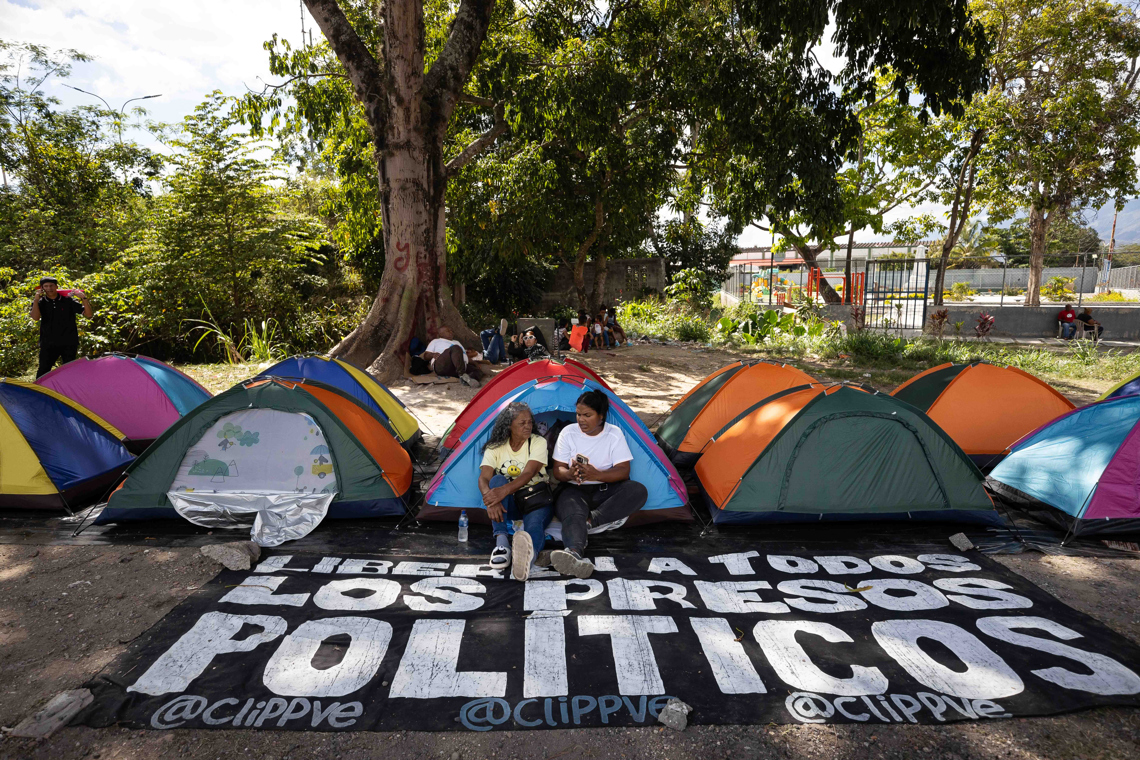
However, opposition and human rights organizations estimate that more than 800 people continue to be detained for political reasons.
Venezuela announces first releases of opponents after Maduro’s capture by the US
International claims
The release of prisoners has also generated reactions outside the country. In Buenos Aires, relatives of Argentines detained in Venezuela demonstrated in front of the former Navy Mechanics School (ESMA), a symbol of state terrorism during the Argentine dictatorship of 1976-1983.
The protesters compared this clandestine center to El Helicoide, headquarters of the Bolivarian Intelligence Service in Caracas, which they described as “the largest torture center in Latin America.”
“It is a symbol of horror, where those who think differently are locked up, tortured and humiliated,” denounced Elisa Trotta, a representative of the Venezuelan opposition in Argentina.
Relatives of those detained demanded the release of all political prisoners and the closure of detention centers.
Opposition demands
The opposition, led by Nobel Peace Prize winner María Corina Machado, insists that the measures are insufficient and demands the release of all political prisoners. This is also what Edmundo González did, considered the winner of the 2024 presidential elections against Maduro.
The United States has also reiterated that demand, accusing the Venezuelan government of using detentions as a tool of political control.
For its part, the official discourse insists that the releases seek to promote peaceful coexistence.
“The actions respond to the permanent efforts promoted by President Nicolás Maduro Moros, aimed at guaranteeing unrestricted respect for human rights. The measure even benefits those compatriots who, after being victims of political and media manipulation by extremist sectors, attacked the sovereignty and institutional stability of the country,” said a report from the network. Telesur.
On the other side of the discourse, analysts point out that the process—at least in its most recent phase—responds both to international pressures and to the current government’s need to rebuild its image after the capture of Maduro by the United States.