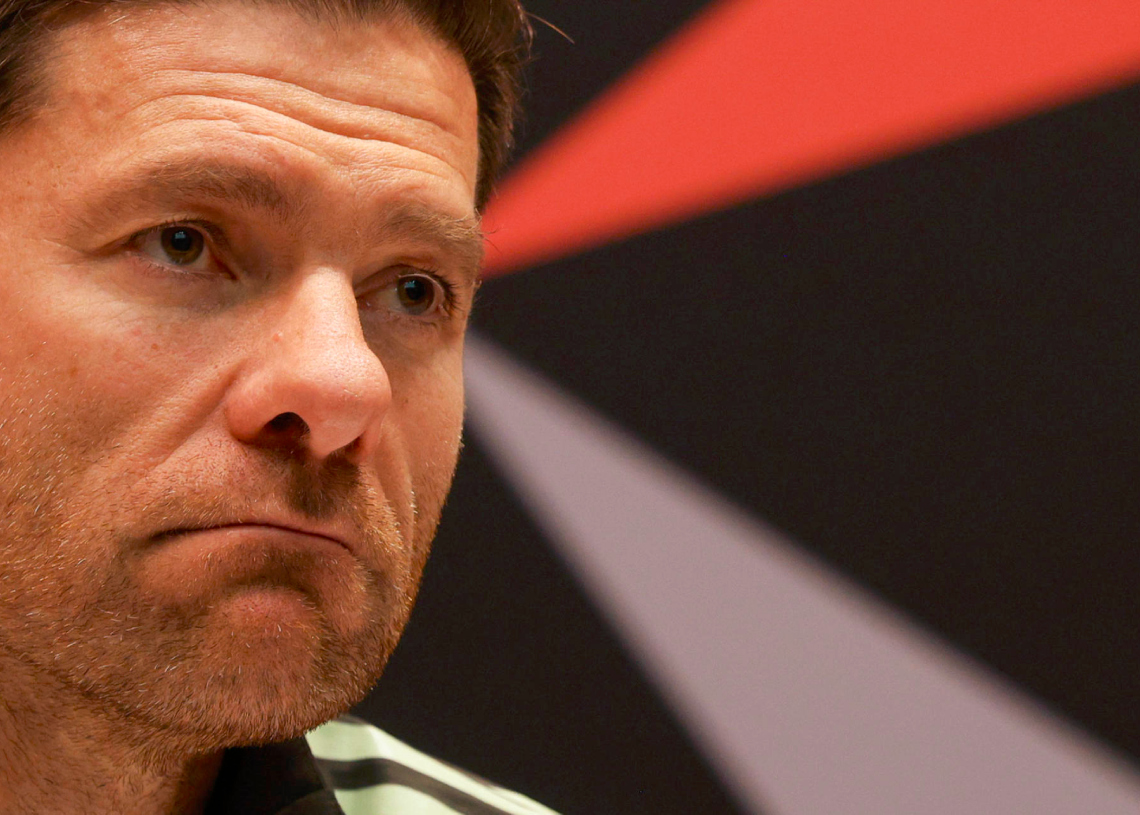
Jordan Díaz, the Cuban-born triple jumper who has jumped the furthest in history, could not believe the dismissal of Xabi Alonso as coach of Real Madrid.
“What???”, the Antillean athlete published between astonishment and disbelief in an Instagram story, where the news of the dismissal of the Tolosa coach and the appointment of Álvaro Arbeloa as the new coach spread like wildfire until breaking the apparent tranquility of the Spanish capital this Monday, January 12.
Still with the wounds exposed after losing the fifth of his last six Clásicos against Barcelona in the final of the Spanish Super Cup, the all-powerful president Florentino Pérez took a sharp turn at the wheel and consummated an idea that had already been spinning in his head for months.
Shortly after six in the afternoon in the Spanish capital, However, that was not enough to counteract the team’s erratic course against the most powerful rivals, the lack of widespread intensity or the tensions in the locker room, which ended up sinking the Basque.
This blow of reality that has now hit Xabi is not a new trend in Madrid, in fact, the list of coaches who have been fired or have resigned during this century is incredibly long.
Don’t you believe me? I invite you to a review of all the names that have ended up killed on the white bench; more than one will surprise.
Vicente del Bosque
After winning the 2002-2003 League and reaching seven titles – including two Champions Leagues – with Madrid in four years, Vicente del Bosque was not renewed to continue leading the white project. His departure occurred alongside captain Fernando Hierro, who was also unable to renew with the club where he had been for 14 seasons. The Whites’ Board of Directors, already chaired by Florentino Pérez, opted for a change of scenery that, in the end, did not go well, since between 2003 and 2007 they only won one Spanish Super Cup.
Carlos Queiroz
He landed as a substitute for Vicente del Bosque from Manchester United, where he was Sir Alex Ferguson’s second. He was in charge of assuming the Madrid bench in that ‘Zidanes and Pavones’ project that combined great stars of world football with products from the quarry. His story did not end well. Although they won the Spanish Super Cup, their train derailed in the League (they were fourth), they lost the Cup final with Zaragoza and fell in the Champions League quarterfinals against Monaco.
Jose Antonio Camacho
He arrived at Madrid in May 2004 and resigned in less than four months after two defeats in six league games. “I think that this team’s performance is not adequate, and I also think that with me as coach it will not improve. That is why I have decided to get dirty,” said the Murcian bluntly when communicating his decision. This was his second spell at the helm of Madrid and, although it may be hard to believe, it lasted longer than his first (summer of 1998), in which he resigned after only 22 days in office.
Mariano García Remón
He was the replacement that Camacho himself proposed after his resignation, but it did not work out in the face of the demands of the Madrid bench either. He took over in September 2004 and by New Year’s Eve he was no longer the coach. Four draws and the same number of defeats in 20 labor matches sentenced him.
Vanderlei Luxembourg
He was the first (and still only) Brazilian coach of Real Madrid. In his first season, despite taking over the dismantled team, he won 16 games in the League (including the Clásico against Barcelona) and finished four points behind the Blaugranas. However, they were eliminated in the Cup by Valladolid and in the Champions League by Juventus. In the following campaign, five defeats in the first 14 league games led to his dismissal in December 2005.
Juan Ramón López Caro
Another interim coach who arrived in an emergency situation and also left through the back door. Of 24 games they only won half (nine draws and three losses), they were eliminated in the Champions League against Arsenal, they finished 12 points behind Barcelona in the League and in the Cup they suffered a resounding 6-1 defeat against Zaragoza in the semifinals. At the end of the course it was not renewed.
Fabio Capello
An old acquaintance of the house (he coached in 96-97) returned to put a heavy hand on the dressing room, but was dismissed after just one season despite winning the first League title for Madrid since the departure of Vicente del Bosque. Their elimination in the Cup (vs. Betis) and in the Champions League (vs. Bayern) weighed too much. His league resurrection was of no use: of the last 17 rounds he only lost one (vs. Racing) and of the last 12 he won ten, with some spectacular comebacks included against Sevilla, Espanyol, Recreativo, Zaragoza and Mallorca.
Bernd Schuster
They arrived and won the 2007-2008 League with almost 20 points ahead of Barcelona, but began to accumulate disappointments. Eliminated in the Champions League (vs. Rome) and Cup (vs. Mallorca) and defeated in the 2007 Spanish Super Cup (vs. Sevilla), the German was on the brink of the abyss until he was dismissed in December 2008 after failing to win in six of his first 14 league games and being eliminated in the Copa del Rey against the modest Real Unión. He only lasted a year and a half in office.
Juande Ramos
A little less than 24 hours after taking over as coach of Real Madrid, he made his Champions League debut with a 3-0 victory over Zenit St. Petersburg, but in his first league game he lost 2-0 at the Camp Nou against Barcelona. Although he later linked a chain of 18 games without losing (with 17 wins) in the domestic competition, he was struck down in the Champions League by Liverpool, with a shocking 40-0 win at Anfield. To top it off, they lost the second Clásico of the season with the unforgettable 2-6 at the Bernabéu and added five consecutive defeats at the end of the League. After these results, he did not have any opportunity for renewal.
Manuel Pellegrini
“The Engineer” arrived in Madrid in the middle of a revolution that also brought Cristiano Ronaldo, Kaká, Benzema, Xabi Alonso, Albiol, Arbeloa and company. It was a spectacular transfer window, one of the most impressive in memory. With that arsenal, the whites scored more than 100 goals and achieved 96 points in the League, but they could not surpass Pep Guardiola’s Barcelona, champions with 99 points. Pellegrini sealed the season without titles, because he lost in the Champions League round of 16 against Lyon and in the Copa del Rey he suffered a scandalous defeat (4-0) against Alcorcón. Those outcomes struck him down and he was fired as soon as the course finished.
Carlo Ancelotti
Ancelotti will forever be one of the most successful coaches in football and in Real Madrid, but that was not enough to avoid his dismissal in 2015, just a year after winning La Décima in Lisbon with that legendary Sergio Ramos header in stoppage time. The following season, Madrid lost the Spanish Super Cup against Atleti, who also eliminated them in the Copa del Rey, and in the League they finished second, two points behind Barcelona. To top it all off, they lost in the Champions League semi-finals against Juventus. It was of little use to Ancelotti to win the European Super Cup and the Club World Cup, because he was fired to make way for Rafa Benítez.
In his second stage (2021-2025) with Madrid, the Italian triumphed again with 11 titles: two Leagues, two Champions Leagues, two European Super Cups, two Spanish Super Cups, one Copa del Rey, one Club World Cup and one Intercontinental. His departure occurred by mutual agreement in May 2025 to take over as Brazil coach.
Rafa Benitez
Rafa Benítez’s Madrid had a start to the season at cruising speed, undefeated in the group stage of the Champions League with 19 goals in six games and without defeats in La Liga in the first ten games. However, consecutive setbacks against Sevilla and Barcelona (0-4 win at the Bernabéu) began to raise doubts about the Spanish coach’s project, who to make matters worse was eliminated in the Copa del Rey against Cádiz due to the improper alignment of Denis Cheryshev. That spiral struck down Benítez, fired at the beginning of 2016 when he was third in the League.
Zinedine Zidane
The hasty departure of Rafa Benítez heralded a disastrous season (15-16) for Madrid, but the arrival of Zinedine Zidane changed the team’s course. The Frenchman took the team in third position in the League, but in the following 20 days he achieved 16 victories, 12 of them consecutive to close the championship in second place, just one point behind Barcelona. Their impact was even more notable in the Champions League, in which they beat Roma, Wolfsburg and Manchester City in the elimination rounds, and then defeated Atlético de Madrid on penalties in the final. That was the beginning of a dynasty that included three European crowns in a row.
After winning nine titles between 2016 and 2018, Zidane resigned as coach of Real Madrid and Cristiano Ronaldo also left with him, closing a glorious and, most likely, unrepeatable cycle. However, less than a year later he came to the rescue again on the Merengue bench. In that second stage, which started in March 2019, he won a League and a Spanish Super Cup, but ended up resigning again in May 2021.
Julen Lopetegui
Julen Lopetegui was in charge of taking over from Zidane. which was known just when he was about to make his debut with Spain in the 2018 World Cup in Russia. That led to his immediate dismissal from the national team, so his first steps in Madrid did not take place in the best of environments and that was noticeable. In August they lost the European Super Cup against Atleti and in the first ten days of the League they only achieved four victories. A streak of five consecutive games without winning, including a 5-1 win against Barcelona, wiped out Lopetegui, who was already out of Madrid in October.
Santiago Solari
Solari was named interim coach of Real Madrid at the end of October 2018 and, like Lopetegui (his predecessor), he did not last even five months in office. Although they won the Club World Cup in Abu Dhabi, they suffered two tough eliminations in the Copa del Rey and the Champions League, in both cases beaten in the return matches at the Bernabéu: 0-3 against Barcelona and 1-4 against Ajax. Those failures and his erratic progress in the League led to his dismissal in March, opening the door again for Zidane, who this time failed to make up for the disaster by finishing third in the League for the second consecutive season.