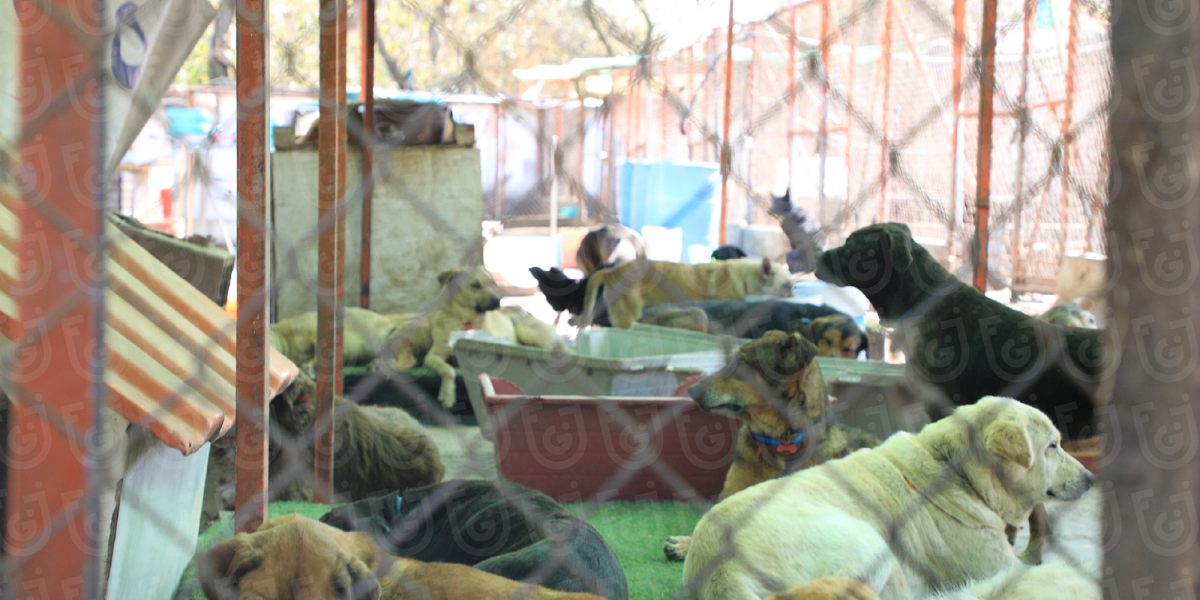
The dispute over a property located in the Santa Fe area, in the Cuajimalpa mayor’s officewhich during his lifetime the philanthropist Antonio Haghenbeck gave as loan to the Franciscan Foundation and which in his will ratified the possession in his favor, with the condition that it should always be dedicated to the protection of animals, led to the eviction of 759 dogs and 39 cats.
Furthermore, it exposed the problem represented by the abandonment of pets and the vulnerability to which they are exposed.
This lawsuit is carried out, on the one hand, by the Franciscan Refugewho operated the shelter and Haghenbeck Foundationwhich in November 2020 sold the property of just over 16 hectares for 650,000 pesos to Banco Ve por Más, in its capacity as trustee of administration trust number 303.
According to the Shelter’s lawyer, Fernando Pérez Correa, the new owners of the property have obtained authorization from the authorities of Mexico City for more than 300 homes and offices to be built there.
Antonio Haghenbeck y de la Lama, who died on September 4, 1991, established two foundations to which he bequeathed all his assets so that his altruistic work could continue. The first is the Antonio Haghenbeck y de la Lama Foundation, IAP, executor and universal heir of his fortune, intended for the protection of the elderly and the conservation of wild and domestic fauna in Mexico.
The second is the Antonio Haghenbeck y de la Lama Cultural Foundation, IAP, which he created with the objective of establishing three museums in the buildings he lived in during his life, which are the Casa la Bola, the Hacienda Santa Mónica and the Hacienda San Cristóbal Polaxtla.
In 1991, the philanthropist gave the then director of the Franciscan Refuge, Ita Osorno, a land of 163,000 square meters, located at kilometer 15.5 of the Mexico-Toluca federal highway, in what is now the Cuajimalpa mayor’s office, which had already been physically delivered in 1971.
In the legal act in which the award was made, it was established that the property would remain indefinitely in possession of the shelter as long as it was maintained as a shelter for animals.
In his will he established that all his assets would be used for animal care and ratified that the Cuajimalpa land would remain in possession of the shelter.
He appointed Josefina González Polo as responsible for monitoring the fulfillment of his last will.
When the foundation began operations, Carmela Rivero was appointed treasurer, who years later assumed the presidency of the foundation and removed Josefina González Polo and Ita Osorno from it.
According to a story by journalist Ricardo Raphael, in 2020, the board of trustees of the Haghenbeck Foundation transferred ownership of the land where the Franciscan Refuge is located to a bank trust.
According to a document from the General Directorate of the Public Registry of Property and Commerce of Mexico City, on November 10, 2020, the foundation, represented by Verónica Blanco González and Carmela Rivero Jiménez, sold, delivered and transferred to Banco Ve por Mas, in its capacity as trustee of the Trust, the ownership of the property of just over 16 hectares where the hostel is located, for a price of 650,000 weights.
The directors of the Franciscan Shelter began litigation to avoid being dispossessed of the property and in 2021 Carmela Rivero, president of the Foundation, initiated a civil lawsuit with the intention of terminating the bailment through which the shelter had possession of the property. The Sixth Civil Court ruled in favor of the Foundation and Carmela Rivero, but the Franciscano Shelter filed an appeal against the judge’s decision.
Later, in 2022, there was an agreement between the parties in conflict according to which the shelter would deliver the land in exchange for the Foundation to use a property located in Texcoco, State of Mexico, as a shelter. The foundation did not do its part.
Last December, the Foundation got a judge to agree with it in the first instance and executed a court order that was not final, since the time in which the Franciscan Refuge could appeal had not yet expired.
According to the lawyer of the Franciscan Shelter, Fernando Pérez Correa, the people who were in the property were violently removed.
The Government of Mexico City reported that on December 7, it carried out an operation, in compliance with a court order, which led to the seizure of 858 dogs, which were transferred to three shelters.
Specifically, 304 dogs were transferred to the Ajusco Shelter; to the Animal Brigade, in Xochimilco 371 and to the temporary shelter set up in the Utopia of Deportivo Hermanos Galeana in the Gustavo A. Madero mayor’s office, 183 dogs.
According to the capital government, the conditions that motivated the intervention in the Franciscan Shelter were overcrowding, unsanitary conditions, lack of timely veterinary care and absence of sanitary control.
In this regard, the shelter’s lawyer, Fernando Pérez Correa, stressed that since December 10 the foundation had control of the shelter and did not let anyone from the shelter staff enter and gathered the animals regardless of their condition and did not clean the cages, which, according to him, served to create a panorama of alleged evidence of irregularities in the treatment of the animals.
He said that on December 23 they obtained a resolution of protection ordering the return of care and possession of the property to the Franciscan Refuge, which was not complied with. In addition, another resolution establishes that the shelter must receive a report on the condition of each of the animals that were stolen from the property, which has not been complied with either.
- For its part, the Attorney General of Justice of Mexico CityBertha María Alcalde, stated that in December numerous visits were made to the shelter in which experts specialized in veterinary medicine participated, who reviewed the animals, the environmental conditions and the management practices.
“What the experts documented was serious; their technical opinions are compelling and that is why we made the decision to request judicial authorization to relocate the animals.”
Meanwhile, activists whose cause is the defense of animals have demonstrated in the streets to demand the restitution of the space to the shelter.
They reported that the animals taken to the Hermanos Galeana sports complex remained in transporters. They demanded that adequate conditions be guaranteed so that their integrity is not put at risk.
In response, the Head of Government, Claudia Brugada, called on the people who demonstrated against the eviction of the shelter. “No animal rights activist could be defending what was happening in the Franciscan shelter.”
500,000 dogs are abandoned annually in CDMX
An academic analysis carried out by academics from the Metropolitan Autonomous University highlights that in the project titled “State of pet homelessness”, the countries with the highest percentage of dogs and cats on the streets are Indonesia, India, Greece and China, while Mexico is positioned in seventh place with 18.8 million.
They also indicate that the Environmental and Territorial Planning Office estimates that 500,000 dogs and cats are abandoned annually in the country’s capital alone and, monthly, 10,000 of them are sacrificed.
They say that among the main reasons why these numbers continue to grow day by day, one of the most important is the fact that their guardians abandon them on the streets.
In the document “The Dog in a street situation: environmental pollution and Public Health”, prepared by academics Daniel Mora, Karina Lezama and Adriana Domínguez, among others, indicate that the overpopulation of stray dogs has grown due to the little or no education that exists regarding responsible ownership of pets; the little or no application of animal protection laws; the poor control of the indiscriminate reproduction of these animals; the little education in responsible ownership by guardians; the lack of permanent sterilization campaigns, among others. others.