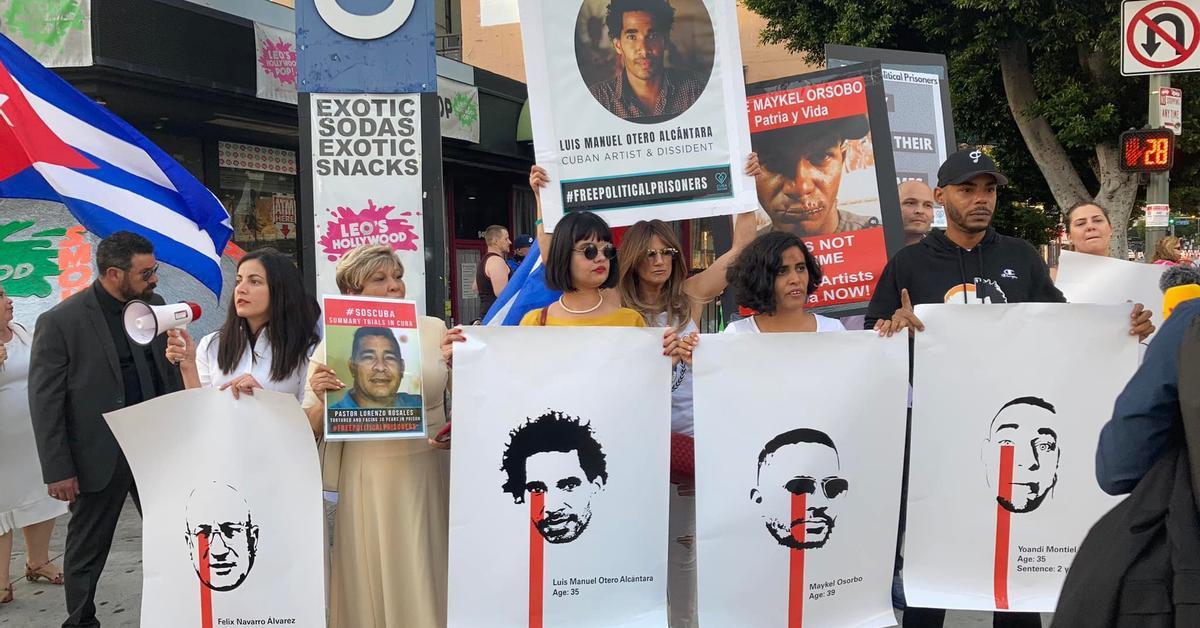
Havana/Activists, independent journalists and relatives of prisoners are calling on the Cuban regime to “immediately and unconditionally” release “all” people who are in prison for political reasons in the country, replicating what Venezuela and Nicaragua have done in recent days.
In a statement published this Monday and signed by more than 270 people, the activists recall that Venezuela and Nicaragua They have launched a process to release political prisoners, so, “in that context, Cuba cannot continue to be the great absentee.”
“Although these announcements are produced in the opaque and manipulative rhetoric typical of authoritarianism, they once again place an inalienable demand on the regional agenda: the freedom of those who have been imprisoned for exercising their rights,” the text highlights.
The signatories add that, with a population of less than 10 million inhabitants, “the country has more than 1,000 people (1,197, according to Prisoners Defenders) who have been imprisoned for political reasons in recent years, a disproportionate and alarming number that continues to be minimized or relativized by large sectors of the international community.
The country accumulates more than 1,000 people (1,197, according to Prisoners Defenders)
Given this, they accuse Cuba of continuing to “benefit from an inadmissible international tolerance, sustained by decades of propaganda and the lack of a firm and coherent political response to the magnitude of the repression”, which is why they demand that from all over the world “the immediate and unconditional release of all prisoners be demanded in a public and sustained manner” and “the definitive cessation of the criminalization of dissent.”
In their message they remember that, last year, during the last days of Democrat Joe Biden’s Administration in the United States, Cuba released to 553 people as part of an agreement between Havana and Washington, mediated by the Vatican.
The process was criticized by different Cuban and international human rights NGOs, which considered that the measure was “opaque, incomplete, unfair and fraudulent.” An example of this were the cases of Jose Daniel Ferrer and Félix Navarro, who were released, but shortly after the Supreme People’s Court revoked their releases. They also point out that more than half of those released at that time were ordinary prisoners and not prisoners for political reasons.
Among the people who subscribed to the text are 20 direct relatives of Cuban prisoners, historical dissidents such as Ferrer himself and Martha Beatriz Roque, former prisoners of the group of the planted (opponents who refused to wear the prison uniform), activists from organizations such as Justicia 11J and artists such as Tania Bruguera. Of that group, at least a dozen appear on the national list of terrorists prepared by the Cuban Government.
Of that group, at least a dozen appear on the national list of terrorists prepared by the Cuban Government.
The same day he also issued a statement demanding the release of the D Frente political prisoners, one of the main opposition platforms in Cuba. In a statement this Monday, he asked the Government to immediately start a “national political negotiation.”
He indicated that, for this process “to be verifiable and acceptable to the people and the international community,” at least four points must be met: “The total release of political prisoners, without exceptions or conditions; the cessation of political repression and an end to the criminalization of dissent and civic protest; legal recognition of all political and social forces, without ideological exclusions; and a call for plural elections, under a provisional electoral law that guarantees transparency and equal conditions.”
In its positioning, D Frente pointed out that “Cuba is going through an unprecedented national crisis today,” which has led the country to be at “a critical threshold.” For this reason, he said, “it is imperative to understand that it is time to return the country, definitively, to the Cubans, under penalty of losing the nation forever,” since “history does not usually offer second chances when the survival of a nation is at stake.”