For decades, in the presidential house of Los Pinos, in the greenest, most exclusive and guarded corner of the first section of Chapultepec, a collection of modern and contemporary art grew up signed by great surnames from the Mexican art circle whose appreciation, due to its origin, was the privilege of a tiny number of people.
Today, the Los Pinos Cultural Complex is able to show all the works that were made specifically to inhabit one of the presidential houses and that are now galleries of this cultural venue open to the public.
The first floor of the Miguel Alemán House, which was inhabited by many of the presidents of the second half of the 20th century and until 2018, receives the exhibition with an extensive title: Painting and sculpture in the heritage collection of Mexico: Panoramic for a usufruct and our creative confirmations.
It is made up of 67 pieces, including works on canvas and sculpture, the core of which are the works commissioned to decorate that presidential house from artists such as Luis Nishizawa, Vicente Rojo, Rafael Cauduro, Francisco Toledo, Julio Galán, Pedro Friedeberg, Arnaldo Coen, José Luis Cuevas and Jorge Yázpik, among others.
Added to the above are pieces from the Payment in Kind Collection of the Ministry of Finance and Public Credit (SHCP), among them, by Joy Laville, Alberto Castro Leñero, Beatriz Zamora, Gilberto Aceves Navarro, Jazzamoart and Javier Marín.
A selection of textile works from the collection of the National School of Painting, Sculpture and Engraving “La Esmeralda” is also integrated, with pictorial works by Pedro Preux and Rodolfo Nieto, as well as equestrian scenes by Ernesto Icaza. The same happens with a selection of pieces from Cencropam, by artists such as Manuela Generali, Marysole Wörner Baz, Gerardo Murillo Dr. Atl and Manuel Marín.
Rediscover a great painter
The exhibition, already strengthened by great artists of the 20th and 21st centuries, helps another of the objectives set by the artist and curator of Los Pinos, Guillermo Santamarina, who was in charge of the details of the exhibition. The exhibition, he commented, helps to vindicate other creators who did not have the reverence they deserved.
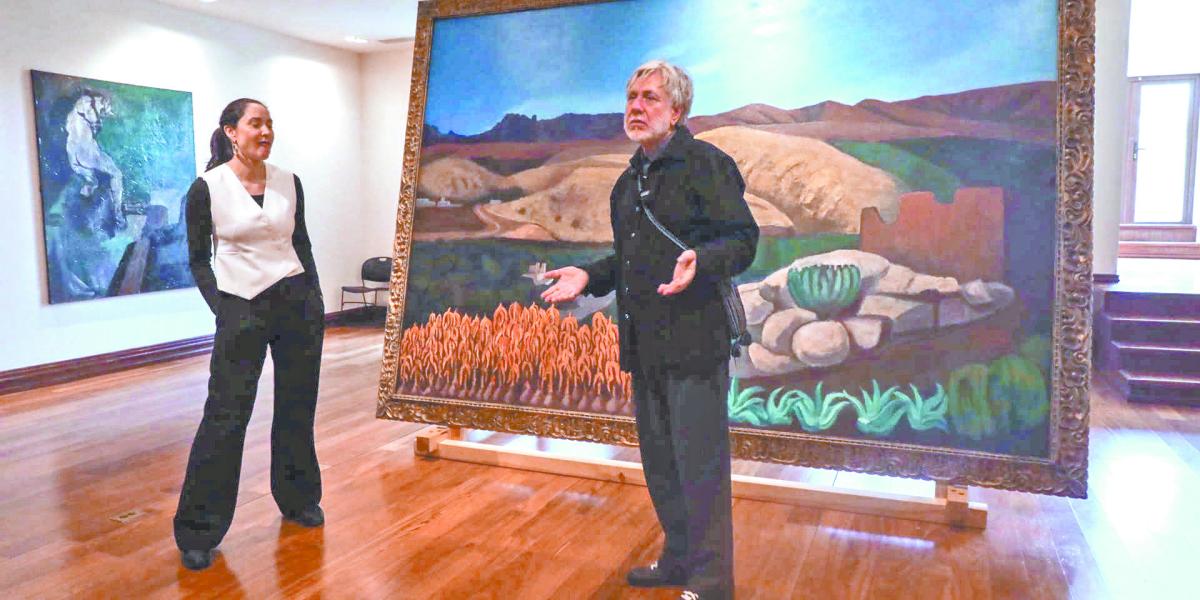
For example, he explained that within this powerful catalog of work, the oil painting “En la mira” (1993) by the Coyoacan painter Cordelia Urueta stands out, whose piece is part of the collection of the Los Pinos Cultural Complex and was made at the age of 87, expressly for the presidential residence, two years before her death.
“I believe that this is one of the great works of the national heritage collection. Cordelia Urueta is one of the great painters, for whom the history of art has postponed its recognition. It is one of its great values. In local history it is just beginning to be recognized. For a long time it was highly appreciated by theorists, by the academies and, above all, by the artists themselves, by the painters, but its full recognition has been delayed,” said Santamarina during a tour of the exhibition accompanied by the secretary. of Federal Culture, Claudia Curiel de Icaza, two days after having been inaugurated.
The catalog titled Los Pinos Cultural Complex. The official residential collection includes Urueta’s work in its list of works about which it extends details: “A contemporary of hers and a prestigious voice from the State, Margarita Nelken and Jaime Torres Bodet, were the first writers in Mexico who warned of Urueta’s worth. For her part, she always said she was indebted to Tamayo’s painting, although not as his disciple or follower.”
For Urueta, the text adds, “art is a tool to resolve a conflict between the brutality of the outside world and the fragility of one’s own sensitivity. Modest, she disdains the notion of creative genius and points out that the author does not create, but only serves as a way for the mystery that is art to be revealed in each painting.”
Several generations of artists
The federal Secretary of Culture, Claudia Curiel de Icaza, present during the presentation of the exhibition, shared:
“Since last year I asked Guillermo Santamarina, who already worked here and had organized many exhibitions, to build one to recover several works from the archive that only the presidents saw at that time, because ultimately it is the country’s heritage. It has nothing to do with an officialdom, but with a generation of artists.”
And Santamarina added that the exhibition, on the other hand, aims to explore “an aesthetic concern very close to what what they call neo-Mexicanism could be, but that moves more in time, to a form of representation (of what is Mexican) that at that time was relevant for several generations of artists, not just one, who were very focused on identity. Of course, there is also abstraction, it is representation and realism. I tried to transfer this exhibition to contemporary interests, that is, to the social pronouncements of the present.”
Earlier this Monday, Claudia Curiel de Icaza led a conference to announce the delivery of the Guinness Record certificate as the largest embroidery and textile exhibition in the world for the exhibition with the same name that occupies the ground floor of the Miguel Alemán House and which is made up of 3,809 textile pieces made by more than 200 artisans from the 32 states of the Mexican Republic.