The chronic lack of supplies for the manufacture of eyeglasses in Cuban state opticians has led to the fact that they can only be purchased in private establishments.
SANTA CLARA, Cuba. – When she was only three years old, Rosamary García was diagnosed with progressive myopia that forces her to renew her glasses almost annually. Last month he managed to “solve” a new refraction exam at the Santa Clara Children’s Hospital and, since then, he has been raising the money he needs to pay for prescription glasses at a particular optician.
“Since my myopia is so advanced, mine are worth more than those of other people with farsightedness or astigmatism, not counting the frame, because I am going to recycle the same one I had,” laments the medical student whose parents, who “work with the State,” cannot cover the figure of 12,000 pesos that her glasses cost, not even combining their two full monthly salaries. “I thought about adapting to contact lenses because they last longer, but they are much more expensive and they are only charged in dollars or euros,” adds Rosamary.
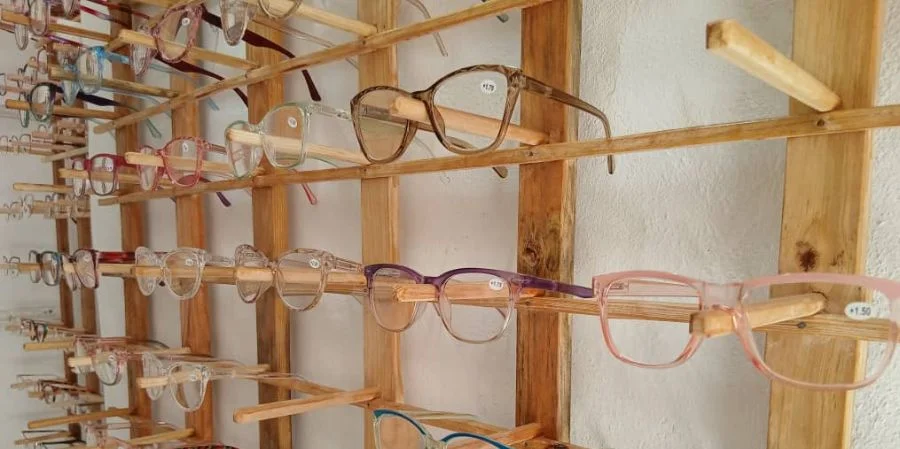
The chronic lack of supplies for the manufacture of eyeglasses in Cuban state opticians has led to the fact that they can only be purchased in private establishments that sell them, either previously graduated or with the specific prescription (they are ordered from clinics located mainly in Mexico or Panama). Only in the center of Saint Clare There are more than seven businesses of this type with prices that vary depending on the dollar rate in the informal market.
“Ours are ordered to be made in Bolivia; that’s why it can take more than 15 days to enter Cuba,” explains Yumia, a young salesperson at one of these stands selling prescription eyeglasses. “The person comes with their prescription and chooses their armor. We always tell them that we are not responsible if the graduation was poorly done,” he warns. “We have had clients who have had a poor measurement job done at the same hospital and have lost their money, because when they try them on they don’t see well in them.”
Many of these establishments offer the service by charging in advance a part of the total amount, which is completed after the delivery of the lenses, and which can vary depending on the complexity of the prescription and the cut. High prescriptions or special crystals usually increase the final price and lengthen delivery times. Some eyeglasses even exceed 15,000 CUP. Also on sale are those that correct farsightedness or presbyopia, commonly known as “close reading” glasses.

“The problem is not the 800 pesos that mine cost, with a grade of +1.75, because you make the effort and buy them,” says Iván Évora, a construction retiree looking for his own. “They come out very bad and, when you come to see, in a year you have to buy more than three pairs. I’ve been told that out there they don’t even cost a dollar, but I don’t have anyone to send them to me,” he laments.
In another of these establishments, located very close to the state optician’s office in the province, they order them from a Mexican laboratory. “Some of the more common graduations we already have here and others do have to be sent to be manufactured,” explains José Alberto, a nursing graduate who manages orders in his free time. “They are expensive, yes, because the equipment is not here around the corner. At least we solve a problem, because if not, people would walk around blind,” he explains.
One of the clients that morning paid 5,000 pesos for the initial payment of a pair of glasses for her 10-year-old son who suffers from myopia and astigmatism, two eye problems that cause unbearable migraines and loss of balance. “I had to ask the family for help to, little by little, complete the money, the 9,000 they asked me for,” says the woman who says she works as a bank teller. “In the meantime, I’ll have to send him to school with the pair he has now, with one of the glass cracked. For all of these, I’m crossing my fingers that they last the entire school year and don’t break again.”
Although in Cuba it is not allowed to legally practice as a private optometrist, the existence of specialists who offer the service on the left is known. “The same thing happens with glasses as when you go to have surgery in a hospital. Even getting your eyesight tested is a problem because there are queues that sometimes last for months and, if you don’t have a friend to help you, you’re stuck,” says Rosamary. “My myopia cannot be operated on, so the expense on glasses seems like it will be for life.”


Although state media have admitted that opticians in Cuba present a bleak picture, they do not even question how an essential health service ends up being inaccessible for the majority of Cuban workers and retirees. The few mentions of the subject in the official press tend to blame “new forms of non-state management” for the high prices, except when it comes to cases in which they receive certain benefits from those same private companies. Last February, the newspaper Havana Tribune promoted on its website a “local development project” that provides eyeglasses “for free” to high-performance athletes. As the media explained, the optician can afford to cover such expenses because it acquires “raw materials through foreign importers.”
Meanwhile, the majority of state opticians are practically in disuse, with staff drains, broken equipment and no spare parts. Just five years ago, an official from the Municipal Pharmacy and Optical Company in Isla de la Juventud recognized that the situation of the optics program in the country would continue to be critical, with shortages at that time of up to 300 stock prescriptions nationwide. From that time to date the scenario looks much worse.
At the Santa Clara optician’s office, in a place that looks similar to a ghost facility, the man who attends to the few staff who come to ask questions this week assures that, although “a small amount of glass” came in last August, they lasted only days and were for small graduations, which does not apply to progressive myopia. To make matters worse, armor of any kind has not been received for a long time. Right in the adjacent store, where they are supposed to repair glasses for those who cannot afford to replace theirs, a sign clearly announces that they do not have welding either.