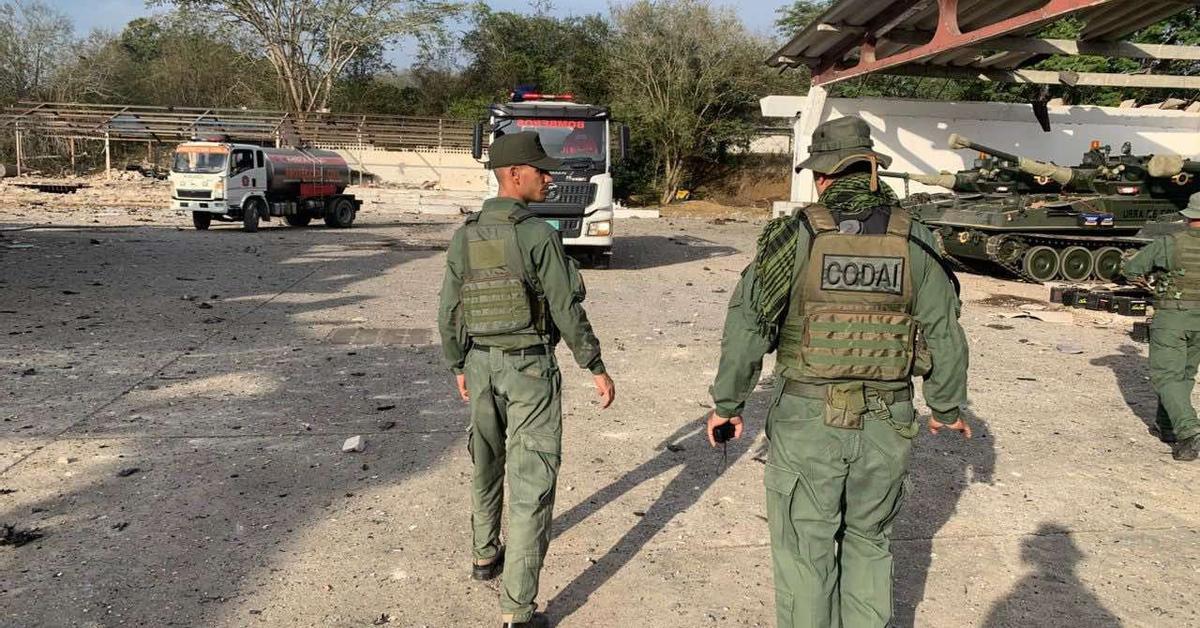
Madrid/A week has passed and still nothing is known about the whereabouts of the Cuban soldiers who survived the US attack on January 3 in which Nicolás Maduro was captured.
A report of Cuba Archivepublished this Sunday with the signature of María Werlau, attempts to fill in the gaps in the official information and casts doubt on the toll of 32 deaths among the Cuban members of the Venezuelan president’s security ring.
“The dead and wounded Cubans in Maduro’s security escort belonged to a contingent – supposedly 140 troops – from the Personal Security Directorate of the Ministry of the Interior of Cuba” and other divisions of that same ministry, in addition to members of the Armed Forces who “provided support of various types and in other parts of Fort Tiuna and other targets of the US bombings,” the text indicates.
The document quotes Venezuelan journalist Casto Ocando, based in Miami, who “has reported that US forces had orders to neutralize – and annihilate if necessary – all Cubans who, according to infiltrators, had instructions to kill Maduro to avoid his capture.” It had already been pointed out that the 32 casualties recognized in Havana did not seem to correspond to the military deployed around Maduro, since the majority were high-ranking intelligence officers and too old to have this type of task. These are probably personnel who were sleeping in other nearby facilities.
Some were saved, like Euclides Bandera, who allegedly told his family that nothing happened to him because “he was not where he should be.”
Cuba Archive does not provide new details on this point, but it does point out that there must have been many wounded and “possible captured” people, who, according to other sources, were taken to the US naval base in Guantánamo to be interrogated.
Apparently, some were saved, such as Euclid Flaglieutenant colonel of the Cuban Military Counterintelligence, who allegedly told his family that nothing happened to him because “he was not where he should be.” According to information from independent media, the soldier still serves in Venezuela, where he earns about $6,000 a month.
The report is not limited to providing new details about Cuba’s military operation in Venezuela, but also warns that, despite the success of the US military operation, we cannot lower our guard regarding the “capacity for interference and survival” of the Havana regime, which continues to represent “a political and regional security risk with global implications.”
The events of October 3 revealed “the vulnerability of a security apparatus designed and supervised by Cuban intelligence.” However, the Cuban presence in Venezuela continues to be overwhelming, as indicated by the data provided by Arturo López-Levy, former advisor to Fidel Castro, who recently evaluated it at around 20,000 people, including all types of workers – political advisors, doctors, teachers and others who appear on the payrolls of different ministries – to which must be added between 5,000 and 6,000 military and intelligence officers. Although Archivo Cuba quarantines this data, because it comes from a “subliminal spokesperson for desired narratives of the Cuban regime,” it suggests that it cannot be ignored.
In any case, it is true that, with the drastic reduction in oil revenues as a result of the drop in production, Havana had already withdrawn part of its personnel in Venezuela. Cuba Archive, based in Miami, refers to a previous report –2019– in which it mentioned the “controlling presence of all spheres of Venezuelan society, including the presidency – whose security Cuba has controlled since 2002 – the armed forces, the security apparatus, the ministries, the immigration and foreigners service, the electoral authority, telecommunications, airports, ports and border crossings, state industries and companies – including PDVSA –, notaries, the management of computer systems and databases and cyber surveillance.
The events of October 3 revealed “the vulnerability of a security apparatus designed and supervised by Cuban intelligence”
The report recalls that “during the petrodollar boom, flows to Cuba [desde Venezuela] were estimated at 10 billion dollars annually.”
In 2012, the document reviews, Hugo Chávez – allegedly captured by Maduro when he was in prison to lead the country on behalf of Fidel Castro – specifically indicated that there were 44,804 Cuban collaborators in the “social missions”, 31,700 from the health sector, a figure consistent with the version of the Cuban authorities, who indicated with less precision that there were “about 45,000 on those dates.” Thirteen years later, in June 2025, the Cuban News Agency estimated there were 12,930 medical “collaborators” in 24 states of Venezuela, 54% of the 23,947 it had worldwide.
Other data that appears in the report is the use of Cuban Santeria by Castro, knowing how superstitious Chávez was. This would have served to, presumably, manipulate him and people in his circle, in a “form of religious-cultural colonialism used to collect intelligence, manipulate perceptions and dispositions, weaken established religious institutions and customs, change values and advance cultural hegemony.” This would have diminished with the death of former President Chávez.