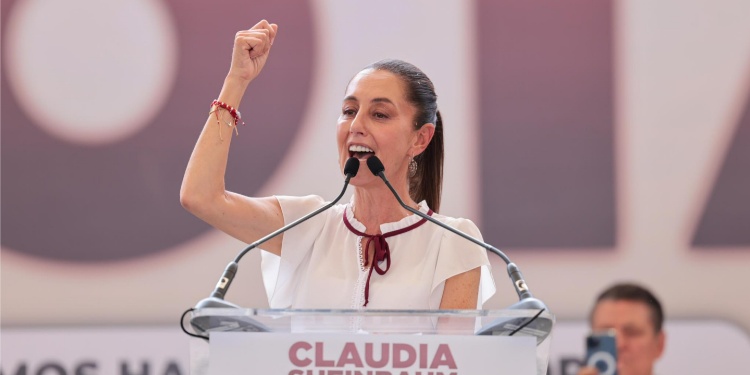
According to Ricardo Pascoe, former Mexican ambassador to Cuba, President Sheinbaum is becoming a “paladin of the radical left.”
LIMA, Peru – Ricardo Pascoe, Mexican diplomat and former Mexican ambassador to Cuba between 2000 and 2002, offered statements this week about the relationship between both countries in the midst of the current context, marked by the capture of Maduro and the crisis of the Chavista regime.
According to the diplomat, by defending the former dictator and positioning itself alongside the bloc of non-democratic states in the hemisphere, the Government of Mexico is putting its commercial and political ties with the United States at risk.
In Pascoe’s opinion, President Claudia Sheinbaum is becoming a “paladin of the radical left, where Mexico is a prisoner of the Morenoist ideology” at the sacrifice of the national interest.
“She (Sheinbaum) is surrounded by Cuban advisors (…) in the National Palace and they are obviously putting pressure on and are a fundamental factor for Mexico to attempt this, this ideological shift towards Cuba,” highlighted the former ambassador.
Pascoe assured that the relationship between the Havana dictatorship and the Aztec country is ideological, now also based on Cuba’s dependence on Mexican crude oil.
“We are the main supplier of gasoline to the Island for a company, the Mexican Pemex, which is completely bankrupt, by the way. That is the company that is paying at this moment for the Cuban economy,” he stressed.
This link would be placing Mexico in “a very delicate geopolitical situation” in the face of the Trump administration, the diplomat believes, also placing the nation at a disadvantage just months after beginning the USMCA negotiation with Washington.
“This completely contaminates the negotiation, this changes the terms of Mexico’s relationship with the United States. Yes, it puts us at risk with our main trading partner.”
Likewise, Ricardo Pascoe detailed the initial nature of the commercial agreement between the state-owned Pemex and the Castro regime, describing it as a revolving loan that in recent times has evolved into mere donations without remuneration.
“It is complicated because Cuba always had a line of credit with Mexico and through that line of credit it paid us a part, which was the oil that was sent to it, but Cuba returned a part of the credit and its interest and Mexico lent it money again,” he said.
According to their statements, there was a causal relationship “that worked” between the receipt of oil support and the payment of the money that was made through the Banco Exterior de México. However, that is no longer the mechanism that exists because former Mexican president Enrique Peña Nieto canceled the total debt of Castroism.
“He saw the debt as canceled because in reality the Cubans had already stopped paying. And then throughout López Obrador’s six-year term, they were pure donations and obviously with Scheinbaum it is exactly the same,” added the former ambassador.
In contrast to Pascoe’s position, last Wednesday during his usual morning conference, Sheinbaum denied that Mexico is sending more oil to Cuba than it has sent “historically.”
Shortly before, the Financial Times had reported – with data from the Kpler firm – that Mexico exported an average of 12,284 barrels of oil per day to Cuba in 2025, equivalent to about 44% of the island’s total crude oil imports, and that Venezuela was behind with 9,528 barrels per day.
In May 2025, Petróleo Mexicanos (PEMEX) increased its crude oil shipments to Cuba in 2024 and its subsidiary Gasolinas de Bienestar exported 20,100 barrels per day of crude oil and 2,700 barrels per day of petroleum products that year, for an amount equivalent to 600 million dollars, according to the company’s annual report before the United States Securities and Exchange Commission (SEC).
At that time, “several sources” they told the Reuters agency that the shipments were made as donations, but that PEMEX recorded them as sales in its reports.
The Mexican Government has not presented a detailed and comparable historical series that would allow us to accurately determine whether current volumes do not exceed those of previous administrations. Sheinbaum assured this Wednesday that he requested the information from PEMEX, but that they had not sent it to him at that time, and reiterated that “there is no particular shipment” to Cuba.