A story published by Fidel Castro’s grandson reopens the debate on the logic of power in Cuba.
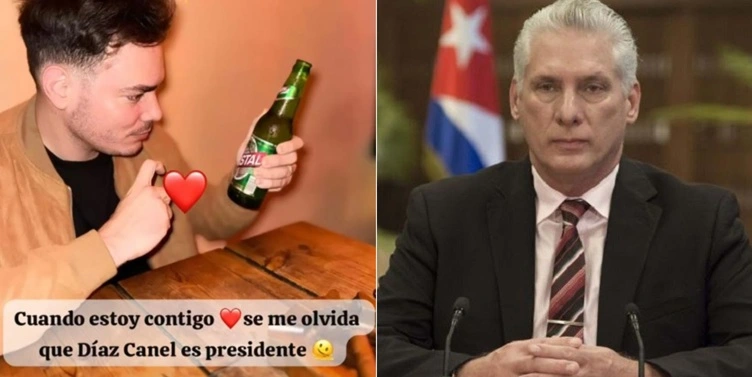
MADRID, Spain.- The publication published in the last few hours by Sandro Castro, grandson of Fidel Castro, once again places its figure at the center of the Cuban public debate. In a story shared on social networks, Sandro appears holding a beer while the image reads: “When I am with you I forget that Díaz-Canel is president.” The message, wrapped in an ironic tone, takes on another dimension in the current political context of the Island.
The direct allusion to the Cuban leader, in a country where public mockery of power is usually punished, is not a minor gesture. Even less so when it comes from a member of the Castro family, an environment historically protected and oblivious to the consequences that other citizens face for similar expressions. Institutional tolerance towards this type of message reinforces the idea that it is not just a matter of personal provocation, but a symptom of something deeper.

In moments of structural crisis, the Cuban regime has repeatedly resorted to political sacrifice. Every time the economic or social situation worsens, the need emerges to identify individual responsible parties to preserve the core of power. The recent case of Alejandro Gil Fernández, dismissed in 2024 and later sentenced to life imprisonment in an opaque process, fits that pattern: a high-ranking official turned into a scapegoat in the midst of the economic collapse.
However, the depth of the current crisis—prolonged blackouts, widespread shortages, a health debacle, growing social unrest—could demand a “head” of greater symbolic weight. In this scenario, the presidential figure appears increasingly exposed. The story published by Sandro Castro can be read, then, as an early signal: a way to trivialize the head of state and prepare the ground for an eventual reconfiguration of the official story.
It wouldn’t be the first time. From the execution of General Arnaldo Ochoa in 1989 to the fall from grace of ministers and senior officials in subsequent decades, the regime has shown that it does not guarantee anyone’s life when it is necessary to divert responsibilities. Today, with Alejandro Gil already out of the scene, the question that begins to arise is whether Díaz-Canel could become the next political sacrifice in a system that, to survive, always ends up taking on a symbolic life.
Added to this is that recently official media and spaces related to the Government They began to make publicly visible Oscar Pérez-Oliva Fraga, a great nephew of the Castro familywhose presentation in acts and institutional structures has been interpreted as the beginning of an accelerated political rise.