The president’s administration donald trump set drastic conditions for the Chavista Government of Venezuela by demanding that it break relations with Cuba, Russia, China and Iran, in exchange for allowing the reactivation of its limited oil production, which is around one million barrels per day.
The decision places Havana at the center of the US offensive, but also seeks to isolate other strategic allies of Caracas and reinforce Washington’s control over the energy sector, the backbone of the Venezuelan economy, whose GDP depends on nearly 90% of oil revenue.
This occurs after, during a speech on Tuesday, interim president Delcy Rodríguez affirmed that the government she now leads as interim president—after the capture of Nicolás Maduro by US forces—fully runs the country.
“No external agent governs Venezuela,” said President Rodríguez at the installation of the Agri-Food, Industrial and Communal General Staff.
He also stated that it is “his constitutional government and popular power” who guide the destiny of the South American nation, which he must now prove in the face of this dilemma imposed by the White House.
This Wednesday, in another statement, the president asserted that her country is experiencing “a new political moment” after the US attack, which she described as “a stain” on the bilateral relationship, but assured that Venezuela “is not at war.” review cnn.
In addition, he called on the Venezuelan opposition to “heal what have been the consequences of extremism and fascism in Venezuela.”
Break with Cuba, Russia, China and Iran
According to sources cited by the chain ABC Newsthe White House informed the interim president of Venezuela, Delcy Rodríguez, that Caracas must cut political and economic ties with these allies as an essential requirement to resume the extraction and marketing of crude oil.
The demand represents a direct blow to energy, medical and other sectors cooperation with Cuba, as well as the strategic alliances with Moscow, Beijing and Tehran, which have been pillars of economic and military support for the Chavista Government.
For Cuba, the interruption of Venezuelan supply would have immediate consequences on its electrical and economic system, which is currently bankrupt. For Russia, China and Iran, the measure represents an attempt by Washington to displace its influence in Latin America and consolidate an energy monopoly.
According to various sources, in recent months Cuba has been receiving between 35,000 and 40,000 barrels of crude oil per day. Others say that Venezuela sent more than 9 million barrels of oil to the island from January to November 2025, which would be almost 27,000 barrels per day.
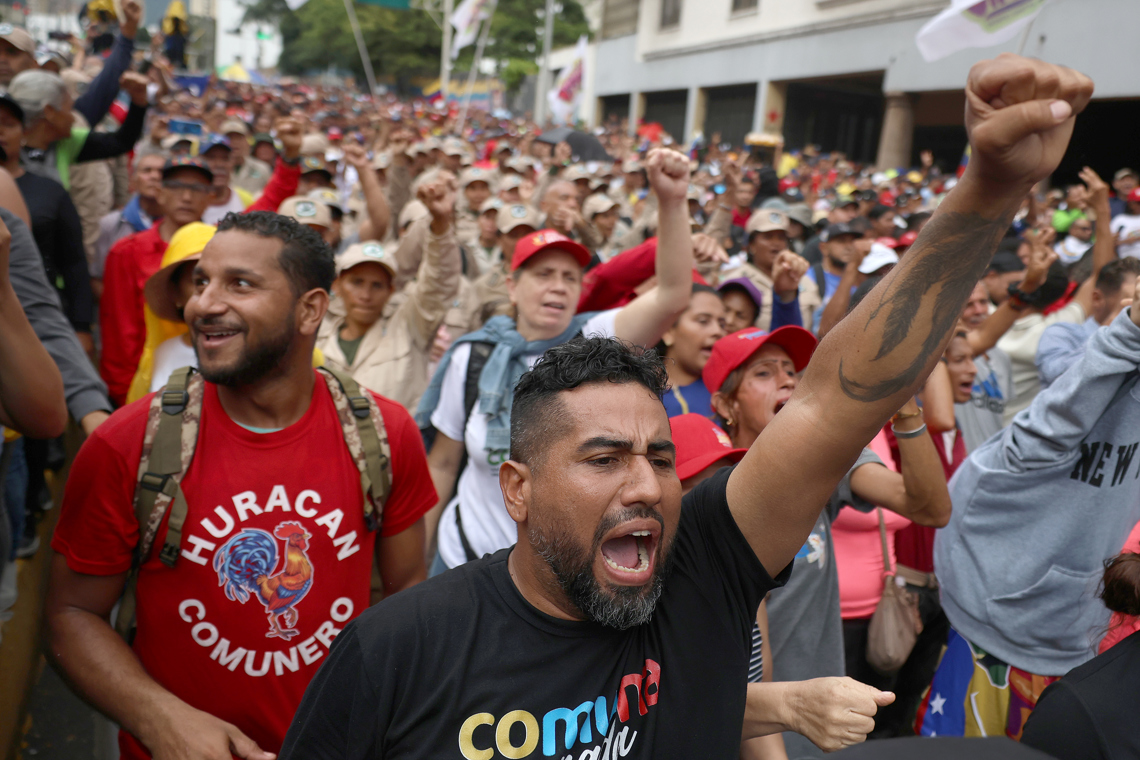
So far, there are no official reactions from Havana to Washington’s new demand to Caracas, where this Wednesday Chavista demonstrations against the capture of Maduro and the US intervention in Venezuela were again registered.
Exclusivity for US companies
Washington also demands that Venezuela partner exclusively with American companies in oil production. The United States demands priority in the purchase of heavy crude oil and a dominant role in the management of energy infrastructure, which leaves out Caracas’ traditional partners.
The Secretary of State, Marco Rubio, explained in private meetings that Venezuela is going through a critical situation: its oil tankers are completely full and the country has a few weeks before falling into insolvency if it cannot sell its reserves.
“The United States can force Venezuela’s hand because its current tankers are full,” he threatened.
For his part, Senator Roger Wicker confirmed that the plan depends on direct control of ships and oil. “The government intends to take charge of the oil tankers, and none of them are going to Havana,” declared the Republican politician, adding that Venezuela does not have ships available to transport more crude oil, which reinforces Washington’s ability to exert pressure.
President Donald Trump assured that between 30 and 50 million barrels of Venezuelan oil would be delivered to the United States for sale on the international market. According to the president, these funds would be controlled directly by his administration to be allocated “to the Venezuelan and American people.”
On your own Truth Social network, the president announced that he had been informed that “Venezuela will ONLY buy products manufactured in the United States with the money it receives from our new oil agreement.”
“These purchases will include, among other things, American agricultural products and medicines, medical devices and equipment manufactured in the United States to improve Venezuela’s electrical grid and energy facilities,” said the Republican.
Meanwhile, Venezuela’s state oil company, PDVSA, announced this Wednesday that it is currently negotiating with the United States for the sale of oil volumes, within the framework of the commercial relations that exist between both countries.
According to a statement issued by the Venezuelan company, the process is developed “under schemes similar to those in force with Chevron and is based on a transaction” that is “strictly commercial, with criteria of legality, transparency and benefit for both parties.”
Funeral of soldiers in Caracas
The consequences of Washington’s military offensive on Saturday were felt in Caracas, where the Venezuelan army held funerals for at least 24 soldiers killed during the US attack that culminated in the capture of Nicolás Maduro, now imprisoned in a maximum security and rigor prison in New York.
Attorney General Tarek William Saab described the deaths as a “war crime” and promised to investigate the events, in which he also 32 Cuban soldiers lost their lives and a number of Venezuelan civilians not yet officially specified.
Men carried wooden coffins covered with the Venezuelan flag in front of rows of uniformed officers.
During the tribute, songs were heard from a church in Caracas and the music of a military orchestra in the cemetery, while crowds of relatives and soldiers marched behind a row of coffins, according to dispatches from international agencies.
The Bolivarian National Armed Forces (FANB) of Venezuela pay tribute at a funeral to 24 soldiers who died in the United States attacks in the South American country last Saturday.https://t.co/cpr39Uhdqt
— EFE News (@EFEnoticias) January 6, 2026
Reactions from Beijing, Moscow and Tehran
In reaction to the Trump Administration’s demands on Caracas, China denounced what it described as “harassment” and “blatant use of force” by the United States. Foreign Ministry spokesman Mao Ning accused Washington of intimidation and imposing an “America First” scheme on resources belonging to Venezuela.
For its part, Russia also condemned the seizure of ships and warned of the risk of military escalation. Iran, for its part, described the offensive as an attempt at “energy colonization” in Latin America.
In Maracaibo, cradle of the Venezuelan oil industry, uncertainty dominates. Storage tanks are full and the joint ventures have been ordered to reduce production while waiting for ships that can transport the crude.
“We have full oil tanks and that is dangerous,” said an operator. Current production is around one million barrels per day, far below the more than three million that Venezuela aspired to recover.
Experts estimate that around $150 billion in investments would be necessary to return to high production levels. The debacle, analysts agree, responds both to Washington sanctions and years of disinvestment and corruption.