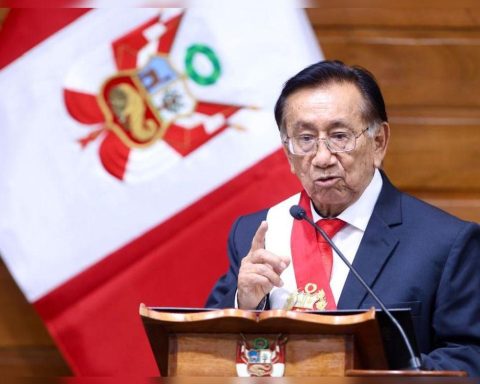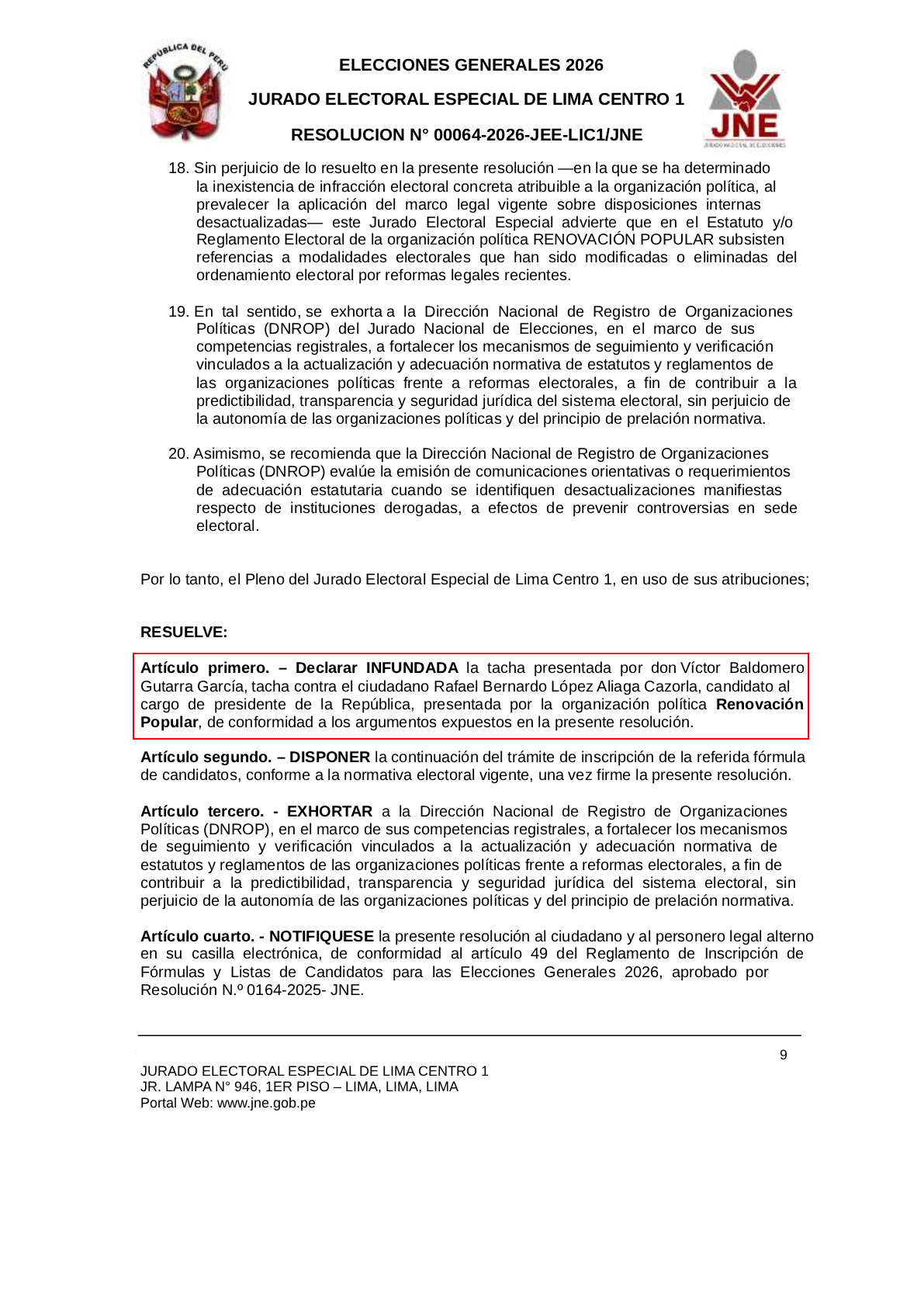
He Special Electoral Jury (JEE) of Lima Centro 1 declared the two unfounded studs presented against the presidential formula of Popular Renewal, headed by Rafael Lopez Aliaga. According to the electoral body, no electoral violation was proven during the party’s primary elections on November 30, 2024.
Both appeals maintained that, presumably, the party carried out its internal election under a different modality than that established in its statute, which would have “violated internal democracy.” Specifically, it was questioned that Popular Renewal has carried out its primary elections under the modality of “elections with universal, free, voluntary, equal, direct and secret vote of members”, when its statute establishes that said process must be carried out through the vote of members and non-members.
YOU CAN SEE: Ramiro Escobar warns: “The attack on Venezuela paves the way for risk scenarios in Latin America”
The blemish also pointed against the National Office of Electoral Processes (ONPE), who supposedly “reframed” the organization’s internal election modality through the “universal vote of members, the only viable option within the expired deadlines to save their participation in the political organization.”
In that sense, the marks indicated that said action of the ONPE would have exceeded its powers because qualifying statutes or modalities corresponds to the National Election Jury (JNE).
YOU CAN SEE: Elections 2026: JNE registers 8 presidential lists, adding 32 parties in the electoral race
JEE rejects blemishes against Rafael López Aliaga: the reasons
In accordance with Resolution 00064-2026-JEE-LIC1/JNE, Popular Renewal informed the ONPE of the modality of its primary elections and that it was this institution that applied “in a supplementary manner” article 24 of Law 28094, Law of Political Organizations (LOP). That is, according to the JEE, the ONPE integrated the existing regulatory void and operationally determined the corresponding primary election modality.
Likewise, the JEE indicated in its resolution that said ruling was not challenged through administrative and jurisdictional channels and that, some time later, the JNE recognized its validity.
“This College verifies that the existence of an administrative act that has imposed a modality different from the current law has not been proven, nor that has replaced the party will because it is the political organization that has given its consent by not questioning it,” says the JEE Lima Center 1.
Along the same lines, the electoral body mentioned that, although it is true that the Popular Renewal statute contains references to open, simultaneous and mandatory primaries (PASO), this was eliminated from Peruvian legislation and “does not automatically generate the nullity of the internal process.”
“There is no legal provision that sanctions the lack of statutory adequacy with automatic nullity, as long as the internal process is carried out in accordance with a legally valid modality and within the electoral deadlines,” the resolution reads.
In addition, the JEE stressed that the citizen who presented the objection is not authorized to challenge the internal elections because he is not a member of the party.