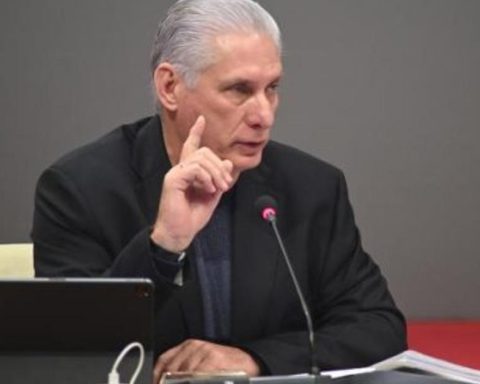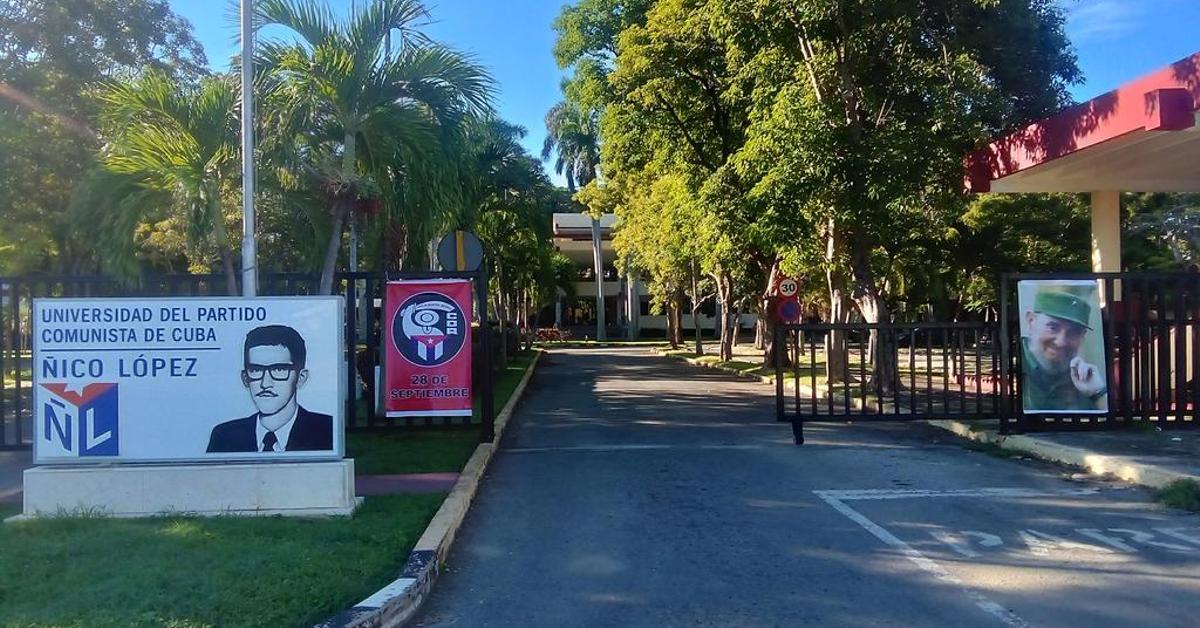
Havana/Just three weeks ago, the University of the Ñico López Communist Party of Cuba – that’s what it’s called now – published an enthusiastic message in The photo showed the president smiling and with his fist raised. No one seemed to imagine that, shortly after, the Venezuelan ruler would be captured by US troops and transferred to New York to face judicial proceedings for drug trafficking. The messageread today, has something of a postcard frozen just before the collapse.
Ñico López is the ideological heart of Cuban power. Founded almost 66 years ago to train political cadres, it has changed its name, structure and rhetoric, but not its mission: to guarantee the doctrinal reproduction of the system. In their classrooms they are taught to read history as an epic, to distrust pluralism, to confuse loyalty with obedience and to consider permanence in power as a revolutionary virtue. From there, a political pedagogy was exported for decades that found fertile ground in Venezuela. Maduro was one of his most dedicated students, as he has demonstrated throughout his years in power.
The biography of Nicolás Maduro is crossed by a central idea: that of the common man elevated to leader by the apparatus’ preference for docile and dim-witted soldiers. Bus driver, trade unionist, Hugo Chávez’s chancellor and, finally, designated heir to the Bolivarian Revolution, Maduro never built a leadership of his own. He always governed from reflection, from repetition, from mimicking the power of his predecessor and the Cuban regime. In Havana he learned to resist, but not to govern; to close ranks, but not to read the signs of the environment; to distrust the external adversary, but not to prepare for the dock.
The Ñico López school teaches that power is preserved by hardening discourse, closing political space and betting on repression
The Ñico López school teaches that power is preserved by hardening discourse, closing political space and betting on repression. What it does not teach—or teaches poorly—is that contexts change, that allies become exhausted, and that excessive control, without legitimacy or economic results, ends up being a countdown. Maduro absorbed the most rudimentary lessons: militarize politics, criminalize dissidence, replace management with slogans. He did not learn, however, that even authoritarian regimes need a certain balance between coercion and consensus.
The Venezuelan case is a tragic caricature of that incomplete learning. Maduro governed a country with the largest oil reserves in the world as if he were managing a besieged trench. He confused sovereignty with isolation and resistance with immobility. As the country became poorer, power was encapsulated in an increasingly narrow circle, where personal security became dependent, ironically, on Cuban advisors and bodyguards. Ñico López teaches how to shield the leader; It does not teach what to do when that armor breaks down like jelly and a helicopter takes away the president.
There is also a lesson that the Cuban manual avoids: the weight of corruption and organized crime in the erosion of power. The drug trafficking accusations that haunt Maduro today are neither an accident nor a recent invention. They are the result of years of collusion between the State, the military and illicit networks, in a system where opacity was not a defect but a method. The Party school trains cadres to resist external pressures, but not to be accountable.
From Havana, Maduro’s capture is observed with a mixture of alarm and recognition
From Havana, Maduro’s capture is observed with a mixture of alarm and recognition. The images of the handcuffed leader are alarming, although they will never admit that this has been a major failure for Cuban intelligence. Because the fall of Maduro is not only the departure from the political board of a strategic ally: it is a reminder that the exported model can also implode. Ñico López prepared Maduro to survive disputed elections, protests and sanctions. It did not prepare him for a scenario in which the bars close and he is left at the mercy of his jailers.
Perhaps that is the lesson that school never taught: that absolute power not only corrupts, it also isolates; that to govern is not to resist indefinitely, but to adapt; that history does not stop by decree. Maduro believed that it was enough to repeat the script learned in Havana to sustain himself. He forgot – or was never taught – that even the schools of power have limits. And that, when the time comes, the most faithful students can end up being the most uncomfortable examples.