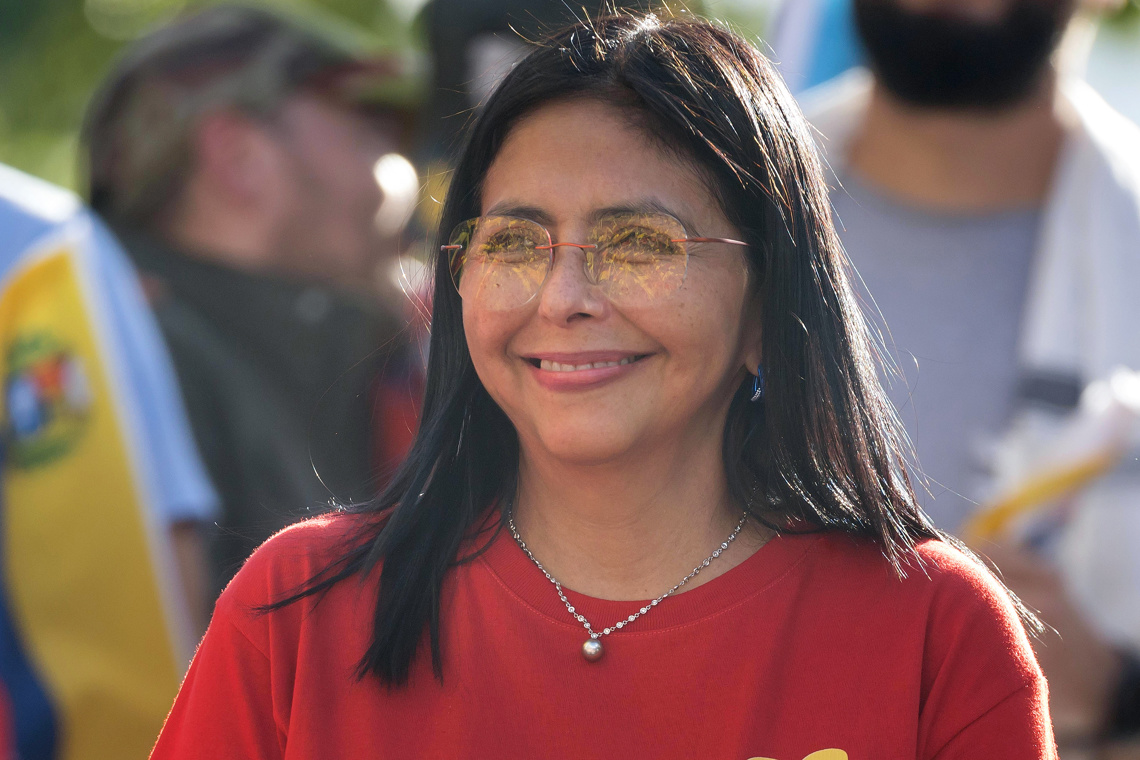
In the midst of growing political uncertainty, the Constitutional Chamber of the Supreme Court of Justice of Venezuela ordered on Saturday night that Executive Vice President Delcy Rodríguez take over as acting president of the Republic, while Washington talks about working with Chavismo for the moment, as long as she meets its expectations and demands.
The highest court argued that the capture of former president Nicolás Maduro by United States special forces constitutes a “material and temporary impossibility” for the exercise of his functions, which requires guaranteeing administrative continuity and the defense of the nation in the midst of an unprecedented crisis.
According to a Telesur channel officethe president of the Chamber, Tania D’Amelio, explained that the decision is based on an interpretation of articles 234 and 239 of the Constitution, in the face of an “exceptional and force majeure” situation not literally provided for in the Magna Carta.
The ruling, signed by the magistrates and the secretary of the Constitutional Chamber, establishes that the measure is precautionary and urgent in nature, without yet defining whether the presidential absence will be classified as temporary or absolute.
The judiciary did not activate, however, article 233, which defines the absolute faults of the president (death, resignation, dismissal, permanent incapacity, abandonment of office or popular recall). In these cases, the vice president assumes and must call presidential elections within the following 30 days.
For its part, the Bolivarian National Armed Forces, considered the main supporter of the government, recognized Delcy Rodríguez this Sunday as acting president after the president’s capture in a US military operation.
In a televised message, the Minister of Defense, Vladimir Padrino, read the ruling of the Supreme Court of Justice that orders Rodríguez to assume power for 90 days. Padrino denounced that in the “cowardly kidnapping” of Maduro, members of his bodyguard team, as well as soldiers and civilians, were murdered “in cold blood.”
He also supported the decree of a state of external commotion promulgated by Maduro, according to Rodríguez, to “guarantee the governability of the country.”
The minister called on the population to resume their daily activities in the coming days and stressed that “the country must move on its constitutional track.” Meanwhile, Caracas woke up calm and with the streets half empty, businesses closed and some lines in markets and pharmacies, the French agency reported. AFP.
Trump: “We are going to control Venezuela until there is a safe and orderly transition”
Civilian and military deaths
The court order comes after the United States air attacks against Venezuela, which left at least 40 dead, according to reports The New York Times.
The military operation, which occurred in the early hours of January 3, aimed to capture Maduro and his wife, who are now in custody at the Metropolitan Detention Center (MDC) in Brooklyn, New York, a high-security federal prison known as the Prison of Hell.
The bombings reached civil and military areas in Caracas and the states of Miranda, Aragua and La Guaira, generating a wave of destruction and increasing tension in the country.
On Saturday, the NYT opined that “President Donald Trump’s declaration on Saturday that the United States planned to ‘manage’ Venezuela for an indeterminate period, giving orders to its government and exploiting its vast oil reserves, plunged the United States into a risky new era in which it will seek economic and political dominance over a nation of some 30 million people.”
Rubio would be the proconsul for Venezuela and would work with the current authorities
The Secretary of State of the United States, Marco Rubio, would have been appointed to lead the political control that Washington seeks to impose on Venezuela, according to reported Bloomberg citing an unnamed US official.
The news came hours after President Donald Trump announced that his country plans to “lead” the South American nation after the kidnapping of Nicolás Maduro by US forces.
“The United States will work with Venezuela’s current leaders if they make ‘the right decisions,’” Secretary of State Marco Rubio said Sunday. “We are going to judge everything by what they do, and we are going to see what they do,” Rubio said this sunday on the show CBS News’ “Face the Nation.”
“I do know this: that if they do not make the right decisions, the United States will maintain multiple levers of pressure,” he added.
Questioned about the deployment of US troops on Venezuelan soil, the Secretary of State described it as an “obsession of public opinion”, but at the same time an “option that he (Donald Trump) cannot publicly rule out.”
The Trump government currently has an oil blockade “that allows us to exert considerable influence on the course of events,” said the head of US diplomacy.
Venezuela is not Libya, Iraq or Afghanistan, he emphasized. “Our mission here is very different,” insisted the diplomat of Cuban origin.
Complicated scenario for Washington
A few hours after being appointed interim president of Venezuela, Delcy Rodríguez appeared on state television with her brother Jorge Rodríguez, president of parliament, Diosdado Cabello, minister of the Interior, and Vladimir Padrino López, head of Defense, to insist that Maduro remains the only head of state and send a message of unity of Chavismo.
This balance means that removing Maduro is not enough to dismantle the system, since multiple actors at different levels support the structure, in addition to popular sectors related to the government, whose economies depend on bonuses or subsidies.
On Saturday, President Donald Trump publicly ruled out opposition leader María Corina MachadoNobel winner and considered Maduro’s most credible rival, and was inclined to negotiate a transition with the now president of the rich oil country.
According to analysts, Cabello’s figure emerges as the most unpredictable. With influence over the intelligence services SEBIN (civil counterintelligence service) and DGCI (military counterintelligence organization), the soldier who was then a lieutenant when he participated alongside Chávez in the coup attempt on February 4, 1992, has toughened his rhetoric on television, dressed in a bulletproof vest and surrounded by armed guards.
Cabello’s control over key military groups and brigades, added to the economic power of the generals in strategic sectors, reinforces the perception that the regime is maintained thanks to a complex network of civil and military loyalties that is difficult to break.
Venezuela has up to 2,000 generals and admirals, more than double that of the United States. High-ranking and retired officials control food distribution, raw materials and the state oil company PDVSA, while dozens of generals sit on the boards of private companies.
China, the Pope and the others
China, which received about 746 thousand barrels a day of Venezuelan oil until November, expressed this Sunday its “serious concern” about the capture of Venezuelan President Nicolás Maduro and his wife, Cilia Flores, and demanded their “immediate release.”
The Chinese Foreign Ministry denounced that Washington “has taken over by force” the president and warned that these actions “clearly violate international law and the basic norms that govern international relations.” Beijing also urged to resolve the crisis “through dialogue and negotiation” and to “guarantee the personal safety” of the detainees.
For his part, Pope Leo XIV joined the critical voices and asked that the sovereignty of Venezuela be respected after the US military attack. “I follow with deep concern the evolution of the situation in Venezuela,” said the pontiff during the Sunday Angelus.
Before thousands of faithful in St. Peter’s Square, the head of the Catholic Church demanded that civil liberties and the rule of law be ensured in the South American nation. “The good of the beloved Venezuelan people must prevail over any other consideration, and inspire us to overcome violence and embark on paths of justice and peace,” he added.

The French Foreign Minister, Jean-Noël Barrot, reiterated France’s position that Edmundo González Urrutia, presumed elected in the 2024 Venezuelan elections, has a “central role” in the political transition after the departure of Nicolás Maduro, an option that Washington already ruled out in advance.
Meanwhile, international organizations also reacted with alarm. Amnesty International warned that the military operation “is most likely a violation of international law” and warned of “serious concerns” regarding the human rights of Venezuelans.
The African Union, for its part, called for respect for international law and stressed that Venezuela’s internal problems must be resolved through “inclusive political dialogue.”
For the Argentine sociologist and analyst Atilio Borón, the military aggression of the United States against Venezuela begins a stage where diplomacy has definitively died” and establishes the “law of the strongest” as a global norm.