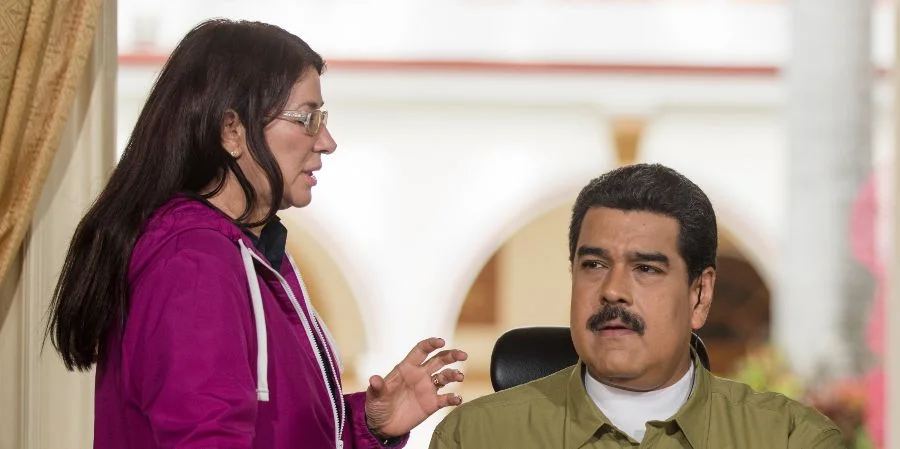
Flores, a 69-year-old lawyer, has been at Maduro’s side for almost three decades.
MIAMI, United States. – The wife of dictator Nicolás Maduro, Cilia Flores, made headlines this Saturday after United States troops They will take her and Maduro out of bed and out of the countryto be tried, both, in New York.
When the couple had not yet arrived in New York, the attorney general of the United States, Pam Bondi assured in X that both she and he had been “formally accused” and specified that the dictator had been charged with “conspiracy for narcoterrorism, conspiracy to import cocaine, possession of machine guns and destructive devices, and conspiracy to possess machine guns and destructive devices against the United States.”
Although in that publication he did not mention that these charges also applied to Flores, he immediately referred to Maduro and her: “They will soon face the full weight of American justice on American soil and in American courts.”
Flores, who in recent years has retreated behind Maduro – she was still considered a key figure of the “shadow power” – was, until the early hours of January 3, Venezuela’s “first combatant.” But who really is this woman who has been at Maduro’s side for 30 years?
Flores was born in 1956 in Tinaquillo, Cojedes state, and grew up in the neighborhoods of western Caracas. A lawyer specialized in labor and criminal law, she participated as a defender of Hugo Chávez and other soldiers who tried to overthrow the then president Carlos Andrés Pérez in 1992. It was in those initial years of Chavismo when she crossed paths with Maduro, who was campaigning for Chávez’s release and was part of the lieutenant colonel’s security team, according to a CNN article.
In November 2023, Flores herself recalled the moment she noticed Maduro: “I always remember an assembly in Catia and when a boy asked to speak, he spoke and I stared. I said: ‘How intelligent.'”
Although her relationship with Maduro spanned more than two decades before marriage, Flores built her own profile in the state. She was elected deputy to the National Assembly in 2000 and re-elected in 2005. A year later, in 2006, she became the first woman to preside over Parliament, after succeeding Maduro himself, who then moved to Chávez’s Foreign Ministry.

During his administration, he banned journalists from entering the chamber and faced accusations for hiring family members in Congress. On that point, he told the Spanish newspaper The Vanguard that it was a smear campaign, but admitted incorporations: “My family did join because of their own qualities; I feel proud and I will defend their work as many times as necessary.”
Between 2009 and 2011, Flores held the second vice presidency of the United Socialist Party of Venezuela, still under the leadership of Chávez, and in 2012 she was appointed Attorney General of the Republic. In the last months of Chávez’s life, he traveled with Maduro—now vice president—to see him in Cuba.
The couple married in July 2013, shortly after Maduro won the presidential election against opponent Henrique Capriles. By then, Flores was already a figure with accumulated power within Chavismo, although her public exposure diminished with the rise of her husband. “She has quite a political job. When she becomes first lady, she takes a backseat. But for many, she is the power behind the throne or a front-line advisor,” Carmen Arteaga, a doctor in Political Science and associate professor at the Simón Bolívar University, told CNN.
Arteaga also maintained that this influence would have been key in the years of internal dispute over Chávez’s political inheritance, when Maduro was still consolidating his leadership over important figures within the ruling party.

Another reading suggests that Flores’ power is not easy to measure because it is exercised without institutional formalities. “It happens behind the scenes” and “it is not institutionalized,” political scientist Estefanía Reyes told CNN. “It is dangerous not to understand the dynamics of decision-making, because that makes it difficult to generate accountability and be transparent about influence,” he warned.
Reyes also described a change of image in recent years, with Flores appearing in a support and mother role, with the intention of connecting with the popular rather than projecting herself as an electoral figure. “Chavismo instrumentalizes the role of mother. Symbolically, she continues to be tied to gender restrictions,” the academic considered.
After the start of the Maduro Government, Flores reduced his appearances and was linked to a media space with the title “With Cilia en familia.”
Flores’ name made headlines outside of Venezuela again in 2015, when two of his nephews were detained by undercover DEA agents in Haiti on accusations of drug trafficking. At that time, Flores described that episode as a kidnapping. The so-called “narco-nephews” were tried and sentenced in New York to 18 years in prison for conspiring to import cocaine into the United States and were released in 2022 in a prisoner exchange between Caracas and Washington.
In 2018, Flores was sanctioned by Canada along with 13 other officials one day after the OAS reported that the Maduro government had committed crimes against humanity. Months later, the US Treasury Department added sanctions and argued that Maduro relied “on his inner circle to stay in power.” The president’s public response He included a direct defense of his wife: “If you want to attack me, attack me, don’t mess with Cilia, don’t mess with the family, don’t be cowards. Your only crime, being my wife.”
By then, Flores had already returned to the Legislative Palace: she was elected in 2017 to the Constituent Assembly and in 2021 she returned as a deputy to the National Assembly, a position she held until the night she was taken out of bed, put on a helicopter, then on a ship and later on a plane. Like Maduro, he made the trip from Caracas to New York, from power to prison.