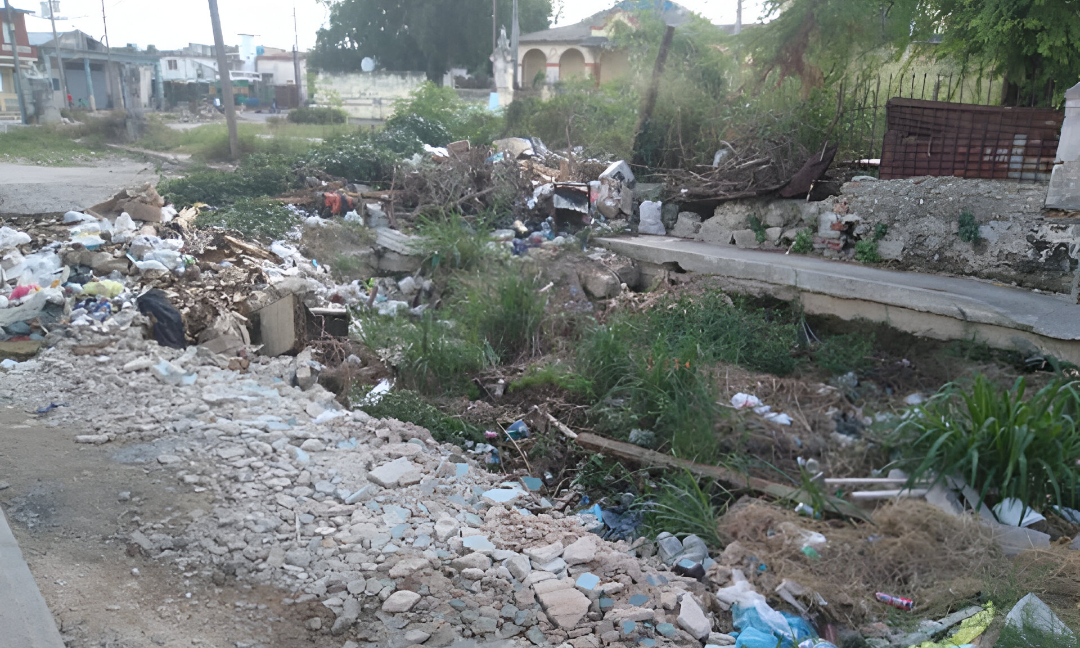
A neighbor told Cubanet that recently a man pushing a wheelbarrow fell into the hole and had to be rescued.
HAVANA.- The Havana population constantly complains about the state of destruction of the pavement and sidewalks. But there is one place that seems to be the height of this disaster: Atocha Street, in the municipality Hill.
That section, impassable between Zaragoza Street and Calzada de Palatino, gives the impression of having suffered an earthquake.
More than two years ago I wrote a piece for CubaNet where I pointed out the existence of a huge hole that, due to a leak, was full of water. There the children came to play as if it were a natural pool. Today the fault in the pipe was repaired, but the work remained unfinished: the hole has not yet been filled and is surrounded by a weed that has grown in the middle of the street.
About ten meters ahead another gap opens up. In it you can see an underground stream that runs under the pavement. To save it, they placed steel beams as a bridge and covered them with asphalt. However, over the years, humidity and the passage of vehicles, that structure broke and the road ended up collapsing to the edge of the sidewalk where pedestrians walk.
The risk is evident for pedestrians and drivers. At night, during blackouts, the danger increases, but there is no warning sign.
A neighbor told Cubanet that recently a man pushing a wheelbarrow fell into the hole and had to be rescued. Fortunately, he only suffered a few blows.
Both holes on Atocha Street are used by some neighbors to throw garbage.
Similar problems are repeated throughout Havana without being solved.
many years ago Fidel Castro spoke of the need to replace a large part of the city’s sewage system and water pipes due to their age, but to date works have only been carried out in specific places.
As the sewers are clogged, heavy rains and cyclones cause flooding that weakens the road structure.
Those who build homes – mainly people from the interior of the country who come to the capital in search of better living conditions – sometimes break the streets and pipes to supply themselves with drinking water, and then do not repair what they broke.
Potholes abound throughout the city, but repair brigades are almost never seen: equipment is broken or discontinued due to lack of spare parts. The few vehicles available are destined for the main avenues, such as Fifth Avenue in Miramar, where tourists and high officials travel.
Due to the lack of adequate trucks for garbage collection, excavators are used to break sidewalks and flower beds, creating new holes that remain unrepaired.
The chaotic road situation in Havana seems to have no short-term solution: there are no means for repairs and they are extremely expensive.
Given the inability of the State to solve the problem, at the rate we are going, soon the streets of Havana will once again be, as in colonial times, embankments of sand and stone that fill with mud when it rains.