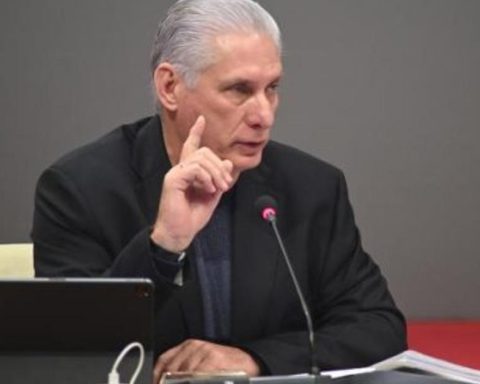
Havana/The Miami-Dade tax collector, Dariel Fernández, spoke on December 30 about the authorization agreed by Havana to a private company based in the county to manage remittances to Cuba, an issue that he called for to be examined as a national security problem for the United States.
The official’s reaction occurs just hours after the decision of the Central Bank of Cuba (BCC) in favor of Cubamax Travel Inc., based in Hialeah, became known. The measure, published in the Official Gazette Cuban, allows the company to “develop money transmission activities to the national territory” through financial channels of the Island, including deposits in accounts and cards, as well as the delivery of cash to beneficiaries in Cuba, either in national currency or foreign currency.
The announcement revived an old and especially sensitive debate in South Florida: who controls the flow of remittances, what actors participate in this business and to what extent family shipments become a source of oxygen for a state and military apparatus, the Gaesa conglomerate, which Washington keeps under sanctions.
Fernández addressed the issue in a subsequent statement, without mentioning Cubamax by name, and framed his concern in terms of security.
Fernández addressed the issue in a subsequent statement, without mentioning Cubamax by name, and framed his concern in terms of security. “Any activity that could put money, operational control or financial influence in the hands of a communist dictatorship that systematically oppresses its people and aligns itself with hostile regimes such as Venezuela, Iran and Russia must be subject to the highest level of scrutiny,” he warned.
In his message, Fernández insisted that the objective of remittances should be to help families and provide humanitarian aid, “not to strengthen or legitimize an authoritarian government or its financial apparatus controlled by the State.”
At the center of their arguments appears a recurring point among local Cuban exile politicians: any financial operation linked to Cuba is crossed by federal restrictions and, therefore, cannot be treated as an ordinary commercial exchange. Fernández recalled that economic relations with the Island are subject to specific and limited authorizations, and that the fact that a foreign entity, in this case, the Cuban Central Bank, “approves” or enables a company does not exempt it from compliance with US regulations.
Fernández assured that if a company intends to maintain commercial or financial relations that involve Cuban entities, it must operate “with a license from the Ofac (Office of Foreign Assets Control, of the Department of the Treasury) or work with a license from the Department of Commerce and comply with all regulations.” With this approach, the collector asked the federal authorities for “a thorough review” of the matter and to guarantee full compliance with the current sanctions and regulations.
The collector’s statement It adds to the political dimension that has already accompanied Cubamax since before. In South Florida, where the Cuban issue functions as an electoral thermometer, the issue of remittances tends to divide even those who share a direct criticism of the regime. For some exiles, facilitating shipments means alleviating family emergencies and preventing Cubans from sinking deeper into the crisis; For others, any channel that ends up connected to Cuban financial institutions reinforces a system that increasingly depends on external currencies to sustain itself.
The authorization of the BCC introduces an element that has drawn attention: the possibility of delivering cash “in foreign currency” to beneficiaries in Cuba
In this context, the authorization of the Cuban Central Bank introduces an element that has drawn particular attention: the possibility of delivering cash “in foreign currency” to beneficiaries in Cuba. This is not just an operational detail. In a country with a chronic shortage of cash and a national currency in permanent deterioration, receiving dollars or another currency directly, without immediate forced conversion, changes the calculation for many families: it allows them to preserve value, postpone the change to pesos and decide when to use it. But it also raises questions about how this delivery would be carried out, with what counterparts on the Island and under what requirements, in a financial framework where the State has tried to maintain control over each channel of foreign currency entry.
Fernández, for his part, stressed that his office has jurisdiction at the county level and is governed by the rules of the state of Florida, but insisted that “compliance” with what is established cannot be interpreted only from the local angle.
Recently, Fernández had announced that Miami-Dade County was revoking the Local Business Tax – equivalent to a commercial license – with immediate effect. to a group of companies accused of illegally participating in trade with the Cuban Governmenta decision that seeks to prevent South Florida from being used as an economic platform to support the Havana regime.
Shortly after, it was announced that at least two of the 20 companies sanctioned in Miami-Dade They claimed to have a license from Ofac. The company Xael Charters filed a lawsuit against the revocation of its local permits in Miami-Dade and the company Yumury Envios & Travel has also assured that its commercial operations with Cuba were permitted by the US federal authorities.