Sancti Spíritus/The afternoon of December 31 has barely fallen and already in some neighborhoods of Sancti Spíritus one can guess that the year will not go away in silence. Among remains of wood, old clothes, cardboard and empty bottles, the “old year” dolls are taking shape, those improvised puppets that traditionally serve to concentrate frustrations, jokes and collective vents before setting them on fire. There is no manual or single design: all that is needed is a human-shaped body and the certainty that, when it burns, something symbolic will also go with the flames.
In one of the doorways of the neighborhood, a doll remains planted as if watching the street. He wears worn boots, blue pants and, not an innocent detail, a white sweater with the phrase “I love this Island” printed next to a Cuban flag. The irony is evident. In a country marked by mass exodus and social fatigue, that message seems less like a slogan and more like an open question. “We did it that way on purpose,” confesses a neighbor while adjusting the neck wire. “Loving the country does not mean that one does not want to burn all the bad things that have been experienced,” he clarifies and lists everything from the long blackouts of 2025 to the chikungunya that has left him with a sore knee.
/ 14ymedio
A few meters away, two almost identical dolls share the sidewalk. Both have exaggeratedly inflated bellies, short arms and a rigid posture reminiscent of official officials: a lot of abdomen, few ideas. No need for an explanatory sign. Those who pass by look at them, smile and comment in low voices. Political satire finds here a rudimentary but effective channel, protected by the alibi of tradition.
The burning of the old year doll is not exclusive to Sancti Spíritus or Cuba, but on the Island it has acquired a very particular tone. Here it is mixed with Creole humor and the need for catharsis. Burning the doll is saying goodbye to the bad: the scarcity, the queues, the unfulfilled promises, the impossible prices and also the accumulated fears.
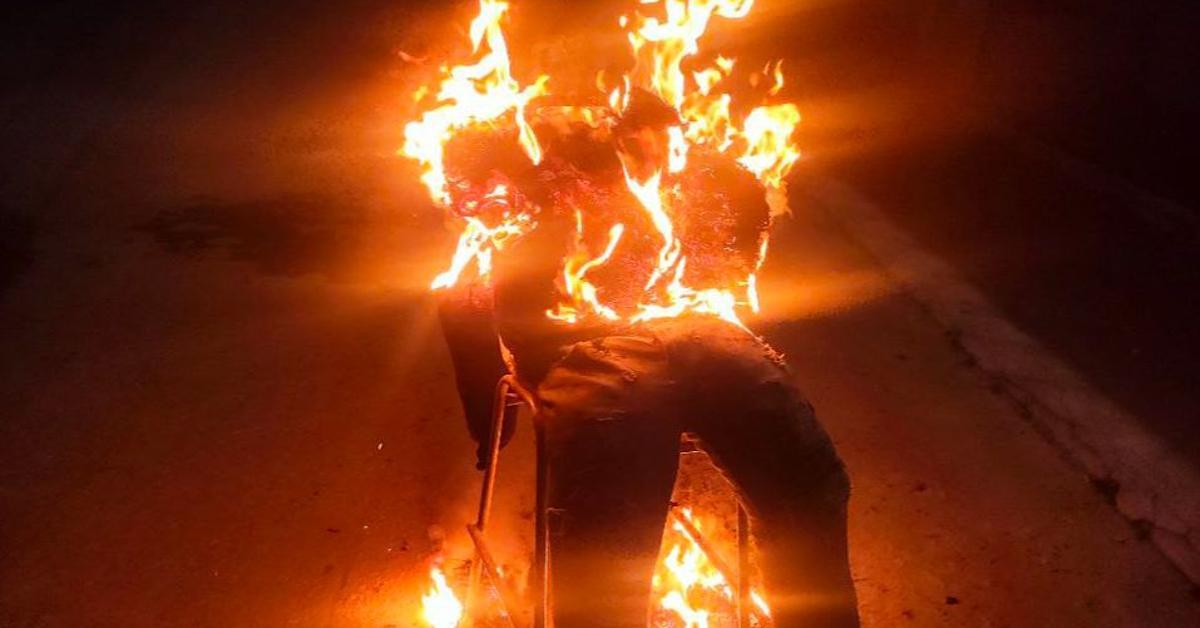
Late at night, when the street darkens and someone brings a match, the atmosphere changes. The fire burns quickly. The flames devour the clothes, the wood creaks and the doll, sitting on an old metal chair, is enveloped in an orange light that illuminates the nearby facades. There is applause, nervous laughter and the occasional sarcastic comment. It is not a solemn bonfire, it is rather a domestic ritual, improvised, but loaded with meaning.

/ 14ymedio
While the doll is consumed, in other parts of Cuba others perform their own rituals. At twelve o’clock, there is no shortage of people who throw buckets of water from the door of the house to “throw away the bad.” Others, more optimistic or desperate, walk around the block with an empty suitcase, convinced that this will attract a trip in the coming year. Every gesture, no matter how minimal it may seem, is a commitment to hope.
When only ashes and a lingering smell of burnt fabric remain, the street regains its calm. The doll is no longer there, but the gesture remains. In Sancti Spíritus, as in so many parts of the country, burning the old year does not change reality from one day to the next, but it allows something equally necessary: to say, without speeches or slogans, that there was too much weight to carry and that at least tonight it was decided to release it to the fire.