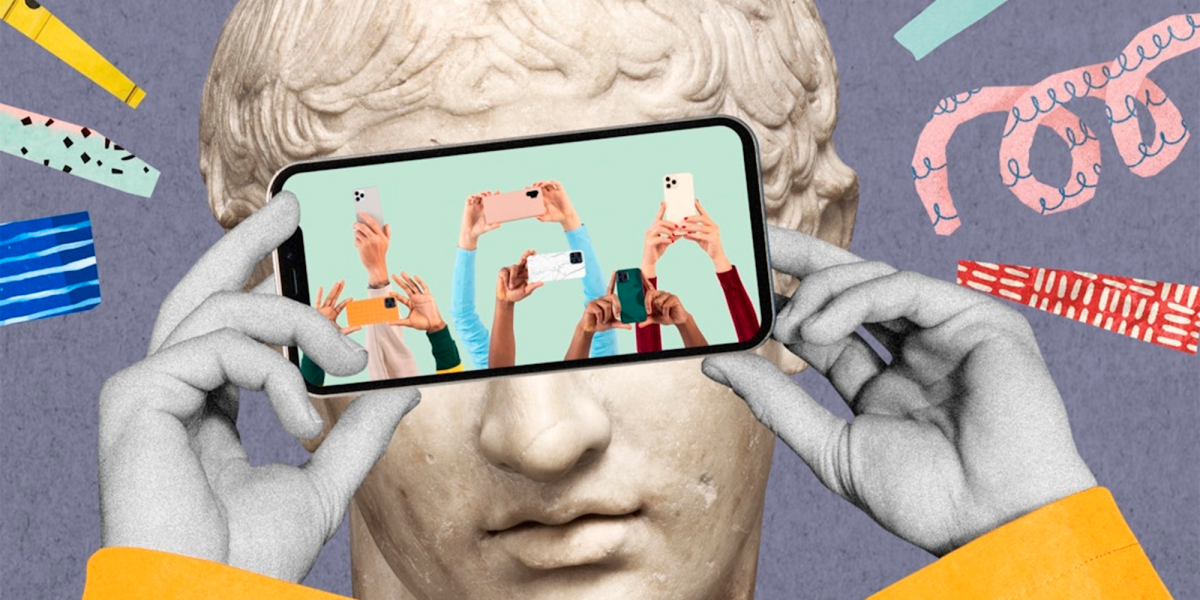
In his History of cronopios and fames, the Argentine writer Julio Cortázar has a story that he could perfectly have dedicated to the mobile phone if he had been born in the 21st century. It is titled “Preamble to the instructions for winding a watch.” And it says like this:
“Think about this: when they give you a watch, they give you a little flowery hell, a chain of roses, a dungeon of air. They don’t just give you the watch, may you have a very happy birthday and we hope it lasts.” […]. They give you – they don’t know it, the terrible thing is that they don’t know it – they give you a new fragile and precarious piece of yourself, something that is yours but is not your body, that must be tied to your body. […] They give you the fear of losing it, of having it stolen, of dropping it on the ground and breaking it. They give you their brand, and the security that it is a better brand than the others, they give you the tendency to compare your watch with other watches. They don’t give you a watch, you are the one given, they offer you for the birthday of the watch.”
With mobile phones, we could have that same feeling of being “the ones given away.” and the gift It can be, in effect, an “air dungeon,” paraphrasing Cortázar. A dungeon where we involuntarily lose track of time, where algorithms tend to amplify polarized and misinformative messages, where one in ten adolescents suffers cyberbullying and the young people are perpetrators and victims of new forms of violence.
Furthermore, far from ending stereotypes, social networks accentuate some inequalities. For example, as Milagros Sáinz, from the Universitat Oberta de Catalunya (UOC), explained to us, in the networks “the excessive importance of the image body, and the objectification and sexualization of women’s bodies that it implies, makes girls especially vulnerable to certain mental health problems.
These are the topics explored in depth by some of the articles we have published on a topic that concerned society: the digital well-being of minors. Through more than sixty texts we have functioned as aggregators of multidisciplinary knowledge on digital well-being contributed by sociologists, educators, psychologists, pediatricians, legislators, cybersecurity experts, psychiatrists, linguists…
With some of them we also had a dozen in-person conversations in which we witnessed the creation of new connections between researchers and social initiatives that share (we share) the interest in digital well-being. And these networks of connections included the young people themselves, an essential part of the events, who greatly appreciated that their voice was heard in this type of forum and dreamed of it becoming commonplace.
What minors have to say
Without underestimating everything we have learned from the debates with experts, we want to emphasize how much listening to the kids has added to us. In one of the last events held, when we asked a group of young people what message they would send “to their past self,” one of them responded:
“I would better send it to my parents, and to the parents of my friends (laughs). I would insist that a cell phone is a bomb of dopamine and stimuli that should not be put in the hands of a child, because they are incapable of dosing themselves. And I would say: why don’t you wait a few more years?”
While her classmates nodded, she continued:
“I recently went up with friends to the Albaicín, in Granada, to contemplate a wonderful sunset. And we found a child in a baby stroller looking absorbed at a screen… with how good it would be for him neurologically to admire that sunset! It is heartbreaking that adults make that decision for them and deprive them of real experiences.”
Finally, he added that in his generation, in his environment and in the networks themselves, voices are beginning to appear that demand time without screens, that value disconnection and increasingly question what screens give them compared to what they take away, what they displace. They talk about reconnecting with others, in-person contact and contact with nature. There is hope…
Understand first, use later
After a year with my ears wide open, demands from young people resonate in my head that are very far from the “Everything is fine” or “Leave us alone, we know what we are doing” that we could predict. “Please explain to us how the Internet works – and about the data economy, security and privacy – before putting a cell phone in our hands (and put it later rather than sooner),” demanded a 14-year-old boy. “I envy my parents, who were teenagers in a world without cell phones,” acknowledged a group of 4th year ESO students. Noticing their desperation, on one occasion I asked them: “Imagine that there is a button here and if I press it, none of your colleagues and friends use social networks, you yourselves cannot use them, all your social network accounts disappear, do I press it?” 90% responded with a resounding yes.
“I disconnect from my cell phone at dinner, but my parents don’t: it’s difficult to talk to them, I suppose because they get work messages on their cell phone at all hours,” lamented one girl, backed by the “Me too,” “And me,” “At my house too” from her classmates. The experts, for their part, although they had not heard these comments, agreed that if they had to change a single habit in the world it would be “having dinner together every day, as a family, without screens.”
What’s more, we shouldn’t even leave our cell phone on the table because, as Estrella Montolío, from the University of Barcelona, insisted to us“the simple presence of a cell phone, even if it is in silent mode, divides the attention of the participants between the real people present and the virtual people.” This silent mobile “inhibits the possibility of initiating and sharing conversations of interest, since participants unconsciously suspect that the device may demand the attention of its owner at any time from a parallel virtual universe, so they decide to ‘surf’ the topics of conversation instead of delving into them.”
Know to have control
So that when they give us a cell phone we are not the ones given away, the best vaccine is knowledge. Understand the data economy, understand the algorithm, critically analyze our renunciations of privacy, etc. It will allow us to take control and consciously decide how, where, how much and with what content we use technology (and we leave the minors in our care to do so).
“We want to educate citizens capable of using technology in a competent, appropriate and responsible way in their daily lives,” declared Victoria Marín Juarros, from the University of Lleida, contributing ideas to develop a critical look at technology from the classrooms. From the classrooms and, of course, from home.