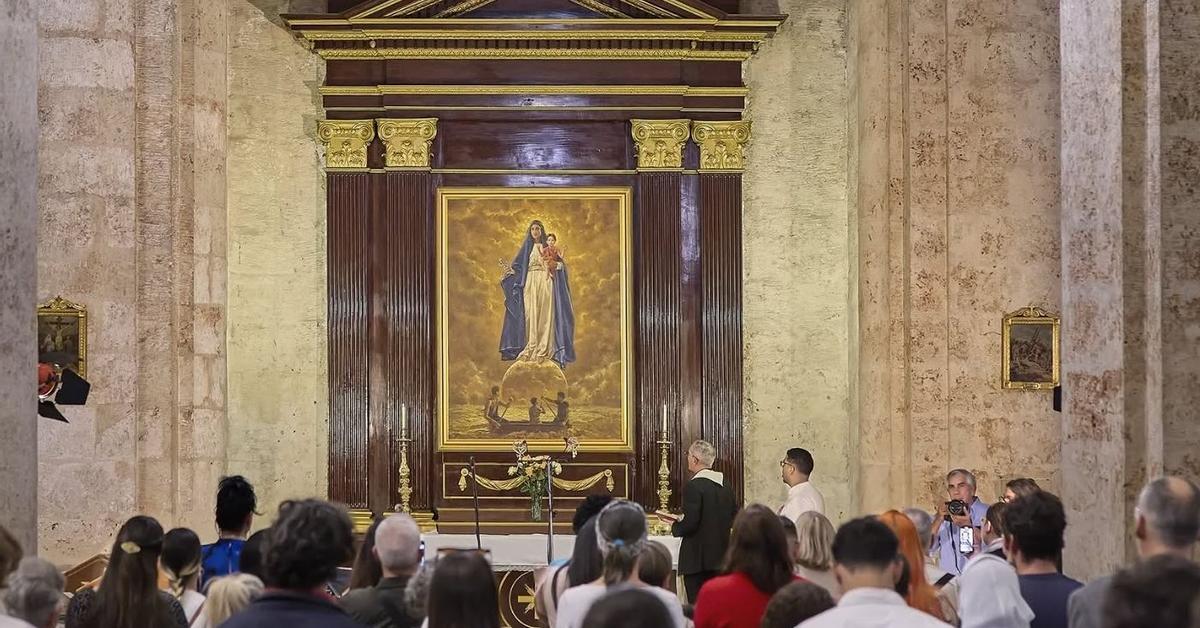
Miami/Three bodies cling to a tiny boat in the middle of a rough sea. There is no clear horizon, only the swaying of the waves and the fragility of the wood that supports them. Above them, elevated but not distant, a luminous figure watches and protects. It is not a scene from the Gospel nor an episode frozen in colonial iconography: it is an image that dialogues head-on with the contemporary Cuban experience. This is how it is presented An altarpiece for the Virgin of Charitythe work that the artist William Acosta inaugurated last November in the cathedral of Havana, and that since then accompanies, in eloquent silence, those who arrive at the temple.
The association is inevitable. For any Cuban who has experienced – or seen – the mass exodus of recent decades, that precarious boat cannot be read outside of the migratory drama. The three men remember the rafters, the tense bodies that have braved the sea with a faith made of desperation, hope and need. The Virgin who covers them does not calm a biblical storm: she accompanies a real, repeated, painfully current journey. From that first visual impact, Acosta’s work settles into the present without renouncing tradition.
In Cuba, ‘Cachita’ has gone through wars of independence, economic crises, migratory processes and long periods of institutional hatred of religion.
The Virgin of Charity of Cobre —Cachitaas the people call her—is much more than a religious figure. It is a symbolic refuge, intimate intercessor, national emblem. In Cuba, its image has gone through wars of independence, economic crises, migratory processes and long periods of institutional hatred of religion. Few Marian devotions concentrate such a transversal affective charge. It does not distinguish between believers and non-believers: it is there, in the shared memory, in the promise, in the prayer, in the gratitude.
William Acosta (1984) does not approach this figure from uncritical reverence or from decorative quotation. Its altarpiece is part of a Cuban iconographic tradition where the sacred has never been static. For centuries, religious imagery on the Island has operated as a field of constant resignifications, crossed by Afro-Cuban syncretism, popular reinterpretation and, more recently, by the gaze of contemporary art. In this mobile territory, the Virgin is not a visual dogma, but a presence that adapts, mutates and responds.
Formally, the work preserves essential elements of the Marian canon: the blue cloak, the moon, the presence of the Child Jesus and the three Juanes in the boat. However, Acosta introduces decisive variations. The Virgin appears without a crown, stripped of all gestures of triumphant power. It is dressed in white and red, colors that discreetly evoke the Cuban flag, and stands on a luminous sphere that replaces the traditional pedestal. His bare feet symbolically touch the fragility of the world he protects.
That detail—the bare feet—concentrates one of the most powerful readings of the work. It humanizes the Virgin, takes her out of the sacred distance and returns her to the realm of what is close. It is not a figure suspended in an unattainable perfection, but a presence located, involved, aware of the elements that define the lives of those who look at it. Cachita He does not observe from above: he shares the risk.
The copper atmosphere that surrounds the scene reinforces this ambiguity between the divine and the earthly. It refers to the Cobre sanctuary in Santiago de Cuba, but also to an almost uncertain twilight light. There is no excessive drama or imposed solemnity. There is, rather, a contained tension, a spirituality that does not promise immediate solutions, but rather accompaniment.
/ William Acosta/ Facebook
During the inauguration, the artist expressed with emotion the personal meaning of this installation in the Havana cathedral. “It is an honor for me to permanently display my version of the Virgin of Charity,” he said, thanking Father Yosvany Carvajal for the blessing, the curatorial work of Antoine Cedeño, the support of Bárbara Menéndez, the words of Laura Arañó and the participation of musicians, singers, technicians and collaborators. The list was not protocol: it evidenced the collective nature of a gesture that functions as an offering and act of community.
Curator Laura Arañó highlighted in her opening remarks the balance achieved by Acosta between tradition and contemporaneity. The image retains “an undeniable contemporary breath”, still sustained in the forms of religious painting. This synthesis is key to understanding the symbolic effectiveness of the altarpiece: it does not break with devotion, but updates it; It does not deny faith, but it subjects it to historical experience.
The insertion of this work in the cathedral is not a minor fact. The temple is a space loaded with symbolic layers: colonial, republican, modern. For decades, religion was relegated from Cuban public discourse, if not openly criminalized. In that context, An altarpiece for the Virgin of Charity It is not just a work of art: it is a gesture of symbolic restitution. It reintroduces the Virgin into her traditional space, but requires her to respond to the present. The agitated raft, the vulnerable bodies, the uncertain sea turn the Marian image into a mirror of the current Cuban experience of goodbyes.
Installed in the main Catholic temple in Havana, William Acosta’s work confirms that contemporary art can dialogue with faith without giving up critical complexity or human sensitivity. His Virgin does not promise to save from shipwreck, but she accompanies. And in a country accustomed to farewells, that presence—silent, luminous, firm—acquires a spiritual and artistic value that is difficult to ignore.