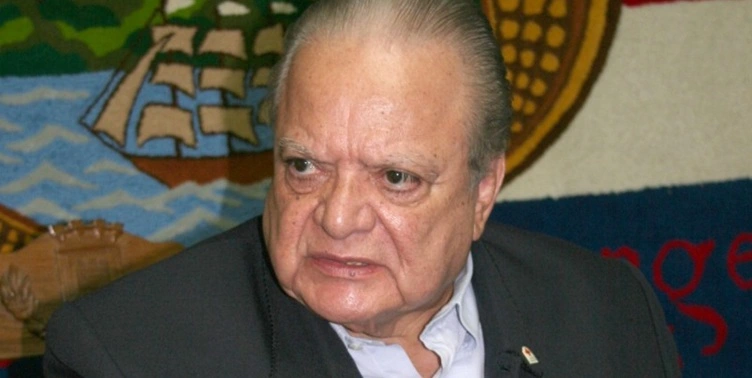
Former president of Costa Rica and key figure of Latin American unionism, Monge maintained an early and firm position against the authoritarian drift of the Cuban regime.
MIAMI, United States.- This year concludes with the centenary of the birth of Luis Alberto Monge Álvarez, one of the most consistent and, however, most underrated Latin American statesmen of the 20th century. At the same time, he was a faithful friend of the Cubans and their fight for freedom and democracy.
Monge was born in Palmares, Alajuela, Costa Rica, on December 29, 1926. From a young age he participated in labor and union struggles and held high positions in them.
In 1948 he participated in the Costa Rican revolution and at the age of 23 he was the youngest delegate elected to the National Constituent Assembly of 1949.
In the following decade Monge continued to play a vital role as a trade unionist. He was founder of the Inter-American Regional Organization of Workers (ORIT) and served as its first general secretary.
He was then a deputy to the Legislative Assembly for the National Liberation Party (PLN) for the first time from 1958 to 1962. His political life coincided with the radical changes that were developing in Cuba, and Monge raised his voice against the repression of the dictatorship.
On April 22, 1961, he warned about the Castro dictatorship that was being installed in Cuba. On that occasion, Monge expressed: “there is no revolution without freedom” and “what is happening in Cuba is not a Latin American revolution.”
Between 1963 and 1966 Monge was the first ambassador of Costa Rica to the State of Israel. Upon his return to Costa Rica, he was appointed Minister of the Presidency by President José (Pepe) Figueres Ferrer from 1970 to 1974. During the same period he was a deputy to the Legislative Assembly for the second time, serving as its president from 1973 to 1974.
In 1982 Monge was elected president of the Republic, a position he held until 1986. During his presidency he demonstrated that the threats of communism in Central America—fostered by Havana—could also be fought democratically. He maintained a close relationship with his American counterpart Ronald Reagan, who was united by his anti-communist conviction. At the same time, it opened the doors to Cubans who sought refuge in lands of freedom.
After leaving power, Monge did not abandon his support for the fight for Cuban freedom. Along with several former Latin American and European heads of state and government, he was part of the International Committee for Democracy in Cuba (ICDC), founded in 2004 in the Czech Republic.
Monge’s support for Cuban freedom was natural, and was evident even when he was outside the government and the public eye. He gave his support to the Cuban Democratic Revolutionary Forum, an organization directed by Dr. Armando Fleites, in which he gave lectures during several of its events held at the Tamiami Global Methodist Church in Little Havana. There, as a university student, I was able to meet him and witness his intelligence, his knowledge and his passion for freedom and democracy.
When I founded Youth for a Free Cubaan organization dedicated to promoting freedom and democracy in Cuba, I asked for your moral support. He did not hesitate to give it to the organization through a letter addressed to its members. This letter was accompanied by another, addressed to the young woman Saylí Navarro Álvarez, who at that time was fighting for the freedom of his father, the Cuban political prisoner Félix Navarro Rodríguez. In his encouraging letter, Monge mentioned that Saylí had been born during his presidency and that he supported his fight for the freedom of his father and the Cuban people.
Monge died in San José on November 29, 2016. As the centenary of his birth is commemorated, I can’t help but wonder: What would he think of Saylí’s imprisonment, the re-imprisonment of his father, and the captivity of more than a thousand political prisoners who still remain in prison after the protests of July 11, 2021?
Today, the legacy of Luis Alberto Monge serves to inspire Latin American youth to fight for the democratic values of the region and for the freedom of oppressed peoples. It demonstrates that a life dedicated to fundamental values is not lived by leading the way, but by example.













