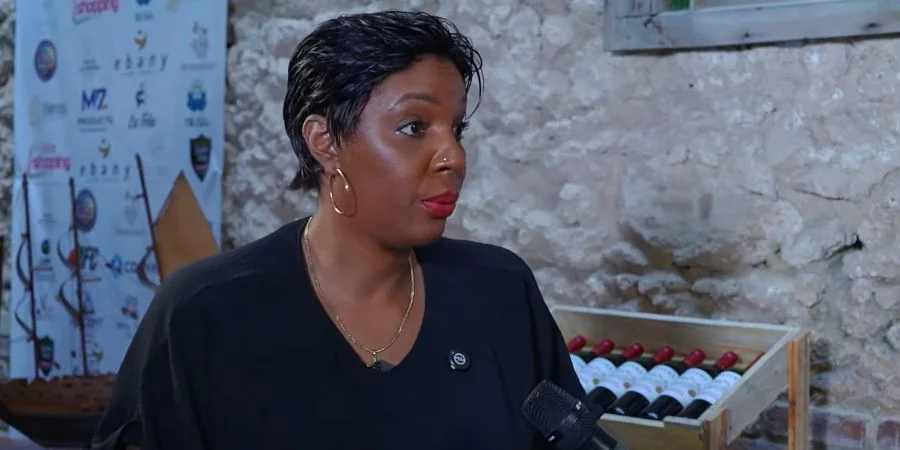
The former volleyball player assures that she decided to leave her role as a coach after 17 years of work.
MIAMI, United States. – The emblematic Cuban volleyball player Regla Torres Herrera announced this Saturday that she decided to retire from training in Cuba after 17 years of work and linked her departure to a profound deterioration in women’s volleyball, which she attributed to the loss of discipline, to decisions that broke the continuity of the team after Sydney 2000 and to a climate that, as she expressed, has been emptying athletes and coaches of respect.
The former player made those criticisms on the podcast Asking for a clueproduced by Deporcuba TV, whose second season premiered with her as the first guest.
“I have already decided to retire from what training is here in Cuba,” Torres stated in the dialogue, specifying that it had been 17 years since it began in 2008 and that his decision responded to “many factors.” Although the conversation covers personal episodes of his sports career, the core of his statements focuses on an insistent idea: the team that dominated world volleyball was sustained by iron discipline and a culture of demands that, in his opinion, broke and was never rebuilt with the same rigor.
Torres located the origin of the decline at the moment when, according to her, the internal mechanism that forced the youngest women to align themselves with a standard of work and behavior stopped working. That culture, he assured, did not depend only on the coach: the veteran players acted as a daily guarantor of discipline and performance. “Our coaches were (…) superlatively demanding. But if they were demanding, the most demanding people were the veteran athletes,” he said. This double control, he added, maintained a chain of continuity: when the veterans retired, those who remained assumed that role and reproduced the system. For Torres, the problem began when that chain broke. “When that stopped happening, the debacle of women’s volleyball began,” she said.
When asked if that discipline is missing today, Torres summarized: “It’s missing a lot. It’s the main thing that’s missing.” In his explanation, the deterioration is not an abstract phenomenon nor just “of mentality”, but the result of a concrete break in continuity within the group, with sporting consequences that are still dragging on. “That was liquefying,” she insisted, describing a team that, after the withdrawal of her generation, was supported by few players with experience in an environment that no longer guaranteed the same rigor.
The former volleyball player also referred to the period after the 2000 Olympics and recalled that several players wanted to start a family and became pregnant, something that, according to her version, “was not understood” then and triggered tensions. He said that, when these athletes recovered and wanted to return to try for another Olympic medal, an internal conflict arose over the supposed “displacement” of the young players who already supported the team. “There was a misinterpretation (…), there was a misunderstanding. And this had the consequence that we left. We all left,” she said.
“So that’s where our fourth Olympic medal went. Maybe gold,” he said. For Torres, it was not just a generational problem, but a poorly managed decision that closed the winning cycle and left subsequent generations without a complete transmission of experience and discipline.
Another of his criticisms points to the arguments that describe Cuban volleyball of his time as “obsolete.” The former player rejected that label and treated it as a simplistic reading that ignores the team’s complexity and ability to adapt. “I don’t see where the obsolescence is that says that our volleyball was an obsolete volleyball. I don’t really understand it,” he stated, after alluding to changes in the scoring system and the transition towards rally point. For her, Cuba’s strength was in a technical mastery that made the attack unpredictable and multiplied resources, something that, according to her regret, they stopped training as before.
Along the same lines, the former athlete criticized changes in the technical structure and training philosophy of Cuban women’s volleyball, including the disappearance or absence of key figures from the golden cycle, which would have altered the preparation of new talents.
Torres also pointed out the incorporation of coaches from the men’s sector to the women’s sector as a change that, he said, Eugene George, considered the best coach of the 20th centuryhe rejected. “Eugenio was always against (…) that coaches from the men’s sector were coaches from the women’s sector. Because the training had nothing to do with it,” he stated in the interview, and added that “many things changed” and “many things were stopped being done that should not” be abandoned because they were part of the team’s “seal.”
The Cuban used the description of the training as proof of the level of demand that, in her opinion, does not exist today. He called it “savage” and “terrible,” and maintained that this harshness was inseparable from the international dominance of his generation. “It is impossible for this current generation to be able to do the training that we did,” he said, detailing jump loads, repetitions and effectiveness exercises under pressure, designed to sustain high performance when rivals wore down.
Torres also insisted that his generation competed in harsh material conditions and that, even so, they maintained a commitment that today is trivialized when these athletes are disqualified or their context is ignored. “One of the things why I decided to retire is because respect for the athlete and the coaches has been lost,” he said.