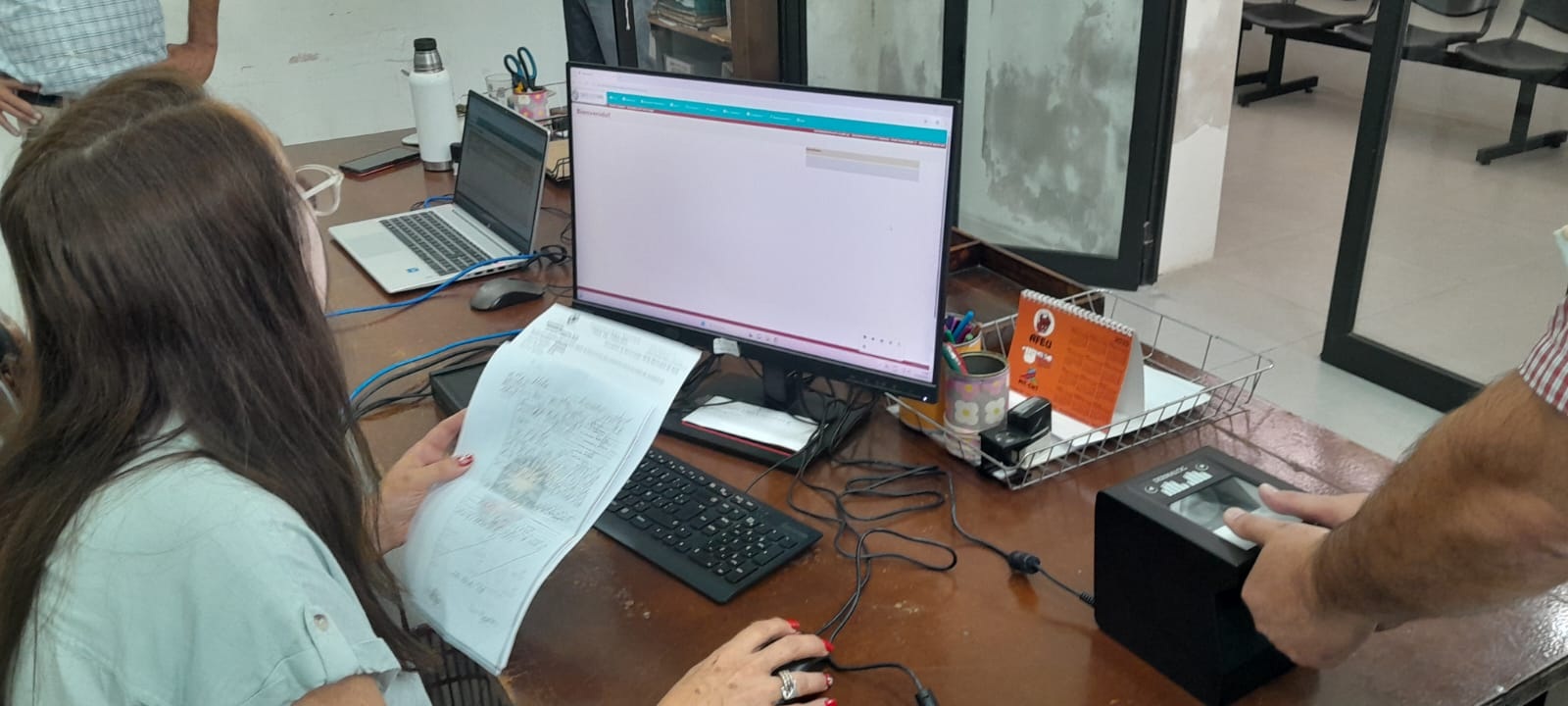
Biometric scanner incorporated into the Electoral Office
This equipment, which has been added to all the offices of the country’s Electoral Court, has been operational in Melo for approximately 15 days.
This Biometric Scanner allows fingerprints to be taken digitally, that is, without the need to ink the hands of those who must carry out renewal and transfer procedures.
“There were 4 departments left that were in testing mode regarding the Biometric Scanner for fingerprinting. About 10 or 15 days ago the Cerro Largo Electoral Office joined the new modality, like the rest of the electoral agencies” confirmed the Secretary of the Departmental Electoral Office to THE DIARY PROFESSIONAL.
“This pilot plan includes renovations and transfers” specific Alejandro Silveira.
“At the moment this system is not being used for new registrations” accurate. “Fingerprints are being taken for transfers and renewals in this Biometric Scanner. The palms and 10 fingers of the hands are taken, but we are not getting our hands dirty. You can come calmly to transfer or renew that we are with this new modality” reported.
“In the first days, like any innovation, it is a little difficult to adapt because on the one hand there is the tool and then the officials who work in the Registration Office have to adapt to the new way of doing the task” Silveira pointed out. “Some officials can adapt a little faster to the equipment and others more slowly. In addition, here in the Office what we try to do is rotate so that not only the officials of the Registrar participate but also the rest so that they also practice with the tool because it is a fact that, starting in April 2026, when the work of the Mobile Registration Tables is resumed, this will be implemented beyond that we will see how it is done.” he stated. “That is why all officials must practice and know how to operate with this new Biometric Scanner for taking fingerprints” said.
Although in the beginning there was a natural process of adaptation to the new technology, as the days have passed it has made it possible to speed up the task. “It is a fixed team, that is, it is not the same as what we were used to in handling with paper and ink. The colleagues are already adapted to the system, rather those who take the fingerprints. It is being implemented at a good pace” stood out.
“We have had some exceptions with elderly and not so elderly people, who due to problems with their prints, whether due to wear, use of chemicals or work in rural areas, sometimes do not have good quality prints” said the Secretary of the Departmental Electoral Office. “In those cases, we go to the traditional way, which is ink. We have to leave records both in the digital part and in the physical file of those exceptions because once we enter production mode with this new modality we cannot go back” held.
“With this, the Electoral Court aims to digitize 100% of the National Civic Registry” advertisement. “It is going to be done this way, but those exceptions appear. In Cerro Largo there are already 3 cases where it has not been possible to obtain clarity in the fingerprint and it has not been possible to make a match. Sometimes it coincides, but the clarity is not good. In that circumstance we have to go to the traditional way. Beyond those specific cases, we are going at a good pace, with officials accustomed to this type of work” said Alejandro Silveira.
In addition to Cerro Largo, only the departments of Paysandú, Tacuarembó and Colonia needed to join the new system.