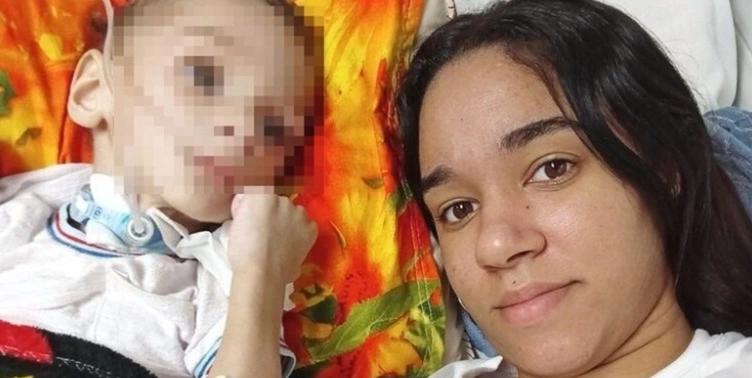
24-year-old single mother, Naila Fonseca faces the permanent care of her youngest son, with infantile cerebral palsy, in a context marked by the lack of medications, medical supplies and specialized care.
SANTIAGO DE CUBA, Cuba.- Naila Fonseca Beltrán is 24 years old and has two small children under her care. The youngest of them, now three years old, requires special care since he suffered a severe cerebral infarction when he was just one and a half years old, in mid-2023. Since then, their lives have changed radically: hospitals, intensive therapies and a series of increasingly demanding efforts.
At that time, little Reinier Alian Quesada Fonseca was admitted to the Leonor Pérez pediatric hospital and later transferred to the William Soler, both in Havana. There, for several days, no one noticed the child’s cerebrovascular injury, until they realized that he was not reacting to pain. “The punctures to extract blood did not cause any gestures,” says the mother. It was a doctor who, after pricking him several times with a needle, confirmed what no one had seen. Then they performed a CT scan that showed brain damage. After the diagnosis, Naila was told to expect the worst.
The doctors proceeded to intubate him and put him in an induced coma but, the next day, the monitor began to drop dangerously. He had to be transferred emergency to Juan Manuel Márquez, in Marianao. As soon as he arrived, he went back into intensive care. At that point, his brain was so swollen that it had no room for oxygen, so they performed a craniotomy to remove part of his skull and relieve the pressure. Although hopes of his survival were minimal, he did.
Ten days after the operation, he had a tracheostomy and then a gastrostomy. As a result, in the following three months he lost weight rapidly: he went from 11 kilos to 6. Between one complication and another, he spent a full year in the hospital: four months in intensive care, two in the ward, two more in therapy for a bacteria and time in the ward until he could return home, in mid-2024.
The return home was not a rest
At home, Reinier Alian needed constant oxygen and the balloon that Naila had was running out. Desperate, she went to the polyclinic to request that the ball be changed, but there what she received was a resounding no. “The oxygen we have available is reserved for emergencies,” they responded, although the child’s situation was an emergency situation, because if the balloon ran out he could die immediately. Naila was clear about it, so she continued asking for help and borrowing money to buy another ball.
Since then, almost everything has been like this: Naila alone, trying to raise her son without family or state support. With a pension of only 3,700 pesos per month, it has to cover the medications and materials essential for the child’s daily life. For example, aspiration probes that he does not receive through a pharmacy and that he has to buy for up to 3,500 pesos for a package of 10 on the black market, when Reinier Alian uses five a day. Likewise, diapers, gloves, dressing materials but, above all, basic medications.
“My child takes Sodium Valproate and Levetiracetam, in suspension, for seizures. The second is a medication for in-hospital management and they have never given it to him. I have to buy it on the street for 3,000 pesos a pop. Nobody understands why there isn’t it in hospitals, but Merolics do have it. Besides, he also consumes Captopril and Ceterizine,” explains the young woman. “I have the medicines because good-hearted people have donated them to me,” he acknowledges.
It is not necessary to do many calculations to conclude that it is impossible for Naila to afford these supplies with 3,700 pesos a month, while also having to guarantee food and cover the needs of her other school-age girl. For this reason, it has chosen to recycle both the aspiration probes and the gloves and gloves, which should be disposable. She sterilizes them herself at home, knowing that she puts her son at risk, who could contract bacteria and get worse. “I have taken the gloves to the polyclinic to have them sterilized, but they tell me that there is no water for that,” she denounces.
“These children are treated as nuisances in Cuba”
With his condition, Reinier Allian is part of the group of patients with PCI, or Infantile Cerebral Palsy. According to her mother, it is not a very large group in Cuba, something that in the first instance led her to think that the care provided by the Public Health System would be optimal, consistent with the care that these children require. However, his experience has been a very different reality check. Currently, he believes that “These children are treated as nuisances in Cuba, both in polyclinics and in hospitals.”
“A few months ago I had to be admitted with the child due to a convulsive condition. My son did not stop convulsing and because he was using permanent oxygen he could only be transported in an ambulance. That time his heart rate dropped to 27, almost to the point of arrest. However, the ambulance took eight hours to arrive, from 7:00 pm to 3:00 am” “Thank God that my little one is strong because he would have been through the worst.”
On the other hand, according to the mother, no one is going to perform physical therapy on the child. This fact has greatly delayed its evolution. In his state, he should have a primary Physiatrist, but he doesn’t. Even though the polyclinic is one block from his house, located in Mulgoba, streets 164/377 and 385, building 96, apartment 28, no one visits it. Naila herself is the one who performs the exercises with tutorials she looks for on the Internet.
Since the moment Reinier suffered that stroke, his mother has been his full-time nurse. As a single mother of a child with a disability, she has had to dedicate herself body and soul to taking care of him. This means not working on the street, although you need more income. Her son can’t even hold his head, plus she has to vacuum him and feed him through the tube every four hours. The outlook is worse when being completely alone.
“As a result of so much effort, I have scoliosis, with the cervical vertebrae compressed to grade 3. The doctor told me that I can carry up to five pounds maximum, but I have to carry my child who weighs 11 kg, two or three times a day,” Naila lamented.
Your case is not isolated
The fact of not being able to work outside and the urgency of generating more income made Naila start creating content for Facebook and instagramwhere he shares daily content, largely to expose the reality he lives without any type of filter. On December 16, for example, he published a reel in which he denounced the state’s abandonment of his case. Soon, dozens of mothers shared similar stories in the comments.
“I was a social worker and it is true that children with special needs are not given anything, that’s why I was disappointed and left. Because I am also the mother of a special child,” commented the user identified as @i_am_wanda_glenda.
For her part, @cristy_rojass added: “You are admirable, my life. I have a child with West syndrome and what the State gives me is 2,500 pesos. Only mothers with special children know how difficult everything is.”
Likewise, @naylafernandez61 agreed: “I understand you, I go through the same thing in my life. My daughter still has a tracheostomy and gastrostomy.”
“It is the reality of us mothers of children with disabilities. They do not guarantee us even the basics, such as medications, healing materials, among thousands of things,” mentioned @roxi_mrtz.g.