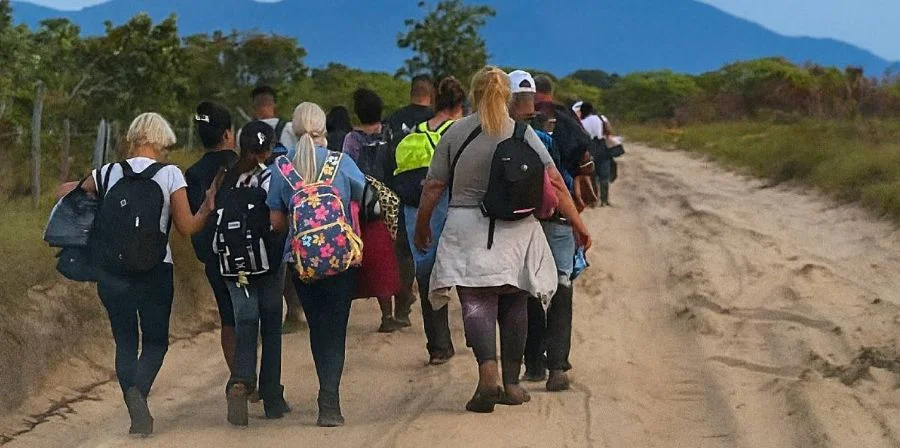
“Brazil is not the United States, but for many of us it is still a real option,” a Cuban migrant told ‘CubaNet’.
SANTA CLARA, Cuba. – At the beginning of the year, Lisandra Garí embarked on the most stressful trip of her life, which would lead her to finally settle in Curitiba, in the south of Brazil. For months he had waited for the possibility of benefiting from the program parole United States humanitarianbut when the option closed, he had no choice but to leave his partner behind and begin the journey to Brazil via Guyana, the usual entry point for those seeking to continue by land towards the interior of the continent.
“Although the coyotes have experience and give you confidence that everything will turn out well, they were very scary days: I crossed rivers in a boat, I went through places with mud up to my knees, I was somewhat hungry and needed to go to the bathroom…”, says the Cuban, who until then lived in Sancti Spíritus. Likewise, he specifies that he paid around $1,200 for the “service” of transfer and accommodation in specific places, previously agreed upon by his guides. After arriving in Boa Vista, the capital of Roraima, on the border with Guyana, he spent more than 24 hours in a bus with only two stops of a few minutes during the journey to other points in Brazil.
Recent data from the Migration Panel in Brazil, of the Ministry of Justice and Public Security (MJSP) confirm that more and more Cubans choose the giant of the southern cone as their definitive destination, thanks to the fact that it combines accessibility of entry, possibility of regularization and job opportunities and free health care. The arrival of Cubans to Brazil occurs mainly through the northern region, in the municipality of Bonfim, in Roraima, or through Oiapoque, a city in Amapá on the border with French Guiana, although other groups do so by crossing the border with Suriname with tourist visas.
In the first quarter of 2025 alone, asylum applications from Cuban citizens exceeded those from Venezuela for the first time in 10 years with 9,467 procedures registered. However, the Brazilian media themselves maintain that, despite the growth in requests, the official recognition of refugee status remains restricted.
Like Lisandra, Héctor Pérez, a singer from Santa Clara, also chose the route to Guyana last August, one of the cheapest. “There were 12 of us in the they go. As soon as I arrived, I went to the [autoridad] that issues the papers and I left with everything legal.” Cubans who enter Brazilian territory through these irregular routes must register at the point of entry with the Federal Police, where they are given a provisional document, which allows them to remain legally in the country while their case is analyzed.
The next step is to start your procedures through the official system SISCONAREthe digital platform to register applications for recognition of refugee status in this country. Once they adhere to this policy, they have access to their proper documentation, such as the National Immigration Registry Card (CRNM), work card and public health and education policy services. However, those who enter with a “refugee protocol” are unable to travel to Cuba until they are able to obtain residency in this country, a process that can take several years.
Although Curitiba is one of the cities in which a large community of Cubans has been created, Héctor chose Palotina to settle, a relatively small agricultural municipality in the state of Paraná. “I spent 15 days doing some ‘daily work’ carrying bags of sawdust for a skirt, that is, jobs where you get paid for the day depending on what you do. I was recently accepted into a meat company in the fish area where I’m doing the best,” he details.
Héctor specifies that, although his salary is considered average, it is enough for him to live there on a small income, pay his bills, feed himself with the money from a voucher of 700 reais that they give him and, of course, help his family in Cuba financially. “I was impressed by everything, the streets, the cleanliness, the stores,” he says, and shares via WhatsApp some images of himself in supermarkets and at his workplace. In all of them he seems satisfied and enthusiastic. “I can even leave the bicycle in the doorway, because no one is going to take it,” he says.


For her part, Lisandra, who did not have friends or family in Curitiba, managed to pay her initial rent with some savings until she got a position as a stocker in a market and another as a maid at a hostel on weekends, which allows her to cover personal expenses and send money to Cuba on a monthly basis. “There I had to work entire early mornings in a bar to make three pesos, which was not even enough for me to eat decently for a month. Here I plan and see that my salary allows me for so many things… Family is missed, but I feel a thousand times better washing dishes and organizing bags of potatoes on a shelf, than in that country without a future where my youth was disappearing.”
In search of a decent life
Brazilian digital media stand out that, in fact, there are job opportunities for recently arrived Cubans: in the first two months of 2025 there were 5,158 hires of migrants from the Island throughout the country, distributed mostly in Paraná, São Paulo and Santa Catarina. “Generally, we Cubans come to the south because they are quieter cities, with less crime,” says Ariel Suárez, another Santa Clara native who also settled in Curitiba with his wife and young daughter. “There is no discrimination with us here, although sometimes there is a certain tendency to preconception, that is, some employers are not convinced at first glance that you are good at what you do.”
Although it is not common to find a job that has any relationship with the professions they practiced in Cuba, there are opportunities available in branches such as sales or hospitality, especially for those who do not have a first-class command of the Portuguese language. As specified by the site G1Cubans are mostly employed in the sectors of agriculture, public administration, education, health, social services, construction and industry.
In the dozen Facebook groups of Cuban communities in Brazil, their members confirm that there is a much more stable labor market than in other countries in the region. “I’ve been here for two months and you have to work, but you can live much better than in Cuba and save money if you want to,” wrote the user identified as Ernesto Pérez at the foot of a post in the group “Cubans in Brazil” that questioned whether there were really people who regretted having settled in that country.

Many content creators who live there have also turned their social networks into a daily window into migrant life. They document their daily lives and, at the same time, offer advice and tips practical for those who plan to undertake the journey, as in the case of the entrepreneur from Pinar del Río Daniela Martinezwho managed to open a pizzeria with his family in the municipality of Tarumirim and recently also celebrated the purchase of his first car. “Only a Cuban understands the immense joy we feel. We come from having nothing and we are achieving little by little what we dreamed of one day,” he said in a video to encourage his more than 24,000 followers.
Other positive experiences are shown on the channel “Danay en Brasil”, another Cuban who was even able to recently buy a small plot of land to rebuild her own house. “I get on a clean, empty bus and I can’t help but think about my Cuba, where even transportation is a daily struggle, sometimes it’s enough to remember how much people suffer for something so simple on my island,” this young woman recently published.
“Brazil is not the United States, but for many of us it is still a real and achievable option to migrate in 2026,” he recommends in one of his reels the Cuban Marisé Alfonso (“Mary in Brazil”). “Many countries have become practically impossible, but this one has something different; here you can still start from scratch without feeling like you are losing your life in the attempt. Here you don’t come to earn thousands of dollars, but you can have a quiet, dignified life, better than the one we left in our country. Here your efforts are seen.”