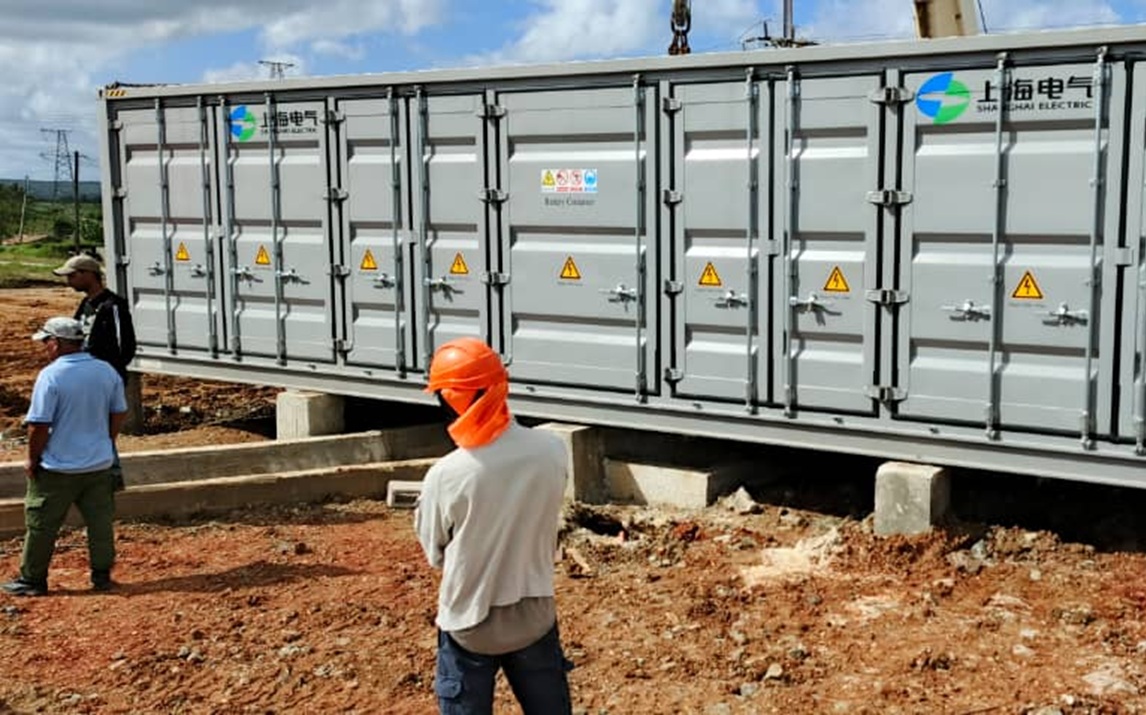
In the municipality of Cueto, in the province of Holguín, the installation of the first Energy Storage System (BESS) began, a technology that will seek to provide greater stability to the National Electroenergy System in the midst of the crisis that the country is going through.
These batteries allow the surplus generation from the solar panels to be conserved for use during consumption peaks or in the event of failures in the production plants, the company notes. Cuban News Agency.
This is, the report indicates, an infrastructure that must be extended to other strategic points in the country. Last August, a report from Cubadebate He announced that these units will also be installed in substations such as Bayamo 220, Cotorro 220 and Habana 220. Each one can store 50 MW.
BESS generally use lithium-ion batteries due to their high energy density and low maintenance, the press outlet indicates. These include, in addition to batteries, inverters, management and control systems that coordinate charging and discharging to guarantee efficiency and safety.
🏗️ Today the assembly of the first battery container of the Energy Storage System (BESS) is carried out in Cueto, a work carried out together with the Military Construction Union (UCM).#UNE #UnitedXCuba #ElectricUnion #BESS pic.twitter.com/BKxxn3dk8B
— Cuban Electrical Union (@OSDE_UNE) December 25, 2025
Until October, renewables covered 9% of Cuba’s energy mix
While the old Cuban thermoelectric plants collapse again and again, the renewable energiesled by solar photovoltaics, emerge as the only sector with concrete advances, although still without the capacity to substantially reduce blackouts on the island.
Until the month of October, with a 9% participation in the national energy matrix – compared to a meager 2% in January – the contribution of the solar parks already synchronized to the National Electric System (SEN) contrasts with the decline and obsolescence of the plants that generate from fossil fuels, as confirmed authorities in the program Round Table.
While thermoelectric plants collapse, photovoltaic energy already covers 9% of Cuba’s energy mix
“Without the 500 MW of solar power at the midday peak, the daytime blackouts would be as serious as the nighttime ones,” admitted engineer Félix Estrada Rodríguez, director of the National Load Dispatch.
In 2025 alone, four units have spent months inactive for maintenance, including the two units of the Cienfuegos thermoelectric plant, one of which is already in operation, but the other has not yet been able to return to the SEN.
Although many of the units that go offline come back into synchronization shortly thereafter, officials acknowledged that “a lack of parts and financing limits repairs.” For this reason, breakdowns are repeated and maintenance is unable to stop the shutdowns and subsequent blackouts.
Various independent calculations agree that the Cuban Government would need between 8 billion and 10 billion dollars to revive the electrical system, an amount that Havana does not even remotely have.
Photovoltaics not only cover 9% of the demand according to the authorities, but between 10 am and 3 pm it comes to “replace 20% of conventional generation” and saves the always deficient fuel, necessary for thermal and distributed generations.
José Concepción Díaz, director of Renewable Generation, highlighted the contrast in the television program: “The solar parks installed this year have already saved 111,623 tons of fossil fuel.”
The government promise plans to install 51 solar parks of 21.8 MW in 2025, of which 32 are operational until October and synchronized with the national electricity grid.