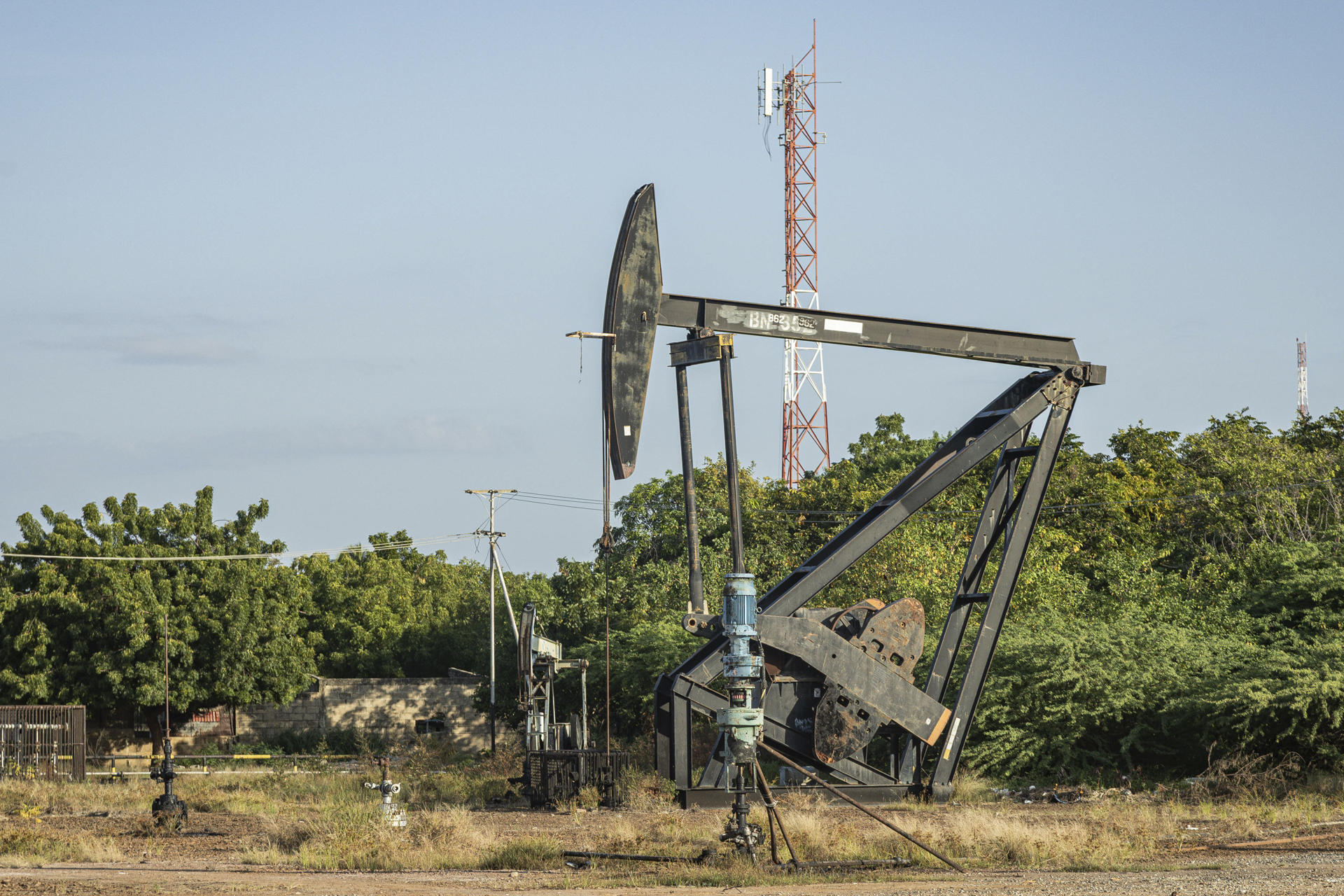
VEnezuela completed the nationalization of its oil industry in 1976 through a legal process during the first government of President Carlos Andrés Pérez (1974-1979), but now the president of the United States, Donald Trump, questions the process by denouncing an alleged stripping of rights from companies in his country, what experts consulted by EFE refute.
While historian Tomás Straka believes that Trump’s words reflect a “very ill-informed” interpretation of the process, former Vice Minister of Energy and Mines Dolores Dobarro told EFE that the resources found in the Venezuelan subsoil have belonged to the country since its independence.
Trump, who ordered a blockade of sanctioned ships to and from the South American country after months of military deployment in the Caribbean, He recently stated that Venezuela took away oil rights from American companies and assured that he wants them back.
For its part, the administration of Nicolás Maduro denounces that Washington’s objective is to appropriate Venezuelan resources. It also accuses him of piracy for the seizure of two ships with crude oil from this Caribbean nation.
Below is a historical account of the nationalization and other measures adopted by the oil country:
The nationalization of 1976
On August 29, 1975, the Organic Law that reserves the hydrocarbon industry and trade to the State, known as the Loreich, was published in the Official Gazette, the state newspaper, which established January 1, 1976 as the date from which the oil concessions operating in Venezuela were declared extinct.
Before, Straka explained, private companies exploited oil locally. They were companies mostly with foreign capital, although “technically they were registered in Venezuela.”
With nationalization, the historian continued, the State reserved the right to explore, exploit, refine and export oil. To manage the industry, The Pérez government created Petróleos de Venezuela (PDVSA) in 1975, which assumed the assets of foreign companies.
This nationalization “replaced national and foreign concessionaire companies with state operating companies (PDVSA and subsidiaries),” said Dobarro.
The former vice minister during the second government of Rafael Caldera (1994-1999) indicated that this policy was “much discussed, debated and, it can be said – in her words – that it was agreed upon among the political factors of the time.”
Straka noted that Venezuela reopened its market to oil investors in the 1990s to guarantee an injection of money and allowed international companies to return to the country through agreements.
The Chávez era
With President Hugo Chavéz, who came to power in 1999, the situation changed. The ruler, who died in 2013, deepened “a nationalization that already existed,” especially starting in 2007, when he forced foreign oil companies to switch to a mixed scheme, said Straka, for whom the leftist leader tried to make propaganda about it, since, he assured, he wanted “that award for himself.”
“Chávez prohibits foreign companies from working alone (with autonomy) and forces them to create joint ventures with PDVSA. These companies, which worked under other terms, had to access a minority participation,” he explained.
In 2007, the president decided that PDVSA would be the majority partner in the oil industry, economist Francisco Monaldi, also director of the Latin American Energy Program at Rice University, recalled to EFE.
In this way, the Venezuelan Government expropriated assets from companies such as ExxonMobil and ConocoPhillips, which did not accept the new conditions. These companies sued the Venezuelan State in international arbitration and obtained favorable awards in which economic compensation was ordered.
On the other hand, Monaldi stressed that PDVSA lost the autonomy it had since its creation and the company’s funds were used to finance various government missions by decision of Chávez.who also fired thousands of state company workers who supported the oil strike between 2002 and 2003.
Major supplier to the United States
Straka indicated that Venezuela has been “a fundamental piece” on the “geopolitical board” of the United States since World War II, even before, for one basic reason: the character of the South American country as an oil exporter.
The historian specified that Although Venezuela is not the same as it was during World War II — when it was the world’s leading oil exporter — it is still important to Washington.
“It is an oil that is four days away in ships from the United States refineries,” he illustrated.
However, the director of the Historical Research Institute of the Catholic University Andrés Bello clarified that the North American country has never had rights over the Venezuelan subsoil and the land is property of the State according to Hispanic legal tradition.