Santiago de Cuba/In Santiago de Cuba, the mattress making profession has survived blackouts, hurricanes, dollarization and unfulfilled promises. It does not have a bright sign and barely has a presence on social networks, but it is sustained by word of mouth, the urgency of sleeping without pain and the impossibility, for most, of buying a new mattress. Here, where the heat sticks to the body even at dawn and the rains sneak in through leaky roofs, the mattress is not a luxury: it is a daily battle.
In many homes in Santiago, people still sleep on mattresses that have more history than comfort. Some came to the house with the grandparents’ wedding, others were inherited, patched, turned over a thousand times. For decades, in the 70s, 80s and much of the 90s, buying a new mattress was almost an exception. The rationed market was reserved for weddings and even then there was not always availability. The arrival of the dollar in the 90s opened a crack: mattresses reappeared in stores, but at prices inaccessible to the majority. Today, to buy a new one you have to have foreign currency or relatives abroad. For the rest, the solution remains the same: call a mattress specialist.
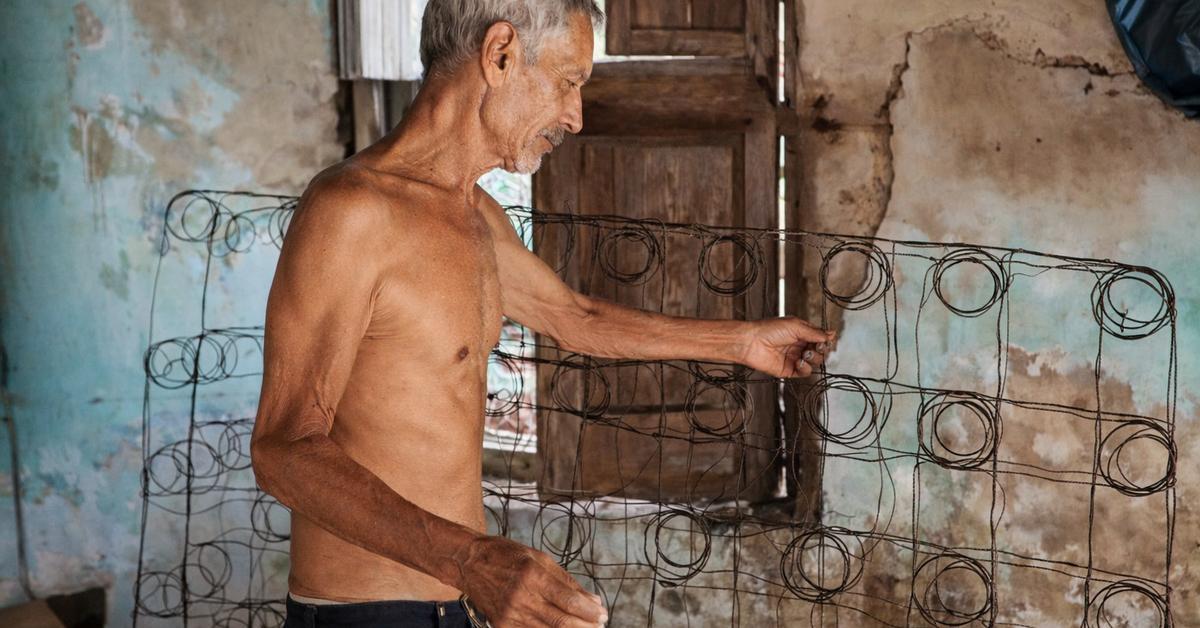
Omar has been in that profession for 32 years. He is a private mattress worker and he does not say it with epic pride, but with the serenity of someone who knows that his work is necessary. “This is not about getting rich,” he clarifies at the outset. “It’s barely enough to feed myself, my wife and my three children.” His day begins at five in the morning. Quick coffee, tools in hand and get to work. If the current allows it, it may be pitch black when you finish. The living room of his house is a permanent workshop: piled up wadding, wires, gutted mattresses, fabrics for linings and his agile hands moving pliers, tweezers and needles with a skill learned through repetition.
/ 14ymedio
A new mattress made by Omar today costs around 30,000 pesos. Repairing a damaged one can cost between 18,000 and 20,000, depending on how much it is expired, how many springs have to be changed and the state of the padding. It is not cheap, but it is still more affordable than buying one in foreign currency that can exceed $300. “Many of the houses that rent to tourists in Santiago have made their mattresses with me,” he says, aware that private rentals drive demand.
Hurricanes have turned this job into a cyclical necessity. Every time it rains heavily or a cyclone passes, mattresses are among the first to be lost. Hurricane Melissa, which hit the east of the country, left flooded homes and soaked and unusable mattresses in its wake. “After a cyclone, the phone doesn’t stop ringing,” says Omar. Wet, deformed, full of humidity and mold, for many victims the only thing left to do is put them in the sun to see if they recover something from their insides. Sleeping on them is torture, but replacing them is not within everyone’s reach.
The problems of the trade begin long before having a client, Omar acknowledges. Getting raw materials is an odyssey: springs, wadding, wire, fabrics. Everything appears very expensive, in dribs and drabs or thanks to contacts in the informal market. Added to that is transportation. Moving a mattress around town, loading it onto a truck has become a challenge now that fuel is scarce. “There are jobs that I can’t take because I don’t have a way to get there,” he admits.
Even so, Omar offers up to two years of warranty. Not everyone does it. The sector is plagued, he warns, by informal workers and scammers. “The most difficult thing, besides getting the raw materials, is maintaining the reputation.” In Santiago, stories circulate of repairs that last just weeks, of mattresses that look new on the outside and are a trap on the inside.
When they opened it, they discovered the scam: the original wadding had been replaced by polyethylene bags, the kind used for rice.
Moraima is one of those stories. He bought his mattress when he got married, in the 60s. “It was of good quality and we had taken good care of it,” he says. The problems were clear: some protruding springs and sagging edges. One day he heard from the kitchen three men passing by on the street shouting that they were repairing mattresses. She had saved “a little money” because sleeping was already becoming difficult. The mattress makers set up the shed in the patio, disassembled the mattress and the padding seemed to be in good condition. Moraima had to go out to the warehouse and left his grandson watching, but the boy entertained himself with his cell phone. He paid 15,000 pesos. On the outside, everything was perfect. Inside, no.
“When I went to bed it sounded like I had paper,” he recalls. Months later, the center of the mattress was completely sagging. He had to call another mattress maker. When they opened it, they discovered the scam: the original wadding had been replaced by polyethylene bags, the kind used for rice. Sleeping on it was literally a lie covered in new fabric.
Stories like Moraima’s circulate through the city and fuel distrust. That’s why colchoneros like Omar live hanging on his name. Every job is a test. Each satisfied customer, a guarantee more effective than any piece of paper.
In Santiago de Cuba, good rest is almost a form of resistance. The mattress is not just any piece of furniture: it is where you sleep, get sick, convalesce from chikungunya and grow old. Between inaccessible currencies, hurricanes and scams, the colchoneros continue to sew imperfect solutions. They do not work miracles, but they support, dock by dock, one of the most basic needs of daily life: being able to go to bed without fear of sinking or burying a dock.