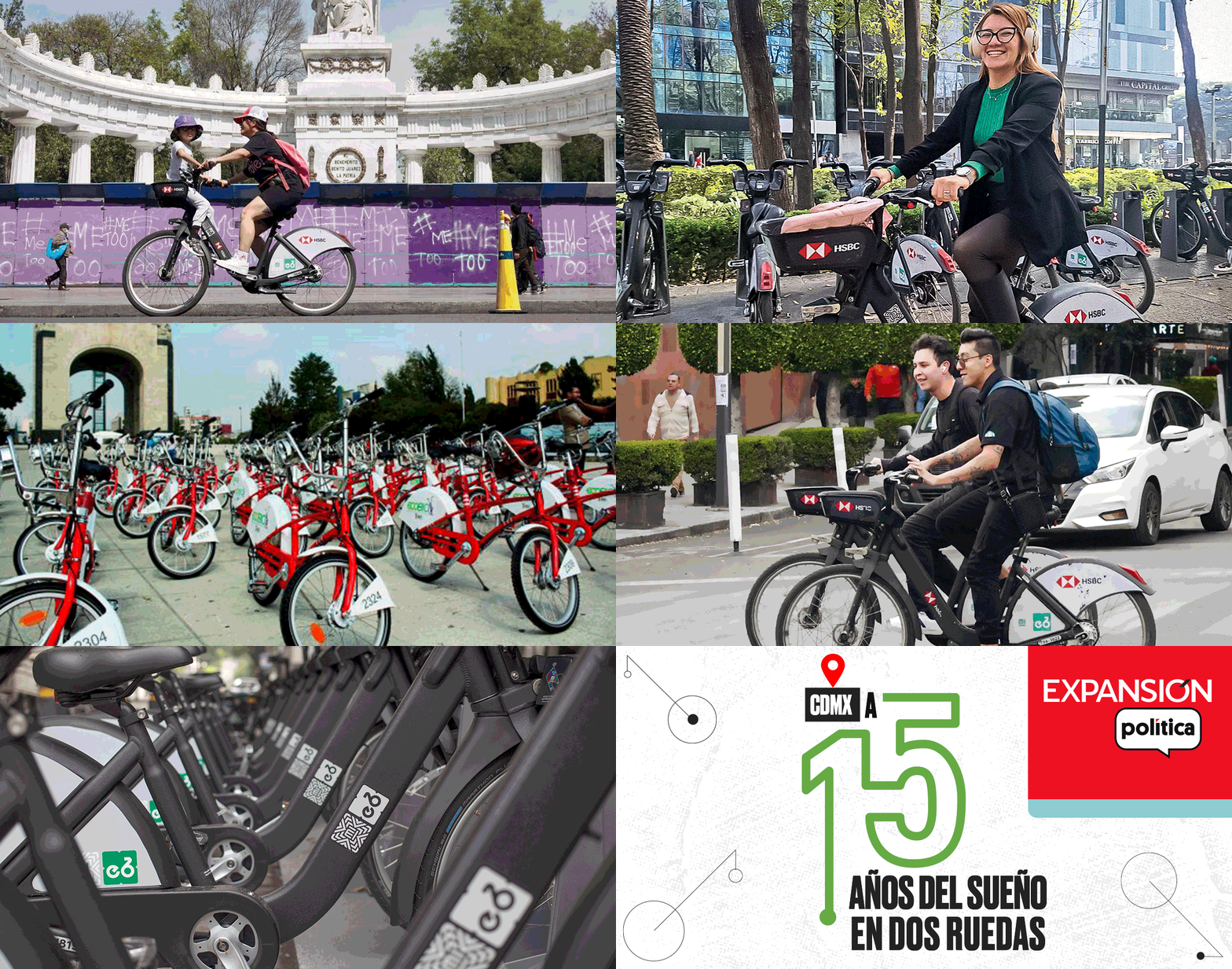
Ecobici’s new challenge is to grow towards the north and east of the capital to reach more municipalities or expand bike lanes where demand is greater. The expansion of the system aims to integrate more neighborhoods and municipalities into a more sustainable and economical way to move, since compared to other motorized or electric transportation systems, Ecobici can cost only 1.51 pesos a trip, taking into account the payment of the annual subscription and that only one ride is made per day.
Andrés Omaña Antunez, director of Ecobici, explains that for the expansion of the network they analyze every aspect, such as the location, the needs of the users, the space around, because sometimes they even have to negotiate with store owners or neighbors, who may be against the placement of a station or, on the contrary, they look for it because they consider that it increases the value of their cafeteria, hotel or bakery. “There are multiple factors that are taken into account to be able to say ‘here goes a station’. They have asked us for cycle stations in front of businesses. They see it as an appreciation of their asset,” he says.
(Photo: Graciela López/Cuartoscuro.)
For Omaña, in 15 years, Ecobici went from being a recreational bicycle to a means of individual transportation and part of the daily routine of the capital’s residents. “When there are confined spaces that are safe and that can be ridden without risk, bicycle use becomes widespread,” he says.
One of the ways to know where to move is the surveys that are launched with users to know not only the suggestions of cyclists about the expansion, their requests and areas for improvement. “For planning, basically the satisfaction survey is the priority to be able to plan, above all, issues of new investments,” he highlights.
Towards a cycling city
Milton Guzmán travels from Santa María la Ribera – where he lives – to Paseo de la Reforma, Polanco, Buenavista and Balderas to visit clients. The 45-year-old financial advisor combines cycling with public transportation to move between these areas more easily. “Practically, I use it every day on my outings just to go to work, go pick up documents, go see clients. It’s how I get around,” he details.
He says that the service is good and “gets out of a lot of trouble” when they cut off transportation, but he considers it necessary to have Ecobici in more parts of the city, such as Tlatelolco, and to provide stricter maintenance to the bicycles. “Many [usuarios] They don’t take care of the bicycles, they aren’t careful,” he points out.

(Photo: Isaac Esquivel Monroy/Cuartoscuro.)
The Secretary of Economy maintains that Mexico City has had great success with this Ecobici system and that, due to its growth rate, Mexico is going to be fourth or fifth in terms of the use of bicycles as a mobility model. “Why is it important? Because you change the entire mobility system and the experience of the city,” says Ebrard.
Today, it is one of the main ones. We are in the top six systems in the world. And due to its growth rate, I would predict that Mexico will be fourth or fifth in terms of the use of bicycles as a mobility model.”
Marcelo Ebrard, former head of government of CDMX.